

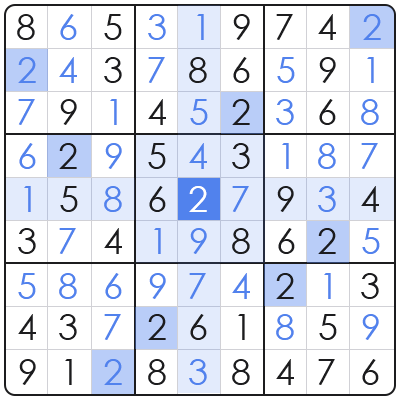
The phrase “how solve sudoku advanced” refers to the intricate methodologies and sophisticated logical deductions required to conquer Sudoku grids that resist conventional, elementary solving techniques. These advanced strategies move beyond simple candidate elimination, delving into complex pattern recognition and dependency analysis that are crucial for completing the most challenging puzzles. In the realm of logic puzzles, particularly Sudoku, the progression from beginner to expert involves a significant shift in analytical approach. The primary problem that advanced Sudoku solving addresses is the apparent dead-end encountered when basic techniques, such as naked or hidden singles, fail to reveal the next number. This requires a deeper understanding of number interactions and potential eliminations across multiple cells and units. The significance of mastering advanced Sudoku techniques extends beyond mere puzzle completion; it hones critical thinking, enhances pattern recognition abilities, and strengthens deductive reasoning skills. These cognitive benefits are highly transferable, making the study of advanced Sudoku a valuable exercise for anyone looking to sharpen their analytical acumen in any complex problem-solving domain. This deep-dive analysis will dissect the core mechanics of these advanced strategies, providing a structured guide for their application, comparing them against simpler methods, and addressing common pitfalls, ultimately illuminating the pathway to becoming a truly proficient Sudoku solver.
Understanding the Core Mechanics of Advanced Sudoku Solving
Advanced Sudoku solving involves moving beyond simple naked/hidden singles to employ intricate logical constructs and candidate elimination strategies that leverage complex interdependencies within the grid. This foundational understanding is critical for identifying non-obvious relationships between numbers across rows, columns, and 3×3 blocks, known as ‘units’.
Based on structural analysis, a cornerstone of advanced techniques is systematic candidate marking, often referred to as ‘pencil marks’. This involves noting all possible numbers that can legitimately occupy each empty cell. With a comprehensive view of candidates, solvers can then identify patterns like Naked Pairs, Triplets, and Quads, where a set of candidates is confined to an equal number of cells within a unit, allowing for their elimination from other cells in that unit.
From a framework perspective, more sophisticated techniques such as X-Wing, Swordfish, and Jellyfish rely on identifying specific candidate patterns for a single number across multiple rows or columns. An X-Wing, for instance, occurs when a specific candidate number is restricted to exactly two cells in two different rows, and these cells align within the same two columns. This formation permits the elimination of that candidate from all other cells in those two columns, outside the X-Wing rows.
Furthermore, advanced solvers delve into chaining techniques like Alternating Inference Chains (AICs) or Almost Locked Sets (ALS). These methods involve tracing a series of strong and weak links between candidates, deducing implications if a certain candidate were true or false. This complex web of dependencies allows for powerful eliminations, often resolving seemingly intractable sections of the puzzle.
A Structured Approach to Implementing Advanced Sudoku Strategies
Applying advanced Sudoku strategies involves a systematic process of observation, meticulous candidate identification, sophisticated pattern recognition, and precise strategic elimination, moving from general scans to highly focused analyses. This structured methodology is essential for maintaining accuracy and efficiency in complex grids.
The initial step, once basic singles are exhausted, is to ensure every empty cell has its complete set of potential candidates meticulously noted. This thorough preparation, often called ‘full candidate marking’, provides the raw data necessary for identifying advanced patterns. Without this granular detail, spotting subtle relationships like Naked Pairs or pointing pairs becomes exceedingly difficult.
In practical application, the next phase involves targeted scanning for specific advanced patterns. For instance, to find an X-Wing, one would systematically examine each candidate number (1-9) across all rows and then all columns, looking for instances where a candidate appears exactly twice in two rows that share the same two column positions. Similarly, searching for Naked Triplets requires scanning units for three cells sharing the same three candidates.
From a framework perspective, successful implementation of chaining techniques (AICs, ALS) demands an even higher level of methodical thinking. This involves identifying potential ‘strong links’ (where if a candidate is not true, its counterpart must be true) and ‘weak links’ (where if a candidate is true, its counterpart might be false), then constructing a chain of inferences. Each step requires careful validation, ensuring that deductions are based on irrefutable logical connections, thereby avoiding premature eliminations or errors.
Comparative Effectiveness of Advanced Sudoku Solving Techniques
Advanced Sudoku solving techniques offer superior efficiency and problem-solving capacity compared to basic methods, especially for complex grids, by providing tools to break through impasses that simple elimination cannot resolve. The strategic value of these advanced methods lies in their ability to uncover hidden logical pathways.
A direct comparison highlights the differing scopes and complexities. Basic techniques such as ‘naked singles’ or ‘hidden singles’ are rapid and effective for introductory puzzles, relying on immediate, localized deductions. However, their utility diminishes sharply as the puzzle’s difficulty increases, often leaving the solver without clear next steps.
Conversely, advanced techniques, while demanding more cognitive effort and time to learn and apply, unlock solutions in grids designed to thwart simpler approaches. Their power stems from identifying inter-unit dependencies and complex candidate interactions, enabling eliminations that are otherwise invisible. This is summarized in the comparative analysis below:
| Feature | Basic Scanning (Singles) | Naked/Hidden Pairs/Triplets | X-Wing/Swordfish/Jellyfish | Alternating Inference Chains |
|—|—|—|—|—|
| **Complexity** | Low | Medium | High | Very High |
| **Efficiency (for hard puzzles)** | Low | Moderate | High | Very High |
| **Approach Difficulty** | Beginner-friendly | Intermediate | Advanced | Expert |
| **Primary Goal** | Direct number placement | Candidate reduction within units | Candidate reduction across units | Complex dependency resolution |
Navigating Common Challenges in Advanced Sudoku Solving
Common pitfalls in advanced Sudoku solving include misidentifying patterns, premature candidate elimination, and losing track of complex dependencies, each requiring focused strategic solutions to maintain accuracy and progress. Overcoming these challenges is integral to truly mastering the puzzle.
One frequent mistake is the misidentification or misapplication of advanced patterns. For instance, an X-Wing might be incorrectly perceived due to an overlooked third candidate in a critical cell, leading to false eliminations. The professional advice here is rigorous double-checking: always confirm that all conditions for a specific pattern (e.g., exactly two occurrences of a candidate in two rows/columns aligning perfectly) are met before making any deductions. “Based on structural analysis, many errors stem from incomplete candidate listings or rushed pattern recognition.”
Another pitfall is premature candidate elimination, often driven by an eagerness to progress. This can happen when a solver believes they have found a pattern but haven’t fully considered all implications or alternative possibilities. The solution involves methodical verification of every elimination. “From a framework perspective, every candidate reduction should be traceable back to an undeniable logical rule or pattern, minimizing the risk of irreparable grid damage.”
Finally, as techniques become more complex, especially with chaining methods, losing track of the logical flow or dependency links is a significant challenge. This can lead to confusion and incorrect deductions. The professional recommendation is to use clear notation, visualize the chain step-by-step, or even mentally (or physically) trace the sequence multiple times. If a chain becomes too intricate to hold mentally, consider a different approach or break it down into smaller, manageable sub-problems, ensuring each segment is fully understood before moving on.
Essential FAQs for Advanced Sudoku Enthusiasts
This section addresses common queries regarding the nuances and applications of advanced Sudoku solving strategies, providing quick, precise answers to frequently asked questions for those looking to deepen their expertise.
**Q: What is the most powerful advanced Sudoku technique?** A: Techniques like X-Wings, Swordfish, and various forms of chaining (e.g., Alternating Inference Chains) are considered highly powerful due to their ability to resolve complex candidate dependencies across multiple units, often unlocking large sections of the grid.
**Q: How can I improve my speed in advanced Sudoku?** A: Consistent practice with challenging puzzles, systematic and clear candidate notation, and active familiarization with common advanced patterns through dedicated study are key to increasing speed and overall proficiency.
**Q: Are there tools to help learn advanced Sudoku?** A: Yes, many online Sudoku solvers and dedicated apps offer step-by-step explanations of advanced techniques, visually guiding solvers through the logic of each move, making them excellent educational and practice aids.
**Q: When should I start learning advanced techniques?** A: Begin learning advanced techniques once you can consistently solve medium-difficulty puzzles using only basic methods. This ensures a solid foundation in core Sudoku logic before tackling more intricate strategies.
**Q: Is ‘guessing’ ever part of advanced Sudoku?** A: True advanced Sudoku relies purely on logical deduction. While bifurcation (trial and error) can technically solve puzzles, it’s generally avoided by purists and advanced solvers as it circumvents the elegance of logical, provable solutions.
Mastering “how solve sudoku advanced” transcends mere recreational activity; it represents a formidable exercise in cognitive strategy and logical deduction, offering tangible benefits in enhanced problem-solving and analytical reasoning. The systematic application of advanced techniques, from complex pattern recognition to intricate chaining, provides a powerful toolkit for overcoming seemingly insurmountable logical challenges. The long-term strategic value lies in the development of a highly analytical mindset, capable of deconstructing complex systems and identifying subtle interdependencies. Looking forward, the principles of advanced Sudoku solving parallel methodologies used in fields like data analysis and algorithmic design, underscoring its enduring relevance in cultivating critical thinking for an increasingly complex world.