

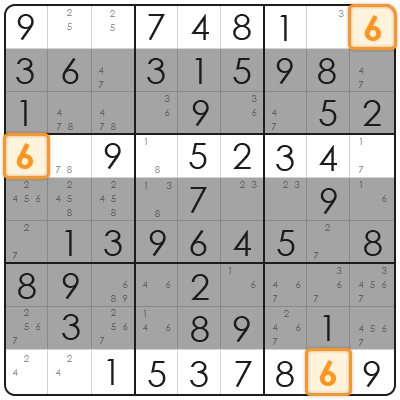
Solving Sudoku Level 4 puzzles represents a crucial step for enthusiasts looking to transition from basic deduction to more complex logical reasoning. This intermediate difficulty level, often characterized by fewer initial givens and a reduced reliance on straightforward eliminations, demands a systematic and analytical approach. It serves as a proving ground for developing advanced pattern recognition and constraint propagation skills that are indispensable for tackling even harder puzzles. From a problem-solving perspective, Level 4 Sudoku addresses the challenge of moving beyond ‘naked singles’ and ‘hidden singles’ to situations where multiple candidates often appear viable in a given cell. The primary problem it solves in the current landscape of logical puzzles is bridging the gap between foundational rules and sophisticated strategic thinking, compelling solvers to look deeper into the grid’s interdependencies rather than isolated cells. This shift in methodology not only enhances mental agility but also refines the discipline required for intricate analytical tasks. Based on structural analysis, Level 4 puzzles are expertly crafted to necessitate a comprehensive understanding of candidate elimination and subset identification. They introduce scenarios where an immediate solution is rarely apparent, pushing solvers to meticulously track possibilities and recognize patterns across rows, columns, and 3×3 blocks. This article will dissect the core strategies and underlying logic essential for mastering Sudoku Level 4, providing a definitive roadmap for advanced puzzle resolution.
Foundational Logic of Level 4 Sudoku
Solving Sudoku Level 4 fundamentally relies on a systematic application of logical deduction, moving beyond simple single-candidate eliminations to identify hidden patterns and constraints within the 9×9 grid. At its core, Sudoku maintains three cardinal rules: each row, each column, and each of the nine 3×3 subgrids must contain all digits from 1 to 9 exactly once. While these rules remain constant across all difficulty levels, Level 4 significantly increases the density of potential candidates, requiring more sophisticated means of reduction.
From a framework perspective, Level 4 puzzles demand a strong grasp of ‘Naked Subsets’ and ‘Hidden Subsets.’ Naked Subsets occur when a set of N cells in a row, column, or block contain only N specific candidates, thereby eliminating those N candidates from all other cells in that unit. For example, if two cells in a row can only be 2 or 5, then 2 and 5 cannot exist in any other cell of that row. Conversely, Hidden Subsets arise when N candidates within a unit can *only* appear in N specific cells within that unit, regardless of other candidates those cells may contain.
In practical application, the challenge of Level 4 is that these subsets are not always immediately obvious. Solvers must meticulously list all possible candidates for each empty cell, often using pencil marks, and then cross-reference these lists across units. This iterative process of identifying direct and indirect eliminations forms the bedrock of Level 4 solving, pushing solvers to think several steps ahead and maintain a precise mental model of the grid’s evolving state. Mastering this foundational logic is paramount before attempting more advanced strategies.
Strategic Approaches to Level 4 Sudoku
Effectively tackling Level 4 Sudoku involves a hierarchical application of advanced scanning and candidate reduction strategies, systematically narrowing possibilities until a definitive number can be placed. Once basic singles and subsets have been exhausted, the solver must pivot to identifying more intricate patterns that span multiple units, such as rows and columns intersecting.
One of the most powerful strategies for Level 4 is the X-Wing. An X-Wing exists when a candidate number appears in exactly two cells in two different rows, and these four cells form a rectangle (i.e., they are in the same two columns). If the candidate is restricted to these cells in both rows, it means the candidate can be eliminated from all other cells in those two columns. Identifying an X-Wing requires diligent tracking of candidates across entire rows and columns, as the pattern may not be immediately apparent within a single 3×3 block.
Another vital technique is the Swordfish, which is an extension of the X-Wing to three rows and three columns. If a candidate number appears in exactly two or three cells in three different rows, and those candidate cells align perfectly within three specific columns, then that number can be eliminated from all other cells in those three columns. Swordfish patterns are more complex to spot but offer significant breakthroughs in Level 4 puzzles, often revealing critical eliminations that unlock further progress. These strategic methods exemplify the analytical depth required at this level, moving beyond simple observation to deliberate pattern seeking.
Advanced Techniques for Constraint Propagation
Beyond basic set theory, advanced constraint propagation techniques like Jellyfish and Skyscraper are critical for dissecting complex Sudoku Level 4 puzzles by identifying intricate interdependencies that lead to candidate eliminations. These methods extend the principles of X-Wing and Swordfish, allowing for more expansive and subtle candidate deductions.
The Skyscraper technique, for instance, involves two rows (or columns) where a specific candidate number appears only twice in each, and these four cells form a structure resembling a skyscraper. The key is that two of these cells share the same column (or row), making them ‘bases.’ If the candidate exists in two cells in one row, and those two cells are in different columns, and there’s another row with the same candidate in two cells in those *same* two columns, then any cell sharing a column with one of the ‘top’ cells and not being a base, can have that candidate eliminated. This relies on the ‘either/or’ logic between the two rows.
Jellyfish takes the concept even further, extending the X-Wing and Swordfish principles to four rows and four columns. If a candidate is restricted to at most four cells in each of four rows, and these cells collectively occupy only four columns, then that candidate can be eliminated from any other cells in those four columns. These techniques require an elevated level of visual scanning and candidate tracking, often necessitating full candidate lists for every cell. Integrating these methods with standard approaches allows solvers to chip away at the most stubborn areas of a Level 4 grid, revealing hidden solutions through systematic logical inference.
Comparative Analysis: Sudoku Levels and Their Methodologies
A comparative analysis across Sudoku difficulty levels reveals a progressive demand for increasingly sophisticated logical techniques, with Level 4 marking a significant pivot from observational solving to strategic deduction. Understanding where Level 4 stands in the spectrum helps to contextualize the methods required.
From a methodological perspective, lower difficulty levels (Easy, Level 1-2) primarily rely on direct application of rules: identifying ‘Naked Singles’ where only one candidate remains for a cell, or ‘Hidden Singles’ where a number can only go into one specific cell within a row, column, or block. Level 4 (Medium/Hard) necessitates the consistent application of ‘Naked/Hidden Subsets’ (Pairs, Triples, Quads) and introduces the need for ‘X-Wing’ and occasionally ‘Swordfish’ patterns. Expert levels (Level 7+) demand even more complex techniques like ‘Jellyfish,’ ‘Squirmbag,’ and various ‘Chains’ and ‘Loops’ to resolve highly constrained grids.
| Difficulty Level | Primary Techniques Required | Average Solve Time | Analytical Complexity |
| :————— | :————————– | :—————– | :———————- |
| Level 1 (Easy) | Naked/Hidden Singles | 5-10 minutes | Low |
| Level 4 (Medium) | Subsets, X-Wing, Swordfish | 15-30 minutes | Medium-High |
| Level 7 (Hard) | Advanced Chains, Jellyfish | 30-60+ minutes | Very High |
This table illustrates the escalating complexity and the shift in required strategies. While easy puzzles are about finding the obvious, Level 4 is about seeing the hidden, and harder puzzles are about inferring the indirect. The ‘Solve Frequency’ of advanced techniques increases dramatically with difficulty, making them a cornerstone of Level 4 proficiency.
Avoiding Common Traps and Optimizing Your Solve Time
Overcoming typical impediments in Sudoku Level 4 requires meticulous attention to detail and a disciplined approach to candidate tracking, preventing common pitfalls such as premature guessing or incomplete candidate elimination. Many solvers get stuck at this level due to fundamental errors in their methodology rather than a lack of understanding complex strategies.
A frequent mistake is ‘premature guessing,’ where a solver makes an assumption about a cell’s value because no clear logical path is immediately visible. This often leads to breaking the puzzle, as backtracking from a wrong guess can be incredibly time-consuming and frustrating. Based on structural analysis, the most effective approach is to always rely on logical deduction; if you cannot deduce it, there’s likely an unspotted pattern or a candidate that hasn’t been properly eliminated.
Another pitfall is ‘incomplete candidate tracking’ or ‘tunnel vision.’ Solvers might correctly identify candidates for a region but fail to update all affected cells or overlook patterns spanning larger areas. From a framework perspective, maintaining a consistent and thorough system for marking and updating candidates for every empty cell is crucial. Regularly re-scanning the entire grid, not just the area you are currently focused on, can help spot global patterns like X-Wings or Swordfish that are often missed when focusing too narrowly. Implementing a methodical review process after each major deduction ensures accuracy and optimizes your solve time.
Frequently Asked Questions About Level 4 Sudoku
This section addresses common inquiries regarding Level 4 Sudoku, providing concise answers designed for quick comprehension and immediate application.
Q: What defines a Level 4 Sudoku? A: Level 4 Sudoku puzzles require more than basic singles. They necessitate the consistent use of techniques like Naked/Hidden Pairs, Triples, and sometimes X-Wing or Swordfish to resolve, bridging the gap between easy and expert levels.
Q: Are guessing strategies ever acceptable? A: In structured Sudoku solving, guessing is generally discouraged. Level 4 puzzles are designed to be solvable purely through logic. If you resort to guessing, you’ve likely missed a crucial logical step or pattern.
Q: How much time should I allocate? A: An experienced solver might complete a Level 4 Sudoku in 15-30 minutes. For those learning, taking 30-60 minutes or more is perfectly acceptable. Focus on accuracy and process over speed.
Q: What’s the best way to improve? A: Consistent practice with Level 4 puzzles, meticulously listing all candidates, and understanding the logic behind advanced techniques (like X-Wing) are key. Reviewing solved puzzles to identify missed patterns also helps.
Q: Can these techniques be applied to harder puzzles? A: Yes, the logical frameworks and advanced techniques learned in Level 4 Sudoku are foundational. They scale up and become integrated into even more complex strategies required for truly expert-level puzzles.
In conclusion, mastering how to solve Sudoku Level 4 is not merely about completing a puzzle; it’s about cultivating a robust framework for logical deduction, pattern recognition, and systematic problem-solving. The transition from basic observation to strategic analysis at this level builds a crucial bridge to more complex challenges, fostering mental discipline that extends far beyond the grid. The strategic value lies in developing an analytical mindset, a skill highly prized across various professional and personal domains. Continuous engagement with these puzzles, coupled with a commitment to understanding advanced techniques, will not only enhance your Sudoku prowess but also sharpen your overall cognitive abilities, preparing you for any intricate problem the future may present.