

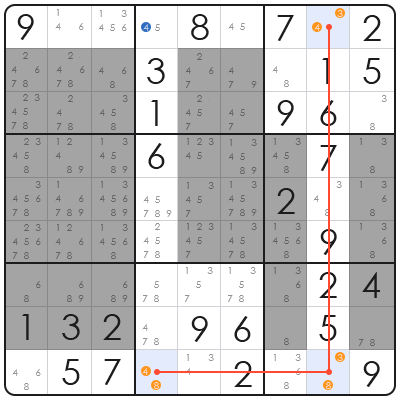
Fast pencil marking, within the realm of Sudoku strategy and digital puzzle interfaces, represents an advanced algorithmic approach to candidate tracking that significantly streamlines the solving process. This methodology automatically populates all potential numbers (candidates) into empty cells based on current board constraints, thereby eliminating the tedious manual enumeration of possibilities that often bogs down solvers. From a framework perspective, its core function is to offload cognitive burden, allowing players to focus on higher-level logical deductions rather than basic candidate elimination. The significance of fast pencil marking cannot be overstated for both novice and experienced Sudoku enthusiasts. For beginners, it demystifies the initial stages of candidate identification, providing a clear visual representation of options. For experts, it accelerates the early and mid-game phases, freeing up mental resources for complex techniques like X-Wing, Swordfish, or chains, which are otherwise obscured by the sheer volume of numbers. Based on structural analysis, its integration transforms the user’s interaction with the puzzle, shifting the primary problem from data management to strategic pattern recognition. This automated candidate management system effectively solves the problem of human error and inefficiency inherent in manual pencil marking. Traditional methods require players to meticulously check each row, column, and 3×3 block for existing numbers before marking candidates in a cell. Fast pencil marking, leveraging computational power, performs these checks instantly and comprehensively, ensuring accuracy and saving considerable time. In practical application, it allows for a more fluid and focused problem-solving experience, making intricate puzzles more accessible and less frustrating.
The Foundational Logic of Fast Pencil Marking
The foundational logic of fast pencil marking in Sudoku is rooted in real-time constraint propagation and algorithmic efficiency. This system operates by continuously evaluating the three primary Sudoku rules for every empty cell: each row must contain digits 1-9 exactly once, each column must contain digits 1-9 exactly once, and each 3×3 block must contain digits 1-9 exactly once. When a digit is placed on the board, either by the user or through another logical deduction, the fast pencil algorithm immediately updates the candidate lists for all affected cells (those in the same row, column, or block).
From a computational perspective, fast pencil marking utilizes a dynamic data structure, often a bitmask or a boolean array, for each empty cell to represent its potential candidates. When a number is confirmed in a cell, the corresponding bit or boolean flag for that number is flipped to ‘false’ in all affected candidate lists. This efficient update mechanism ensures that candidate sets are always minimal and accurate, reflecting the current state of the board. The system automatically identifies ‘single candidates’ (cells with only one possible number) and ‘naked singles’ (numbers that can only fit in one cell within a row, column, or block), often highlighting them for the user or even auto-filling them, depending on the implementation.
Based on structural analysis, the underlying mechanics involve a loop that iterates through all empty cells, generating an initial set of candidates. Subsequently, an event-driven model listens for changes to the Sudoku grid. Any placement triggers a cascade of updates, propagating eliminations across the board. This constant re-evaluation is what gives ‘fast pencil’ its speed and accuracy, making it an indispensable tool for efficient Sudoku solving, particularly in digital environments where processing power is readily available to handle these rapid calculations.
Implementing Fast Pencil Marking: A Practical Workflow
Implementing fast pencil marking effectively involves understanding its activation, interpretation, and integration into your personal solving strategy. Typically, fast pencil marking is toggled ‘on’ or ‘off’ via a dedicated button or menu option within a digital Sudoku application. Once activated, the interface will automatically populate the small, subscripted numbers (candidates) within each empty cell, representing all valid possibilities based on the current state of the puzzle. This immediate visual feedback is the cornerstone of its practical application.
A practical workflow often begins by activating fast pencil marking immediately after loading a new Sudoku puzzle. The system will then instantly fill all initial candidates. Your next step is to scan the board for obvious deductions: cells with only one candidate (naked singles) or numbers that appear as a candidate only once in a row, column, or block (hidden singles). Place these numbers, and observe how the fast pencil system automatically updates and refines the candidates in surrounding cells. This iterative process of placing a digit and re-evaluating the refined candidate lists is central to using fast pencil efficiently.
In practical application, the beauty of fast pencil is its ability to reveal patterns for advanced techniques. For instance, if you’re looking for a ‘naked pair,’ you can quickly spot two cells in the same unit (row, column, or block) that share the exact same two candidates, and no others. The fast pencil display makes these visual cues stand out. Similarly, spotting ‘pointing pairs’ or ‘triples’ that eliminate candidates from other cells becomes significantly easier when all possibilities are clearly enumerated. Leverage this automated insight to confirm your deductions and maintain a high level of accuracy throughout the solve.
Fast Pencil Marking vs. Traditional Candidate Tracking: A Comparative Overview
When comparing fast pencil marking to traditional candidate tracking methods, it becomes clear that fast pencil offers distinct advantages, particularly in terms of efficiency and error reduction. Traditional manual pencil marking requires the solver to painstakingly scan rows, columns, and blocks for each empty cell to list potential candidates. This process is time-consuming and highly susceptible to human oversight, leading to incorrect candidate lists that can derail an entire solve.
In contrast, fast pencil marking automates this tedious process, providing instantly updated and error-free candidate sets. This allows the solver to allocate their cognitive resources to more complex logical deductions, such as identifying advanced patterns, rather than basic data entry and validation. From a framework perspective, fast pencil shifts the solver’s role from a data entry clerk to a strategic analyst, significantly enhancing the problem-solving experience and often reducing overall solve times.
Based on structural analysis, the differences can be summarized in the following table, highlighting key dimensions relevant to Sudoku solvers:
| Dimension | Fast Pencil Marking | Manual Pencil Marking | Visual Deduction Only |
|—|—|—|—|
| **Complexity** | Low (user interaction) | High (mental effort) | Moderate (pattern recognition) |
| **Efficiency** | Very High | Low | Medium |
| **Error Rate** | Very Low | High | Medium |
| **Focus** | Advanced Strategy | Basic Candidate Tracking | Immediate Obvious Moves |
Navigating Common Challenges in Fast Pencil Application
While fast pencil marking offers substantial benefits, several common challenges can arise if its features are not fully understood or properly integrated into one’s solving strategy. One frequent mistake is over-reliance, where solvers become so accustomed to the automated candidate generation that they neglect to understand the underlying logic. This can hinder the development of intuition and lead to confusion when faced with puzzles that require deeper manual insight or when the tool is unavailable.
Another pitfall is misinterpreting the output, especially when dealing with advanced techniques. Fast pencil marking shows all possible candidates, but it doesn’t explicitly highlight ‘naked pairs’ or ‘hidden triples’ beyond simply displaying the numbers. Solvers must still possess the knowledge and skill to identify these patterns from the presented candidates. Professional advice dictates using fast pencil as a data foundation, not a complete solution, requiring the user to actively engage their deductive reasoning to interpret and leverage the information.
A third challenge involves neglecting the importance of ‘single’ candidates. Some fast pencil implementations will automatically fill naked singles, which is helpful. However, ‘hidden singles’ (a candidate that appears only once in a specific row, column, or block) still require the solver to scan the candidates to find them. The solution is to develop a systematic scanning habit, regularly reviewing rows, columns, and blocks for unique candidates within the fast pencil display, even after placing new numbers. This ensures no obvious moves are missed and maintains the puzzle’s momentum.
Frequently Asked Questions on Fast Pencil Sudoku
**Q: What is fast pencil marking?** A: Fast pencil marking is an automated feature in digital Sudoku that automatically fills and updates all valid candidate numbers in empty cells, based on current board constraints. It streamlines candidate tracking.
**Q: Does fast pencil marking solve the puzzle for you?** A: No, fast pencil marking assists by managing candidates, but it does not perform advanced logical deductions. You still need to apply strategy to identify patterns and place numbers.
**Q: Can I turn fast pencil marking off?** A: Yes, most digital Sudoku applications offer a toggle to activate or deactivate the fast pencil feature, allowing you to choose your preferred solving method.
**Q: Is fast pencil marking considered ‘cheating’?** A: No, it’s a tool to enhance efficiency and reduce manual effort, similar to using a calculator for complex arithmetic. It’s a strategic aid, not a solution provider.
**Q: How does fast pencil improve my Sudoku skills?** A: By handling basic candidate tracking, it frees your mind to concentrate on learning and applying more complex logical techniques, accelerating your skill development.
In conclusion, fast pencil marking stands as a pivotal advancement in digital Sudoku, fundamentally reshaping the solving experience by automating the laborious task of candidate management. Its strategic value lies in its ability to significantly enhance efficiency, minimize errors, and re-focus the solver’s cognitive energy on higher-order logical deductions. From a framework perspective, it represents an intelligent abstraction layer that allows players to transcend basic mechanics and delve deeper into the nuanced complexities of Sudoku strategy. Looking forward, the principles behind fast pencil marking are likely to see further integration into more complex logic puzzles and educational tools, continuing to democratize access to intricate problem-solving by streamlining foundational processes and fostering a more engaging, insightful experience for enthusiasts worldwide.