

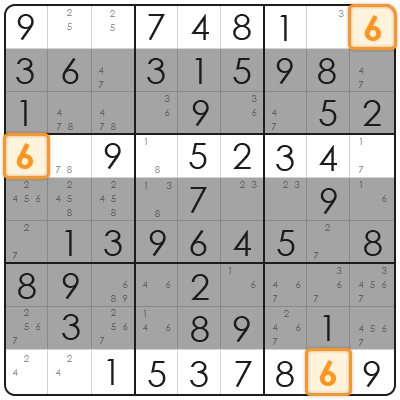
In the intricate world of advanced Sudoku solving, the X-Wing stands as a pivotal technique, allowing solvers to bypass common impasses and progress through particularly challenging grids. This method transcends basic single-candidate eliminations, introducing a structured approach to identifying and leveraging patterns that are not immediately obvious. From a framework perspective, the X-Wing is fundamentally a logical deduction tool that, when correctly applied, dramatically reduces the candidate pool within specific rows or columns. It is an essential component in the arsenal of any serious Sudoku enthusiast looking to elevate their solving capabilities beyond fundamental strategies such as Naked Singles, Hidden Pairs, or Pointing Pairs. The primary problem the X-Wing solves in the current landscape of Sudoku puzzles is the frequent scenario where basic elimination techniques have been exhausted, yet multiple possibilities persist for numerous cells. This often leaves solvers feeling stuck; the X-Wing provides a systematic mechanism to break these stalemates by identifying implicit relationships between candidate positions across different units.
Understanding the X-Wing Pattern in Sudoku
The X-Wing pattern in Sudoku is an advanced elimination technique used to identify and remove candidate numbers from cells, primarily when a particular candidate appears in exactly two rows and two columns, forming a rectangular shape. Based on structural analysis, this pattern signifies a forced choice that impacts the larger grid, allowing for strategic eliminations that would otherwise be impossible.
At its core, an X-Wing involves a specific candidate number (let’s call it ‘X’) that appears exclusively in two cells within a given row, and simultaneously, the same candidate ‘X’ appears exclusively in two cells within another distinct row. Crucially, these two pairs of cells must occupy the exact same two columns.
The underlying logic of the X-Wing is elegant: consider the two rows forming the X-Wing. In the first row, candidate ‘X’ must be in one of its two possible cells. If it’s in the first cell, then in the second row, ‘X’ must be in its second possible cell (in the same column). Conversely, if ‘X’ is in the second cell of the first row, then in the second row, ‘X’ must be in its first possible cell. This forms two mutually exclusive scenarios, both of which dictate that the candidate ‘X’ must occupy one of the two cells within each of the involved columns, eliminating ‘X’ from all other cells in those columns.
Identifying the X-Wing: A Visual Guide
Identifying an X-Wing involves systematically scanning for a specific candidate number that appears only twice within two distinct rows (or columns), with those occurrences aligning across two distinct columns (or rows). This meticulous process requires attention to detail and a methodical approach to candidate management.
In practical application, begin by focusing on a single candidate number, for instance, ‘5’. Scan each row for instances where ‘5’ appears as a candidate in precisely two cells. Mark these rows. Next, identify if there are two such rows where the two candidate ‘5’s align perfectly in the same two columns. If you find two rows (R1 and R2) where candidate ‘5’ is only in cells (R1, C1), (R1, C2) and (R2, C1), (R2, C2) respectively, you have successfully identified a row-based X-Wing.
The same principle applies for column-based X-Wings. You would scan columns for a candidate appearing exactly twice, and then verify if two such columns have these candidates in the same two rows. Visualizing the four cells forming a rectangle is key; this geometric pattern is the definitive indicator of an X-Wing’s presence, requiring careful verification of candidate uniqueness within the primary units.
Applying the X-Wing Strategy: Step-by-Step Elimination
Applying the X-Wing strategy involves leveraging the identified pattern to eliminate the candidate number from all other cells within the two columns (or rows) where the X-Wing candidates are located, outside of the X-Wing cells themselves. This is the crucial step where the pattern translates into tangible progress on the Sudoku grid.
Once an X-Wing is confirmed, based on our earlier example with a row-based X-Wing for candidate ‘5’ in (R1, C1), (R1, C2), (R2, C1), and (R2, C2), the logical deduction is that ‘5’ must be present in either (R1, C1) and (R2, C2) OR (R1, C2) and (R2, C1). In both scenarios, the candidate ‘5’ is definitively placed within column C1 and column C2. Therefore, ‘5’ can be safely eliminated as a candidate from all other cells in column C1 (excluding (R1, C1) and (R2, C1)) and all other cells in column C2 (excluding (R1, C2) and (R2, C2)).
Following this elimination, it is imperative to update the candidate lists for all affected cells. This often uncovers new Naked Singles, Hidden Singles, or other simpler patterns that were previously obscured. This cascaded effect underscores the power of advanced techniques; one successful application of an X-Wing can unlock several subsequent moves, making it a highly efficient strategy when identified and applied correctly.
X-Wing vs. Swordfish and Simple Pairs: A Strategic Comparison
The X-Wing differs from techniques like Swordfish and Simple Pairs in its scope of application and complexity, primarily targeting two rows/columns for candidate elimination, while Swordfish extends to three, and Simple Pairs are localized to a single unit. Understanding these distinctions is crucial for optimal strategic deployment.
From a comparative analysis perspective, Simple Pairs (or Triples) are foundational, involving two (or three) cells within a single unit (row, column, or block) that share the same two (or three) candidates. These are high-frequency, low-complexity eliminations. The X-Wing represents a step up in complexity, linking two units (rows or columns) across two other units (columns or rows) to eliminate a single candidate. It’s a moderate-frequency, moderate-impact strategy that often breaks mid-level stalemates.
The Swordfish technique, while sharing the same underlying logic as the X-Wing, scales this principle to three units. It involves a candidate appearing exactly twice or three times in three distinct rows, with these occurrences confined to the same three columns. This makes Swordfish a higher-complexity, lower-frequency technique with potentially greater impact, reserved for particularly challenging puzzles. A solver’s progression typically involves mastering Simple Pairs, then X-Wings, before tackling the intricacies of Swordfish and more advanced patterns, building a robust analytical framework.
Avoiding Common Traps When Using X-Wings in Sudoku
Common pitfalls when using X-Wings in Sudoku include misidentifying the pattern, failing to verify candidate uniqueness within the primary rows/columns, and overlooking potential stronger strategies, all of which can lead to incorrect eliminations or missed opportunities. Professional advice dictates a rigorous verification process.
One frequent mistake is misidentifying an X-Wing due to overlooking a third instance of the candidate in one of the primary rows or columns. It is crucial that the candidate appears *exactly* twice in each of the two rows (or columns) forming the base of the X-Wing. Failing to verify this can lead to erroneous eliminations, causing irreversible errors in the puzzle. Always double-check candidate counts in the involved units.
Another trap is incorrect elimination. Based on a framework perspective, if you identify a row-based X-Wing, eliminations can *only* occur in the two columns involved, and *only* from cells outside the four X-Wing cells. Conversely, for a column-based X-Wing, eliminations are restricted to the two involved rows, outside the X-Wing cells. Attempting to eliminate from other areas or incorrectly identifying the elimination scope will compromise the puzzle’s integrity. Finally, it’s easy to jump to complex strategies; however, always exhaust simpler techniques like Naked Singles, Hidden Singles, and other block-level eliminations first, as they are less prone to error and often provide quicker progress.
Frequently Asked Questions About the Sudoku X-Wing
Key questions about the Sudoku X-Wing technique typically revolve around its definition, identification process, its effectiveness in advanced puzzles, and its relationship to other complex strategies, providing clarity for solvers seeking to enhance their skills and understand industry standards in logic puzzle solving.
Q1: What defines an X-Wing in Sudoku? A1: An X-Wing exists when a specific candidate number appears exactly twice in two distinct rows, and these occurrences are confined to the same two columns, forming a perfect rectangle.
Q2: Why is the X-Wing strategy effective? A2: Its effectiveness stems from the logical deduction that if a candidate in an X-Wing isn’t in one pair of cells, it *must* be in the other, allowing elimination from other cells in the shared columns or rows.
Q3: Is an X-Wing always based on rows? A3: No, an X-Wing can be formed by two columns where a candidate appears exactly twice, and those instances are limited to the same two rows. The principle remains identical.
Q4: When should I look for X-Wings? A4: X-Wings are typically employed after simpler strategies like naked/hidden singles, pairs, and triples have been exhausted, serving as a powerful tool to break stalemates in medium to hard Sudoku puzzles.
Q5: Can an X-Wing be part of a larger pattern? A5: Yes, an X-Wing is a foundational component of more complex strategies like the Swordfish or Jellyfish, which extend the same logical principle to three or four units, respectively.
In conclusion, the X-Wing is an indispensable advanced technique for any serious Sudoku solver, offering a clear path through puzzles that stump simpler methods. Its mastery signifies a deeper understanding of Sudoku’s underlying logical structure and a crucial step towards becoming a proficient solver. Based on structural analysis, integrating the X-Wing into one’s strategic repertoire not only enhances problem-solving capabilities within Sudoku but also hones broader analytical skills, providing long-term strategic value and positioning solvers at the forefront of advanced logic puzzle engagement.