

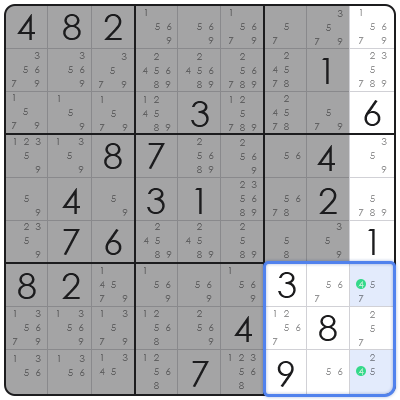
Sudoku, at its core, is a compelling number placement puzzle designed to challenge logical deduction rather than arithmetic prowess. The fundamental objective is to fill a 9×9 grid, which is further subdivided into nine 3×3 smaller grids or “blocks,” with digits from 1 to 9. Each digit must appear exactly once in every row, every column, and every one of these nine 3×3 blocks. This deceptively simple set of rules underpins a vast landscape of strategic thinking and pattern recognition, making it a globally accessible and engaging mental exercise. From a cognitive framework perspective, Sudoku’s significance lies in its ability to sharpen critical thinking, enhance concentration, and foster systematic problem-solving skills. Unlike many puzzles that rely on language or specific domain knowledge, Sudoku transcends cultural barriers due to its universal numerical foundation. It provides a structured environment for the brain to practice logical inference, where each move is a direct consequence of previous deductions, rather than mere guesswork. The primary problem that comprehensive Sudoku puzzle instructions solve in the current landscape is demystifying its initial complexity and ensuring players grasp the foundational principles. Without clear guidance, new players might resort to trial-and-error, missing the elegant logical pathways inherent in its design. Effective instruction illuminates the systematic approach required, transforming a seemingly daunting grid into an approachable challenge, thereby unlocking its full potential as a cognitive stimulant and a rewarding pastime.
Deconstructing the Sudoku Grid: Core Mechanics and Logical Foundations
The Sudoku grid is a 9×9 matrix, structurally divided into three distinct types of ‘regions’: nine rows, nine columns, and nine 3×3 ‘blocks’. These regions are the foundational elements governing number placement. Each of the 81 cells within this grid must eventually contain a single digit from 1 to 9. Based on structural analysis, understanding these interlocking regions is paramount, as all deductions flow from the unique constraints they impose on digit placement.
The core mechanics dictate that within each row, column, and 3×3 block, every digit from 1 to 9 must appear exactly once. This ‘uniqueness constraint’ is the engine of all Sudoku logic. Cells are pre-filled with ‘givens’ or ‘clues,’ which are immutable digits that provide the starting points for deduction. These givens strategically limit possibilities in their respective rows, columns, and blocks, creating the initial logical pathways that players must identify and exploit.
In practical application, the interplay between these constraints allows for various deduction techniques. For instance, if a specific digit, say ‘7’, is present in a row and a column that intersect within a particular 3×3 block, then ‘7’ can only be placed in the remaining available cell within that block’s boundaries, assuming no other ‘7’s are present in that specific block already. This ‘cross-hatching’ or ‘scanning’ method forms the bedrock of introductory Sudoku strategies, guiding players to find immediate and obvious solutions. From a framework perspective, this systematic reduction of possibilities is what makes Sudoku solvable through pure logic.
Initiating Play: A Step-by-Step Guide to Sudoku Deduction
Initiating Sudoku play involves a methodical approach to identifying certainties within the grid. The first step, upon encountering a new puzzle, is to scan the entire grid for ‘Naked Singles’. This means looking for cells where, after considering the existing ‘givens’ in its row, column, and 3×3 block, only one possible digit can be placed. This often involves focusing on numbers that appear frequently in the initial setup, as they tend to quickly reveal empty cells’ values.
Step two involves what is known as ‘Candidate Elimination’ or using ‘pencil marks’. For cells that don’t immediately reveal a ‘Naked Single’, players should list all possible candidate digits in small numbers within the cell. This systematic notation, a cornerstone of advanced play, transforms the puzzle from a guessing game into an organized logical problem. Based on structural analysis, these small marks prevent overlooking possibilities and facilitate complex deductions by visually mapping the potential state of the grid.
The third step is an iterative process of refinement and ‘Hidden Singles’ identification. As new digits are placed, previously identified pencil marks become invalid, reducing the possibilities in adjacent cells. This cascade effect can reveal ‘Hidden Singles’ – cells where a digit is the only possible candidate within its row, column, or block, even if the cell itself has multiple candidates initially. Regularly reviewing rows, columns, and blocks after each confirmed placement is crucial for uncovering these hidden certainties and progressing through the puzzle. This continuous cycle of placement and re-evaluation is central to successful Sudoku solving.
Comparing Sudoku with Related Logic Puzzles: A Structural Analysis
To appreciate the unique elegance of Sudoku, it’s insightful to compare its structural framework with other prominent number-based logic puzzles. While all aim to engage cognitive abilities through numerical challenges, their underlying mechanics and the types of deductions required can vary significantly. This comparative analysis helps define Sudoku’s distinct position within the realm of logic games.
Consider Kakuro, often described as ‘mathematical Sudoku.’ Unlike Sudoku, which relies purely on number uniqueness, Kakuro involves arithmetic sums. Players must fill a grid with digits 1-9 (no repeats in a given sum-area) such that they add up to a specified total for each row and column segment. From a framework perspective, Kakuro introduces an additional layer of numerical calculation, increasing its cognitive load in terms of arithmetic but maintaining a similar spatial deduction challenge. Sudoku’s strength lies in its pure logical deduction, requiring no arithmetic beyond recognizing unique digits.
Another comparative example is KenKen, a puzzle that combines arithmetic and logic with ‘cages.’ In KenKen, regions of cells (cages) are marked with an operator (+, -, ×, ÷) and a target number. Players must fill the grid (typically 4×4 to 9×9) with digits 1-X (where X is the grid size), ensuring no repeats in any row or column, and that the numbers in each cage produce the target number using the given operation. KenKen demands both algebraic reasoning and the row/column uniqueness familiar from Sudoku, often leading to higher complexity. Sudoku, by contrast, maintains a more direct, constraint-satisfaction approach, making it accessible even without strong arithmetic proficiency. Its efficiency stems from the singular rule set, allowing for rapid application of core logical principles.
Based on structural analysis, Sudoku’s advantage lies in its singular focus on pattern recognition and uniqueness, making it highly efficient for developing pure deductive reasoning. While Kakuro and KenKen introduce arithmetic complexity, potentially enhancing mathematical fluency, Sudoku offers a streamlined cognitive workout primarily focused on spatial logic and elimination. Its lower barrier to entry in terms of prior knowledge contributes to its widespread appeal and its efficacy as a universal brain exercise.
Navigating Common Sudoku Challenges: Pitfalls and Expert Solutions
Even for experienced players, specific challenges can hinder efficient Sudoku solving. Identifying common pitfalls and applying professional solutions is key to consistent success and deeper engagement with the puzzle’s logic. Based on structural analysis, many errors stem from a deviation from systematic deduction.
A frequent mistake is premature guessing. When faced with a seemingly difficult spot, players might be tempted to ‘try’ a number without sufficient logical basis. This often leads to contradictions later in the puzzle, requiring extensive backtracking and frustrating restarts. The expert solution is to rigorously adhere to pencil marking and elimination. If no logical deduction can be made, it means there are still hidden implications or another area of the grid holds the key. Always confirm a placement with certainty; if there’s any doubt, it’s still a candidate, not a solution.
Another common pitfall involves overlooking ‘Hidden Singles’ or ‘Naked Pairs/Triples.’ This occurs when players focus too narrowly on individual cells or fail to re-evaluate the entire grid after placing a new digit. The professional advice here is to adopt a systematic scanning routine: after each confirmed number, briefly re-scan its row, column, and 3×3 block for new implications. Furthermore, actively search for pairs or triples of candidates within a region that occupy a limited set of cells, as these can eliminate those candidates from other cells in that region, thus revealing other solutions.
In practical application, inconsistent or messy pencil marking is a significant impediment. If candidates are not clearly noted or updated, the player loses track of possibilities, leading to confusion and errors. The solution is to develop a consistent and neat pencil marking system. Use small, clear numbers for candidates and erase them completely when they are no longer viable. Some advanced players also use different colors for different types of candidates. This meticulous approach to notation is a fundamental component of managing the puzzle’s complexity and ensuring a clear logical pathway.
Frequently Asked Questions About Sudoku Play
Q: What is the primary goal of Sudoku? A: The primary goal of Sudoku is to fill a 9×9 grid with digits 1 through 9 such that each column, each row, and each of the nine 3×3 subgrids contains all of the digits from 1 to 9 without repetition.
Q: Are there any mathematical skills needed for Sudoku? A: No advanced mathematical skills are required for Sudoku. It primarily tests logic and deductive reasoning, relying on number placement rather than arithmetic operations or complex calculations.
Q: How do I start a Sudoku puzzle? A: Begin by identifying numbers that can only fit in one specific cell within a row, column, or 3×3 block due to existing ‘givens.’ Use pencil marks for potential candidates in other cells.
Q: What are ‘pencil marks’ in Sudoku? A: ‘Pencil marks’ are small numbers noted in a cell to represent the possible candidates for that cell. They are crucial for tracking possibilities and making complex, multi-step deductions.
Q: Can I guess numbers in Sudoku? A: Guessing is generally discouraged in Sudoku as it often leads to errors and requires extensive backtracking. The puzzle is designed to be solvable through pure logic and systematic deduction, not chance.
In conclusion, mastering Sudoku puzzle instructions transcends mere entertainment; it represents an investment in cognitive agility and systematic problem-solving. From a framework perspective, its enduring appeal lies in its elegant simplicity coupled with profound logical depth. The ability to methodically break down a complex grid, apply deductive reasoning, and iteratively narrow down possibilities is a skill transferable to countless real-world scenarios requiring analytical thought. As a timeless mental exercise, Sudoku not only offers a rewarding challenge but also serves as a potent tool for enhancing focus, patience, and the strategic thinking capabilities essential in any demanding field.