

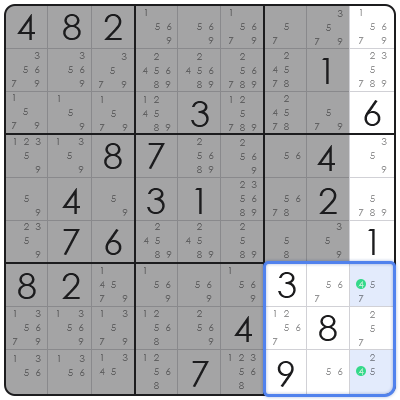
A Sudoku Swordfish represents a powerful, intermediate-to-advanced technique in the realm of Sudoku strategy, designed to systematically eliminate candidate numbers from cells, thereby simplifying complex puzzles. It is a refinement of the simpler X-Wing pattern, extending its logical application to a broader set of grid interactions. The significance of mastering the Swordfish lies in its ability to break through grid stalemates that resist resolution by more basic elimination methods. As puzzles increase in difficulty, the reliance on advanced patterns like the Swordfish becomes paramount, transitioning solvers from intuitive observation to structured, logical deduction. The primary problem a Swordfish solves is the reduction of candidate numbers in a clustered area where direct naked or hidden singles, pairs, or triples are not evident. By identifying a specific pattern of three rows or columns (base sets) that restrict a candidate digit to only three other columns or rows (cover sets), the strategy allows for the confident elimination of that candidate from all other cells within those cover sets, thus progressing the puzzle to a solvable state. From a framework perspective, it represents a critical juncture in advanced Sudoku analysis.
The Core Mechanics of a Sudoku Swordfish Pattern
A Sudoku Swordfish pattern is identified by observing three rows (or columns) that each contain candidate numbers for a specific digit (e.g., ‘1’) in exactly two or three cells within those rows (or columns), such that these candidate cells align across exactly three columns (or rows). This precise 3×3 alignment forms the structural backbone of the Swordfish, allowing for broad candidate eliminations.
Based on structural analysis, the components are meticulously defined: first, a specific ‘candidate digit’ is selected, for which the pattern is sought across the entire grid. Second, ‘base sets’ are identified as three distinct rows (or columns) where this candidate digit appears in 2 or 3 cells. Critically, these candidate cells in the base sets must be confined exclusively to three corresponding ‘cover sets’ (columns or rows, respectively).
The underlying logic dictates that if the chosen candidate digit must occupy one of the two or three possible cells within each of the three base sets, and if all these potential cells are confined to only three cover sets, then the candidate cannot exist in any other cell within those same three cover sets. This is because placing the candidate elsewhere in a cover set would invalidate the possibility of it existing in the base cells, leading to a contradiction. This principle allows for powerful eliminations.
Applying the Swordfish Strategy: A Step-by-Step Identification Guide
Identifying a Sudoku Swordfish involves systematically scanning the grid for specific candidate number alignments across rows or columns, requiring patience and a keen eye for pattern recognition.
The process begins by: 1. **Choosing a Candidate Digit:** Select any digit from 1 to 9 to search for a potential Swordfish pattern. It’s often strategic to start with candidates that appear sparsely or in interesting configurations. 2. **Scanning Rows for Base Sets:** For the chosen digit, identify three rows where that digit appears as a candidate in exactly two or three cells. These are your potential base rows. Meticulously mark or note these cells and their column positions. 3. **Identifying Potential Cover Sets:** Observe the columns where these marked candidate cells reside. If you can find three such rows whose candidate cells for that digit are contained *entirely* within exactly three columns, you have identified your base rows and corresponding cover columns. Conversely, the same logic applies if you start by scanning columns for base sets and identifying cover rows.
4. **Verifying the Pattern:** Double-check that for each of the three identified base units (rows or columns), the candidate digit appears *only* in cells within those three identified cover units. There must be no ‘stray’ candidates in the base units outside of the cover units. 5. **Performing Eliminations:** Once a valid Swordfish is unequivocally confirmed, you can confidently eliminate the candidate digit from any other cell *within the three cover columns (or rows)* that is *not* one of the original base row (or column) cells. This refined candidate list often reveals new singles or pairs, accelerating the puzzle’s resolution. 6. **Repeating the Process:** Always remember to reverse the process; if you found a row-based Swordfish, scan for a column-based one, and then move to other candidate digits.
Swordfish vs. Related Sudoku Techniques: A Comparative Analysis
Understanding the Swordfish is often best achieved through its comparison with related, foundational Sudoku strategies. This comparative analysis highlights its unique position in the hierarchy of advanced techniques, illuminating its specific utility and complexity relative to others.
The following table provides a clear differentiation between the Swordfish and a selection of other frequently employed Sudoku patterns, focusing on key operational dimensions:
| Feature | Swordfish | X-Wing | Jellyfish | Hidden Pair/Triple | | :———— | :——————————————— | :——————————————- | :——————————————— | :—————————————– | | **Complexity** | Intermediate-Advanced; 3×3 alignment | Intermediate; 2×2 alignment | Advanced; 4×4 alignment | Beginner-Intermediate; unit-based scanning | | **Efficiency** | Significant eliminations across cover sets | Moderate eliminations across cover sets | Potentially vast eliminations | Localized, precise eliminations | | **Frequency** | Less common than X-Wing; more frequent than Jellyfish | Relatively common in medium-hard puzzles | Rare; typically in very hard puzzles | Very common; foundational technique | | **Mechanism** | 3 base rows/columns linking 3 cover columns/rows | 2 base rows/columns linking 2 cover columns/rows | 4 base rows/columns linking 4 cover columns/rows | Two/three candidates sharing two/three cells in a unit |
Common Pitfalls & Professional Solutions
Even experienced solvers can fall prey to common misinterpretations when attempting to spot a Sudoku Swordfish. Recognizing these pitfalls and applying professional corrective measures is crucial for consistent success in advanced Sudoku.
**Pitfall 1: Misidentifying Candidate Counts in Base Sets.** A frequent error involves assuming a row or column is a base set when the target candidate digit appears in more than three cells, or conversely, fewer than two cells, within that unit. This violates the core definition of the Swordfish’s structural requirements. **Solution:** Meticulously count candidate occurrences within each potential base row or column. Ensure that for your chosen digit, there are *exactly* two or three candidate positions. Precision in candidate tracking is non-negotiable for accurate pattern identification.
**Pitfall 2: Incorrect Alignment of Cover Sets.** Another common mistake is not ensuring that *all* candidate cells from the identified base rows/columns are contained *exclusively* within the three corresponding cover columns/rows. If even a single candidate ‘strays’ outside this 3×3 confinement, the pattern is invalid. **Solution:** Visually track the intersecting cells. If any base candidate for your chosen digit is found in a column (or row) outside the three designated cover sets, it is not a Swordfish. Based on structural analysis, precise alignment is paramount; deviations invalidate the pattern.
**Pitfall 3: Overlooking Row/Column Duality.** Solvers sometimes exclusively search for row-based Swordfish patterns, neglecting the equally valid column-based variations. This halves the potential opportunities for detection and elimination. **Solution:** From a framework perspective, always check both orientations (rows acting as base sets, then columns acting as base sets) for potential patterns. A comprehensive search strategy will significantly increase the likelihood of discovering a Swordfish and leveraging its power.
Frequently Asked Questions (FAQ)
**Q1: What is the primary purpose of a Sudoku Swordfish?** A1: A Swordfish helps eliminate a specific candidate digit from cells outside the pattern’s core structure, simplifying challenging Sudoku puzzles when simpler strategies are exhausted.
**Q2: How does a Swordfish differ from an X-Wing?** A2: An X-Wing involves a 2×2 alignment of candidates (two base units, two cover units), while a Swordfish extends this logic to a 3×3 alignment, making it a more complex but often more powerful elimination technique.
**Q3: Can a Swordfish involve more than three rows or columns?** A3: No, by definition, a Swordfish specifically refers to a 3×3 alignment (three base units, three cover units). Larger patterns (e.g., 4×4) are distinct techniques, generally referred to as Jellyfish or more generically, ‘n-Wing’ patterns.
**Q4: Is the Swordfish an advanced Sudoku technique?** A4: Yes, it is considered an advanced technique. It requires a thorough understanding of candidate tracking and visual pattern recognition beyond basic single-candidate or block-based strategies, demanding a high level of analytical skill.
**Q5: When should I look for a Swordfish?** A5: In practical application, you should typically search for Swordfish patterns after exhausting simpler strategies like hidden singles, naked pairs/triples, and X-Wings, especially when confronted with medium-to-hard difficulty puzzles that appear to be stuck.
The Sudoku Swordfish stands as a testament to the elegant complexity and deep logical structures inherent in advanced Sudoku. Mastering this intermediate-to-advanced strategy is not merely about solving a specific puzzle; it represents a significant leap in a solver’s analytical capabilities, providing a robust tool to dismantle even the most stubborn grids. Its systematic application reduces reliance on guesswork and promotes a disciplined approach to problem-solving. From a framework perspective, it exemplifies how understanding intersecting constraints across multiple units can yield powerful deductions.