

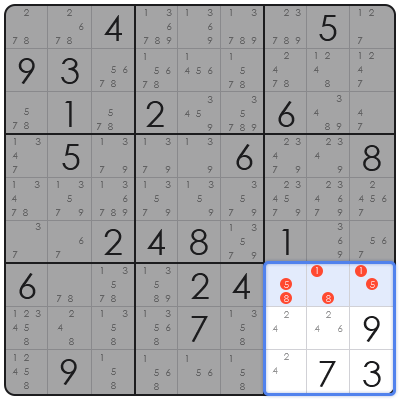
A standard 9×9 Sudoku puzzle is fundamentally governed by a precise system of 27 primary constraints: nine row constraints, nine column constraints, and nine 3×3 block constraints. These fundamental rules dictate the placement of digits 1 through 9 within the 9×9 grid, ensuring absolute uniqueness within each designated unit. This highly structured framework transforms a simple grid of numbers into a complex combinatorial challenge. From a framework perspective, the significance of these constraints cannot be overstated; they define the entire problem space, turning an apparently straightforward task into an exercise in rigorous logical deduction. Sudoku serves as a classic, accessible example within the domain of Constraint Satisfaction Problems (CSPs), frequently utilized in artificial intelligence and operations research to illustrate principles of backtracking and propagation. In practical application, the primary problem these constraints solve is providing a clear, bounded, and logically consistent environment for testing various problem-solving methodologies. It acts as a pedagogical tool across diverse fields, from computer science for algorithm design and optimization to cognitive psychology for studying human logical inference, demonstrating how a limited set of rules can generate immense combinatorial complexity and a wide array of solution paths.
The Foundational Constraint Set: Deconstructing Sudoku’s Core Rules
Based on structural analysis, the fundamental constraint set of a standard 9×9 Sudoku puzzle is precisely 27 distinct rules, composed of three primary categories: row uniqueness, column uniqueness, and 3×3 block uniqueness. Each category applies to 9 individual units within the grid, totaling 9 rows, 9 columns, and 9 3×3 blocks. This specific number forms the bedrock of every Sudoku puzzle.
From a framework perspective, these 27 units each must contain the digits 1 through 9 exactly once, without repetition. This means that for any given row, column, or 3×3 block, every digit from 1 to 9 must be present, and no digit can appear more than once. This elegant simplicity underpins the entire solving process, dictating every possible move and deduction.
In practical application, the combined effect of these 27 constraints generates a highly restrictive environment for digit placement. Every single cell in the 9×9 grid is simultaneously a member of one row, one column, and one 3×3 block, meaning its value is constrained by three distinct uniqueness rules at all times. This tripartite restriction is what gives Sudoku its characteristic challenge.
Translating Unit Constraints into Cell-Level Restrictions
While there are 27 core unit constraints that define the puzzle’s structure, their true power lies in how they translate into a multitude of specific restrictions on individual cell values. For each of the 81 cells, the valid digit it can hold is dynamically determined by checking the digits already present in its corresponding row, column, and 3×3 block, which are directly governed by the primary constraints.
From a combinatorial viewpoint, if a cell is located at `(r, c)` (row `r`, column `c`), its permissible values are derived from the set of all possible digits `D = {1, …, 9}`. This set is then filtered by subtracting the digits already occupying row `r`, column `c`, and the 3×3 block containing `(r, c)`. This iterative process of elimination, driven by the 27 constraints, is the essence of Sudoku solving.
In practical application, these cell-level restrictions are highly dynamic. As more cells are filled, the set of possible candidates for remaining empty cells progressively shrinks. This often leads to situations where only one digit remains possible for a particular cell—a ‘naked single’—or where a specific digit can only be placed in one particular cell within a given unit—a ‘hidden single’. These deductions are direct consequences of the ever-tightening constraints.
Algorithmic Identification and Application of Sudoku Constraints
To identify and apply Sudoku constraints systematically, computational approaches typically begin by representing the grid as a data structure, such as a 2D array, and maintaining candidate sets for each empty cell. The process is inherently iterative, focusing on efficiently reducing these candidate sets based on the 27 fundamental rules. This structured approach is critical for solving puzzles algorithmically.
Step 1: Initialization. For every empty cell, initialize its candidate set with all digits {1-9}. For pre-filled cells (givens), remove that digit from the candidate sets of all other empty cells located in its row, column, and 3×3 block. This initial propagation of known values immediately leverages the constraints.
Step 2: Single Candidate Reduction. Iteratively scan through all empty cells. If any cell has only one candidate remaining after constraint propagation (a naked single), assign that digit to the cell. Propagate its effect by removing this new digit from candidates of all other empty cells in its row, column, and block. Repeat this step until no more naked singles can be found.
Step 3: Hidden Candidate Identification. For each of the 27 units (rows, columns, blocks), iterate through digits 1-9. If a digit appears as a candidate in only one specific empty cell within that unit, it’s a hidden single for that unit. Assign the digit to that cell and propagate its effect. After finding hidden singles, return to Step 2 as new naked singles might have emerged.
Step 4: Advanced Pattern Detection (Optional). Implement more complex strategies, such as ‘locked candidates’ (pointing/claiming) or ‘subsets’ (naked/hidden pairs, triplets, quadruplets), to further reduce candidate sets when simpler methods stall. This recursive application of constraint logic, guided by the initial 27 constraints, is crucial for solving harder puzzles and forms the basis of many robust Sudoku solvers.
Comparative Analysis: Sudoku Constraints vs. Related Logic Puzzles
From a framework perspective, comparing Sudoku’s constraint system to other logic puzzles highlights its unique balance of simplicity and depth, primarily driven by its fundamental 27 constraints. Sudoku operates purely on uniqueness constraints within predefined orthogonal and regional units, making it a quintessential example of a Constraint Satisfaction Problem (CSP). This distinct characteristic sets it apart from many other puzzles.
When assessing complexity, efficiency, and the frequency of constraint application, consider the relative characteristics of Sudoku alongside other popular logic puzzles:
**Sudoku:** Employs uniqueness constraints across 27 units (9 rows, 9 columns, 9 blocks). It demonstrates high efficiency in basic logical deduction, moderate complexity in initial constraint setup, and minimal computational cost for fundamental solving algorithms. The frequency of constraint application is pervasive and constant across every cell of the grid, with each cell constantly subject to three overlapping uniqueness rules.
**Kakuro:** Integrates summation constraints within defined horizontal and vertical blocks, alongside uniqueness. This introduces higher complexity in constraint propagation due to arithmetic dependencies, potentially leading to lower efficiency for brute-force methods compared to Sudoku due to the varying sum targets. Its constraint set is a blend of uniqueness and arithmetic sums.
**Nonograms (Picross):** Relies on adjacency and block-length constraints across rows and columns to reveal a hidden image. This represents a distinctly different constraint type, focused on spatial arrangement and numerical sequence rather than digit uniqueness, leading to different algorithmic approaches and solver complexities. Its constraints are about ‘how many filled cells’ in a sequence, not ‘which number’.
Navigating Common Pitfalls and Optimizing Constraint Management
In practical application, common pitfalls in managing Sudoku constraints often stem from premature assumptions or a failure to systematically propagate deductions, which can lead to errors even when the underlying 27 constraints are fully understood. One frequent mistake is incorrectly marking candidates, which can create logical contradictions later in the solve process.
Pitfall 1: Inconsistent Candidate Tracking. Without meticulous candidate tracking for each empty cell, solvers often miss obvious eliminations or make errors that violate the uniqueness constraints. Solution: Employ a consistent system, whether mental or physical (e.g., pencil marks or digital tools), to meticulously list all possible candidates for each empty cell. Continuously update these lists whenever a new digit is placed or eliminated.
Pitfall 2: Overlooking Unit-Wide Implications. Focusing too narrowly on a single cell without considering the full implications across its encompassing row, column, and 3×3 block can lead to stalled progress or missed deductions. Solution: After each digit placement or candidate elimination, systematically sweep through the affected row, column, and block to identify new single candidates (naked or hidden) or pointing/claiming opportunities that the 27 constraints now reveal.
Pitfall 3: Guessing Too Early. Resorting to trial-and-error without exhausting all purely logical deductions is a significant inefficiency and often leads to prolonged solving times. Solution: Implement advanced strategies (like ‘X-Wing’ or ‘Swordfish’) if basic deductions cease, rather than immediately guessing. Only when purely logical steps, derived from the core constraints, are truly exhausted should controlled branching (speculative assignment) be considered, always with a clear rollback mechanism to prevent irreversible errors.
Key Insights: Understanding Sudoku Constraints in Practice
From a framework perspective, understanding the nuances of Sudoku constraints is crucial for both human solvers and algorithmic approaches, optimizing the solving process. **Q: What is the primary constraint type in Sudoku?** A: The primary constraint type is uniqueness: each digit from 1 to 9 must appear exactly once within each row, column, and 3×3 block.
**Q: How do initial ‘givens’ affect the constraints?** A: Initial ‘givens’ activate the constraints by immediately eliminating specific digits from the candidate sets of all other empty cells within their respective rows, columns, and blocks. This reduction of possibilities effectively initiates the solving process.
**Q: Can a Sudoku have fewer or more than 27 constraints?** A: A standard 9×9 Sudoku always adheres to the 27 unit constraints. While variations exist (e.g., Killer Sudoku, Sum Sudoku), these typically add *additional* layers of constraints rather than altering the fundamental 27 uniqueness rules.
**Q: What makes a Sudoku puzzle difficult based on its constraints?** A: Difficulty arises not from the number of constraints, which remains constant, but from the initial pattern of ‘givens’ which obscure direct deductions, requiring deeper inferential leaps or advanced pattern recognition across multiple constraints simultaneously to resolve ambiguities.
The structural analysis of Sudoku clearly demonstrates that its elegant complexity stems from a precisely defined set of 27 primary constraints: nine row, nine column, and nine 3×3 block uniqueness rules. Based on this framework, these fundamental rules, when iteratively applied and logically propagated, orchestrate a rich environment for problem-solving that has captivated millions. The enduring strategic value of understanding how these constraints interact lies in their broader applicability to various constraint satisfaction problems in computational logic, offering profound insights into algorithm design, logical deduction, and the architecture of complex systems across diverse industries.