

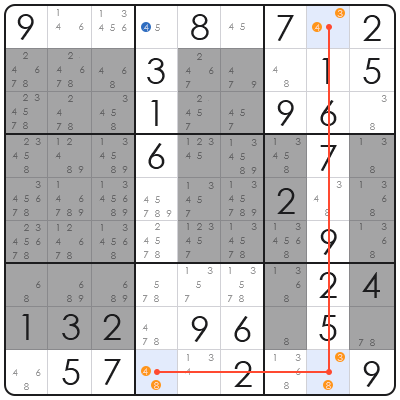
Irregular Sudoku, often referred to as Jigsaw Sudoku or Squiggly Sudoku, presents a compelling evolution of the classic logic puzzle, fundamentally challenging conventional solving strategies by introducing non-standard 3×3 regions. From a framework perspective, this variant adheres to the foundational rules of Sudoku concerning numbers within rows and columns, yet innovates by replacing rigid square blocks with uniquely shaped, contiguous regions, each of which must contain the numbers 1 through 9 exactly once. The significance of understanding how to solve irregular sudoku extends beyond mere recreation; it serves as a critical exercise in adaptive problem-solving and enhanced logical deduction, mirroring complex analytical tasks in real-world professional environments. This puzzle variant actively forces solvers to discard ingrained patterns and cultivate a more fluid, context-dependent approach, thereby refining cognitive flexibility. In practical application, the primary problem irregular Sudoku solves in the current landscape of cognitive training is the plateau effect often experienced by enthusiasts of traditional Sudoku. By introducing an element of spatial irregularity, it reinvigorates the challenge, demanding a deeper structural analysis of the grid and the intricate interplay between its various constraints, thereby pushing the boundaries of logical reasoning and pattern recognition.
Unpacking the Core Mechanics of Irregular Sudoku
Understanding how to solve irregular sudoku begins with a deep dive into its unique structural mechanics, which differentiate it profoundly from its classic counterpart. While the fundamental rules dictate that each number from 1 to 9 must appear exactly once in every row and every column, irregular Sudoku introduces ‘jigsaw’ or ‘squiggly’ shaped regions instead of the standard 3×3 blocks. These regions, though irregular in form, must also contain each number from 1 to 9 precisely once, creating a more complex spatial puzzle.
Based on structural analysis, the key challenge lies in the visual identification and mental mapping of these non-standard regions. Unlike uniform blocks, irregular regions demand meticulous attention to their boundaries, as a single cell can significantly alter the candidate pool for an entire section. This necessitates a fluid scanning approach rather than a rigid, quadrant-based focus, requiring solvers to constantly reassess the ‘neighborhood’ of each cell.
From a framework perspective, each irregular region functions as an independent constraint set that interacts dynamically with the row and column constraints. This interconnectedness means that a deduction made in one part of a squiggly region can have far-reaching implications across multiple rows and columns, demanding a holistic view of the puzzle grid rather than isolated analysis.
Foundational Solving Techniques for Jigsaw Variants
Applying foundational solving techniques to irregular Sudoku requires adaptation rather than abandonment of classic strategies. The core principle of ‘how to solve irregular sudoku’ for beginners still revolves around candidate elimination and identification of naked or hidden singles, pairs, and triplets, but the irregular region shapes introduce new complexities to these methods.
In practical application, a common starting point is the ‘single candidate’ technique, where one identifies a cell that can only logically contain one specific number based on its row, column, and crucially, its irregular region. Due to the varied sizes and shapes of regions, some cells might quickly become singles simply because their region is already heavily populated or restricts possibilities more severely than a standard block would.
Furthermore, advanced techniques such as ‘hidden singles’ within rows, columns, or irregular regions become more pertinent. A number might only have one possible location within a specific irregular region, even if that cell has multiple candidates from the row/column perspective. The visual irregular boundaries often hide these opportunities, demanding a more systematic scan of each region for numbers that ‘must go’ in a particular cell.
Advanced Strategies for Complex Irregular Grids
For intricate irregular Sudoku puzzles, advanced strategies are essential in understanding how to solve irregular sudoku efficiently, particularly when basic candidate elimination stalls. Techniques such as ‘X-Wing’ and ‘Swordfish’ can be adapted, but their application requires a heightened awareness of how irregular region constraints intersect with traditional row and column logic.
Based on structural analysis, an X-Wing occurs when a candidate number is restricted to only two cells in two different rows, and those two cells share the same two columns. In irregular Sudoku, identifying these patterns can be more challenging as the irregular regions might obscure clear visual lines. Solvers must mentally isolate the rows and columns, then cross-reference with candidate lists, ensuring the irregular region rule isn’t violated by the potential elimination.
Entity-based writing emphasizes that ‘coloring’ or ‘chaining’ techniques become particularly powerful in complex irregular grids. This involves marking cells with potential candidates and tracing logical implications if a certain candidate were true or false. Given the unpredictable nature of irregular regions, these methods help in navigating convoluted dependencies and breaking deadlocks by exposing contradictions or necessary assignments across multiple interlinked cells and regions.
Comparative Analysis: Irregular Sudoku in the Puzzle Landscape
A comparative analysis of how to solve irregular sudoku against other logic puzzles highlights its unique position in cognitive training and recreational mathematics. While sharing a common lineage with classic Sudoku, its irregular regions introduce distinct dimensions of complexity, efficiency requirements, and problem-solving frequency.
| Puzzle Type | Complexity | Efficiency of Solving Methods | Cognitive Demand | Innovation Level |
|———————|———————————————–|————————————————————-|————————|———————-|
| Classic Sudoku | Moderate (fixed 3×3 blocks) | High (standardized algorithms, pattern recognition) | Structured Logic | Foundational |
| Irregular Sudoku | High (dynamic, non-standard regions) | Moderate (adaptive strategies, visual mapping) | Adaptive Spatial Logic | Significant |
| Killer Sudoku | Very High (arithmetic sums & standard blocks) | Low (requires arithmetic + combinatorial analysis) | Numerical & Logical | Transformative |
From a framework perspective, Irregular Sudoku demands greater spatial reasoning and adaptability compared to Classic Sudoku, which relies more on rote pattern recognition within predictable block structures. Killer Sudoku, while also an advanced variant, shifts the primary complexity to numerical summation within cages, making Irregular Sudoku uniquely challenging in its pure spatial and regional constraint.
In practical application, the ‘how to solve irregular sudoku’ methodology thus bridges the gap between purely logical deduction and nuanced spatial intelligence. This makes it an invaluable tool for enhancing flexible thinking, a critical skill in various professional fields requiring dynamic problem assessment and solution formulation.
Overcoming Common Solving Hurdles
Navigating the complexities of irregular Sudoku involves anticipating and effectively addressing common pitfalls that can impede progress. Understanding how to solve irregular sudoku effectively means developing strategies to circumvent these frequent mistakes.
A primary pitfall is the misidentification or oversight of irregular region boundaries. Unlike standard Sudoku, where 3×3 blocks are clearly demarcated, the squiggly nature of irregular regions can lead to errors where solvers mistakenly assume a cell belongs to one region when it actually belongs to another. Professional advice: Always begin by clearly outlining or color-coding the distinct regions to prevent visual confusion and ensure accurate candidate elimination based on region-specific rules.
Another common mistake is neglecting to fully update candidate lists after each deduction, particularly in cells that border multiple irregular regions. A number placed in one region might eliminate candidates in an adjacent region, but also in overlapping rows and columns, creating a ripple effect. Based on structural analysis, consistent and meticulous updating of all affected candidates is crucial to avoid dead ends or incorrect placements later in the solve.
Finally, an over-reliance on traditional 3×3 block heuristics can be detrimental. Solvers might subconsciously seek out 3×3 patterns that don’t exist in the irregular grid, leading to wasted time and missed opportunities. In practical application, consciously training oneself to view each puzzle as a unique topological challenge, rather than a variation of a standard grid, allows for a more open and adaptive approach.
Essential Questions on Irregular Sudoku (FAQ)
Q: What is irregular Sudoku? A: Irregular Sudoku, also known as Jigsaw Sudoku, is a variant where the traditional 3×3 blocks are replaced by unique, contiguous ‘jigsaw’ shapes, while row and column rules remain the same.
Q: How do irregular regions affect solving? A: They introduce an extra layer of spatial reasoning, requiring solvers to adapt candidate elimination and deduction techniques to non-standard shapes, making visual mapping crucial.
Q: Are there specific techniques for irregular Sudoku? A: Yes, while core Sudoku techniques apply, emphasis shifts to careful region boundary identification, ‘coloring’, and adapted X-Wing/Swordfish patterns due to the unique cell groupings.
Q: What is the main benefit of solving irregular Sudoku? A: It significantly enhances cognitive flexibility, spatial reasoning, and adaptive problem-solving skills beyond what classic Sudoku offers, challenging ingrained logical patterns.
In conclusion, mastering how to solve irregular sudoku is not merely about conquering a more complex puzzle; it represents a profound advancement in developing flexible, adaptive logical and spatial reasoning. Based on structural analysis, its unique regional constraints demand a higher degree of visual discernment and a readiness to abandon conventional heuristics, cultivating a truly robust problem-solving mindset. This strategic value positions irregular Sudoku as an indispensable tool for cognitive development, offering continuous challenge and fostering a deeper understanding of interconnected logical systems, ultimately preparing individuals for complex analytical demands in any field.