

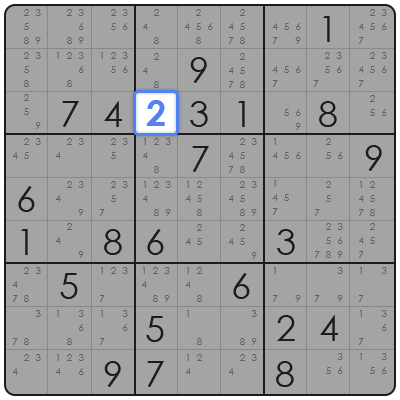
Becoming good at Sudoku fundamentally involves developing a systematic approach to logical deduction and pattern recognition within a structured 9×9 grid. At its core, Sudoku is a combinatorial number-placement puzzle that operates on three simple yet profound constraints: each row, each column, and each of the nine 3×3 subgrids must contain all of the digits from 1 to 9, without repetition. The problem it primarily solves in the realm of cognitive skill development is the cultivation of meticulous attention to detail, enhanced working memory, and the capacity for multi-layered logical inference, crucial attributes in any analytical field. From a cognitive skill development perspective, mastering Sudoku transcends mere entertainment; it functions as a highly accessible training ground for improving critical thinking and systematic problem-solving. It compels the solver to analyze interconnected data points and anticipate consequences, fostering a mental discipline that is transferable to complex real-world scenarios. This engagement with a finite, rule-bound system helps individuals to internalize logical frameworks, moving from intuitive guessing to structured, evidence-based decision-making. The significance of developing proficiency in Sudoku lies in its ability to refine the brain’s processing efficiency for sequential and conditional logic. It addresses the common challenge of feeling overwhelmed by seemingly complex problems by breaking them down into manageable, iterative steps. Through consistent practice and the adoption of specific strategies, individuals can transform initial frustrations into a rewarding sense of intellectual accomplishment, demonstrating a clear pathway from novice to expert in a tangible, measurable domain. This structured progression offers a template for skill acquisition in any complex field.
The Foundational Mechanics of Sudoku Mastery
Based on structural analysis, the path to becoming proficient in Sudoku hinges on a deep understanding of its core mechanics: the ‘rule of one’ across rows, columns, and 3×3 blocks. Each of these segments, referred to as ‘units,’ must contain every digit from 1 to 9 exactly once. The grid’s interconnectedness means that a decision in one cell ripples across its corresponding row, column, and block, creating a dynamic system of constraints that solvers exploit.
The underlying logic of Sudoku is purely deductive, relying on the elimination principle. Initially, solvers identify ‘naked singles’ – cells where only one possible digit can be placed due to existing numbers in its units. This is often followed by ‘hidden singles,’ where a specific digit can only fit into one particular cell within a unit, even if that cell has multiple other candidate digits. These fundamental techniques form the bedrock upon which more complex strategies are built.
From a framework perspective, the 9×9 grid is not just a collection of cells but a network of overlapping constraints. Visualizing these overlaps – where a row intersects a column, and both intersect a block – is critical. Effective mechanical engagement involves methodical scanning: first focusing on numbers that appear frequently, then checking rows, columns, and blocks for immediate eliminations or single placements. This systematic approach ensures no simple opportunities are missed before moving to more intricate deductions.
Systematic Approaches to Sudoku Puzzle Solving
Becoming good at Sudoku requires the adoption of systematic processes that move beyond basic singles. One crucial technique involves ‘candidate marking,’ where every possible digit for each empty cell is lightly noted. This practice transforms the problem from pure memory recall to a visual analysis of patterns and eliminations, significantly reducing cognitive load and increasing accuracy.
In practical application, after establishing all candidates, the next step involves identifying ‘naked subsets.’ These occur when a set of N candidates is confined to exactly N cells within a unit. For example, if two cells in a row exclusively share two candidates (e.g., 2 and 5), then 2 and 5 cannot exist anywhere else in that row. This direct answer syntax helps to prune the candidate list for other cells, progressively simplifying the puzzle.
Following naked subsets, ‘hidden subsets’ represent a slightly more advanced systematic approach. A hidden subset exists when N candidates are the *only* candidates for a set of N cells within a unit, even if those cells also contain other candidates. For instance, if digits 3 and 7 can *only* appear in two specific cells within a block (regardless of what other candidates those cells might have), then 3 and 7 must reside in those two cells, allowing all other candidates to be removed from them. Identifying these patterns requires meticulous cross-referencing and attention to detail, forming a core aspect of strategic improvement.
Advanced Strategies for Complex Sudoku Grids
From a framework perspective, navigating truly complex Sudoku grids demands mastery of advanced techniques that leverage intersecting constraints across multiple units. The ‘Pointing Pair’ or ‘Pointing Triple’ strategy exemplifies this, occurring when a candidate digit within a block is confined to a single row or column within that block. If this happens, that candidate digit cannot appear anywhere else in that specific row or column outside the block.
Conversely, the ‘Claiming Pair’ or ‘Claiming Triple’ operates on a similar principle but in reverse. If a candidate digit in a row or column is confined to a single 3×3 block, then that digit cannot exist in any other cell within that block outside of the designated row or column. These strategies require a higher level of grid awareness and the ability to visualize how candidates’ restrictions propagate across different units.
For even greater challenges, ‘X-Wing’ and ‘Swordfish’ patterns represent powerful multi-unit elimination tools. An ‘X-Wing’ occurs when a candidate digit appears in only two cells in two different rows, and these cells align in the same two columns. This allows for the elimination of that candidate from all other cells in those two columns. ‘Swordfish’ is an extension involving three rows/columns. While conceptually more abstract, identifying these structured patterns significantly accelerates solving advanced puzzles, moving the solver beyond cell-by-cell analysis to broader strategic sweeps of the grid.
Comparative Analysis: Sudoku vs. Other Logic Puzzles
In practical application, understanding how Sudoku compares to other logic puzzles illuminates its unique cognitive demands and why its mastery is a distinct skill set. Compared to Kakuro, which requires both logic and arithmetic to sum numbers in specific areas, Sudoku is purely about placement and exclusion, making its ‘cost’ of entry (basic rules) lower but its ‘complexity’ in advanced techniques comparable due to the interconnectedness of its units.
When placed against KenKen, another arithmetic and logic puzzle, Sudoku’s ‘efficiency’ lies in its consistent rule set across the entire grid, whereas KenKen introduces varied mathematical operations within ‘cages,’ demanding dynamic application of rules. Sudoku’s ‘frequency’ of practice benefits from its global ubiquity, offering a consistent logical challenge that reinforces pattern recognition without the added layer of arithmetic calculations.
Based on comparative analysis, while all these puzzles enhance logical reasoning, Sudoku uniquely focuses on non-numerical pattern identification and exclusion, making it an excellent tool for developing spatial reasoning and constraint satisfaction. Its lack of arithmetic allows for pure logical deduction to be the primary driver, a key differentiator that shapes the strategies needed to become truly proficient.
Avoiding Common Pitfalls in Your Sudoku Journey
One of the most frequent mistakes made when learning how to become good at Sudoku is ‘premature guessing.’ This common pitfall involves placing a digit without absolute certainty, often leading to cascading errors that are difficult to trace and correct. Professional advice dictates a strict adherence to logical deduction; if you cannot definitively place a number, it’s better to leave it as a candidate and move on, trusting that other deductions will eventually reveal its correct position. Patience and methodical scanning are paramount.
Another significant pitfall is the failure to systematically use ‘pencil marks’ or candidate notations. Many beginners attempt to solve puzzles entirely in their head, especially as the difficulty increases. This overwhelms working memory and leads to missed opportunities for advanced eliminations. Based on structural analysis, consistent and neat candidate marking is not a crutch but an essential analytical tool that transforms the grid into a visual database for pattern identification and complex strategy application, preventing unnecessary re-evaluation.
Finally, a common error is tunnel vision – focusing too intensely on a single cell or a small area of the grid. This prevents the solver from seeing broader patterns and interconnections crucial for unlocking harder puzzles. To avoid this, a professional approach involves constantly shifting focus, scanning the entire grid for ‘hot spots’ (cells with few candidates), and systematically checking all rows, columns, and blocks for new deductions after each successful number placement. This holistic grid analysis ensures that all available information is continuously leveraged.
Frequently Asked Questions About Sudoku Proficiency
Q: How long does it take to get good at Sudoku? A: The time varies, but consistent daily practice for a few weeks, focusing on understanding strategies, typically leads to noticeable improvement.
Q: Are there any specific apps or tools to help improve? A: Yes, many apps offer difficulty levels and hints, which can be useful for learning. Websites like Sudoku.com or the countless mobile apps provide excellent practice environments.
Q: What’s the best way to practice daily? A: Start with easier puzzles to warm up, then tackle a moderately difficult one. Focus on applying one new strategy you’re trying to learn each session.
Q: Can Sudoku improve memory? A: Yes, consistent Sudoku playing engages working memory and logical reasoning, which can contribute to overall cognitive health and potentially slow cognitive decline.
Q: What if I get stuck on a puzzle? A: Step away for a bit and return with fresh eyes. Alternatively, review your pencil marks carefully for mistakes or overlooked candidate eliminations.
In conclusion, becoming good at Sudoku is not merely about speed or luck, but a deliberate cultivation of logical reasoning, systematic analysis, and strategic pattern recognition. From a framework perspective, it involves mastering foundational rules, employing systematic candidate tracking, and progressively integrating advanced techniques. The long-term strategic value extends beyond puzzle-solving, enhancing critical cognitive skills transferable to diverse professional and personal challenges. As a forward-looking insight, the principles of constraint satisfaction and deductive logic inherent in Sudoku will remain invaluable tools for navigating an increasingly complex, data-driven world, reinforcing the notion that structured thinking is an evergreen asset.