

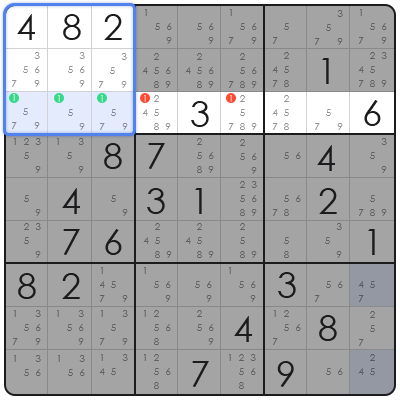
Defining how to establish a definite in Sudoku involves pinpointing a cell where only one specific digit can logically exist, irrespective of further deductions. This foundational method is critical for advanced Sudoku solving, providing clear, unambiguous steps forward even in the most complex grids. It underpins efficient puzzle resolution by transforming uncertainty into certainty. The significance of definites is profound, as they are crucial for breaking stalemates, providing critical anchors in complex puzzles, and transforming opaque grids into navigable logical landscapes. Without the ability to reliably identify these singular truths, solvers often resort to less efficient, more error-prone strategies. This technique is a cornerstone of systematic analytical reasoning. Primarily, establishing a definite addresses the common challenge of combinatorial explosion, where numerous possibilities obscure the singular correct path. By methodically eliminating impossible candidates, solvers can progress deterministically, avoiding the pitfalls of trial-and-error. From a framework perspective, this systematic reduction of possibilities is an industry standard in constraint satisfaction problems.
The Foundational Logic of Definites in Sudoku
Establishing a definite in Sudoku involves pinpointing a cell where only one number can logically reside, based on the elimination of all other possible candidates within its row, column, and 3×3 block. This principle is fundamental to the game’s inherent rules, which dictate that each number from 1-9 must appear exactly once in every row, column, and 3×3 subgrid. The logical certainty derived from these constraints forms the basis of a definite.
The core mechanics involve identifying either ‘naked singles’ or ‘hidden singles’. A naked single occurs when, after eliminating all other candidate numbers based on existing filled cells, only one number remains as a possibility for a specific empty cell. Conversely, a hidden single emerges when a particular number can only fit into one specific cell within a given row, column, or block, even if that cell initially has other candidates. Based on structural analysis, both represent an absolute certainty within the grid’s current state.
This certainty is not merely a high probability but a verifiable truth, making definites the most reliable form of deduction in Sudoku. The process leverages the finite nature of the 9×9 grid and its interlocking regions, ensuring that every identified definite contributes irrefutably to the puzzle’s eventual solution. From an analytical standpoint, understanding these foundational logical constructs is paramount for efficient problem-solving.
Systematically Identifying Definite Values
To systematically identify definite values, a solver must meticulously track candidate numbers for each empty cell and apply elimination rules across all three intersecting regions: row, column, and 3×3 block. This disciplined approach ensures that no potential definite is overlooked and that all deductions are soundly based on the puzzle’s current state. It’s a structured method for uncovering immediate certainties.
The process typically begins with ‘Candidate Marking’, where all possible numbers (1-9) for every empty cell are lightly noted. Following this, ‘Elimination through Direct Observation’ is applied, where any number already present in a cell’s row, column, or block is removed from that cell’s candidate list. This recursive elimination gradually reduces the potential numbers for each empty square, setting the stage for definite identification.
Once candidate lists are refined, ‘Identifying Naked Singles’ becomes straightforward: if a cell’s candidate list is reduced to a single number, that number is a definite. More subtly, ‘Identifying Hidden Singles’ requires scanning each row, column, and block to see if a particular number has only one possible placement within that region, even if that cell has other candidates. In practical application, discovering one definite often triggers a cascade of new eliminations, revealing further definites and accelerating the puzzle’s resolution. Iteration is key, as each new definite simplifies the grid further.
Definite Establishment Versus Related Sudoku Strategies
Definite establishment differentiates itself from other Sudoku strategies by its direct, irrefutable identification of a single correct digit for a cell, offering immediate progress compared to pattern-based or assumptive techniques. While many advanced strategies exist, definites are the purest form of deterministic deduction, requiring no speculation or backtracking.
When comparing definites (naked/hidden singles) with ‘Naked/Hidden Pairs/Triples’, definites are generally simpler, more frequent, and more immediately impactful. Pairs/Triples involve identifying sets of two or three candidates confined to two or three cells within a region, allowing for elimination of those candidates from other cells in that region. While also definitive, these techniques require recognizing more complex patterns and typically arise when simpler singles have been exhausted. From a framework perspective, definites offer unmatched efficiency and logical certainty at the entry level of advanced solving.
Further distinction arises when contrasting definites with highly advanced methods like ‘X-Wing’ or ‘Swordfish’. These techniques involve intricate cross-grid candidate eliminations spanning multiple rows and columns, demanding a deeper understanding of candidate interactions. Their complexity is significantly higher, their frequency of appearance lower, and their application is typically reserved for puzzles where direct definites and simple hidden/naked subsets no longer yield progress. Definites, by contrast, offer a cost-free, deterministic pathway, entirely avoiding the inefficiencies and potential errors associated with assumption-based methods or complex pattern recognition for basic breakthroughs.
Avoiding Common Mistakes in Definite Identification
Avoiding common mistakes in establishing definites hinges on disciplined candidate tracking, thorough cross-referencing, and resisting premature assumptions. Many errors stem from incomplete or rushed analysis, which can lead to invalid deductions and propagate incorrect numbers throughout the grid, making the puzzle unsolvable.
One frequent mistake is ‘Incomplete Candidate Lists’, where not all possible numbers are noted for empty cells or existing numbers are not fully removed from candidate lists. This often happens after placing a new number; forgetting to update all affected cells can lead to overlooking new definite opportunities or misidentifying candidates. The solution is rigorous re-evaluation: always re-assess candidate lists for all affected rows, columns, and blocks after each number placement.
Another common pitfall is ‘Overlooking Hidden Singles’, which requires a shift in perspective. Solvers often focus on what numbers can go into a cell, rather than which cells a specific number can go into within a region. To counteract this, systematically scan each row, column, and 3×3 block for numbers (1-9) that can only fit in one specific empty cell within that region. Finally, ‘Rushing or “Penciling In” Without Full Verification’ is detrimental. Only mark a number as definite once all eliminations confirm it; based on structural analysis, errors frequently arise from insufficient verification of candidate exclusions, leading to compounded mistakes.
Frequently Asked Questions on Establishing Sudoku Definites
Common inquiries regarding how to establish a definite in Sudoku often focus on initial steps, differentiating definite techniques, and optimizing the identification process for speed and accuracy.
Q: What is the very first step in finding definites? A: Begin by listing all possible candidates (1-9) for every empty cell, then eliminate numbers present in its row, column, or block. Q: Are definite values always ‘naked singles’? A: No, definite values also include ‘hidden singles’, where a number uniquely fits one specific cell within a row, column, or block, even if that cell initially has other candidates. Both are equally definite.
Q: How do definites speed up solving? A: They provide undeniable progress by revealing a single correct number for a cell, thereby significantly reducing the search space and simplifying subsequent deductions without resorting to guesswork. Q: Can complex puzzles lack definites initially? A: Yes, some advanced puzzles require applying more complex techniques, like pairs or triples, first to create opportunities for identifying new definite cells. Q: Is there software to help find definites? A: Many online Sudoku solvers and mobile applications offer ‘hint’ functions that can identify and explain how a definite cell’s value is derived, aiding in learning the process.
The long-term strategic value of mastering how to establish a definite in Sudoku lies in developing a rigorous, systematic approach to problem-solving that transcends the puzzle itself. This skill is paramount for both novice and expert solvers, providing the most reliable and efficient means to progress through a grid. It is not merely a technique but a cornerstone of logical deduction, refining analytical thinking and attention to detail. This methodical approach can be applied to diverse analytical challenges, reflecting its foundational importance in computational logic and artificial intelligence algorithms designed for constraint satisfaction problems, positioning it as an invaluable tool for any field requiring precise problem resolution.