

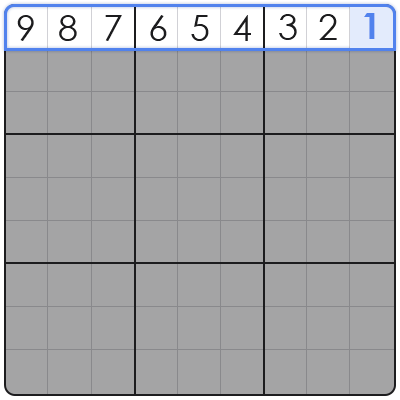
Working out Sudoku puzzles involves a systematic application of logical deduction to fill a 9×9 grid with digits, ensuring each column, row, and 3×3 subgrid contains all digits from 1 to 9 without repetition. This intellectual exercise, originating from ancient number placement puzzles, has evolved into a global phenomenon, captivating millions with its elegant simplicity and profound depth. From a cognitive training perspective, the primary challenge Sudoku addresses is the development of pattern recognition, critical thinking, and disciplined problem-solving under constraints. It offers a structured environment for improving focus and analytical skills, making it more than just a pastime but a valuable mental workout. In the domain of logic puzzles, Sudoku stands out due to its universal rules and the absence of arithmetic calculations, focusing purely on positional logic. This makes it accessible across language barriers and age groups, establishing its significance as a benchmark for deductive reasoning and constraint satisfaction problems.
Deconstructing Sudoku: Core Principles and Mechanics
The fundamental mechanics of working out a Sudoku puzzle hinge on three inviolable rules: each row must contain every digit from 1 to 9 exactly once, each column must contain every digit from 1 to 9 exactly once, and each of the nine 3×3 subgrids (often called ‘blocks’ or ‘regions’) must contain every digit from 1 to 9 exactly once. Based on structural analysis, these rules create a highly interdependent system where the placement of a single digit can have cascading implications across the entire grid.
Understanding the grid’s architecture is paramount. The 9×9 grid is composed of 81 cells, interconnected through rows, columns, and blocks. This tripartite constraint system is what makes the puzzle solvable through pure logic, eliminating the need for guesswork in expertly crafted puzzles. Identifying ‘naked singles’ or ‘hidden singles’ – cells where only one digit is possible – forms the bedrock of initial progress and often dictates the subsequent deduction chains.
From a framework perspective, the solver essentially navigates a landscape of possibilities, progressively eliminating incorrect options until only one valid digit remains for each empty cell. This iterative process often involves scanning for missing numbers in rows, columns, and blocks, then cross-referencing these possibilities to pinpoint unique cell assignments. The elegance lies in how complex solutions emerge from these simple, repetitive logical steps.
Systematic Approaches to Solving Sudoku Puzzles
Systematic approaches to working out Sudoku puzzles begin with establishing a firm mental map of known digits and actively searching for ‘singles’. This involves meticulously scanning each empty cell to see if its row, column, and 3×3 block already contain all but one possible digit, making that last digit the definite occupant of the cell. This initial phase, often called ‘scanning for naked singles’, is crucial for building a strong foundation.
Following the identification of singles, more advanced techniques become necessary. These include ‘naked pairs’ and ‘hidden pairs’, where two specific digits are the only possibilities for two specific cells within a row, column, or block. In practical application, once such a pair is identified, those two digits can be eliminated as possibilities from all other cells within that same row, column, or block, significantly simplifying the remaining options.
Further strategic moves involve ‘pointing pairs’ and ‘claiming pairs’, which leverage the interaction between blocks and rows/columns. A ‘pointing pair’ occurs when two possible locations for a digit within a block are confined to a single row or column, allowing that digit to be eliminated from other cells in that row or column outside the block. Similarly, a ‘claiming pair’ identifies a digit that can only reside in two cells within a row or column, both of which fall within the same block, thereby allowing elimination of that digit from other cells in that block outside of those two cells. Consistent application of these layered strategies is key to resolving more challenging puzzles.
Comparative Strategies: Sudoku vs. Related Logic Puzzles
When working out Sudoku puzzles, their methodology often invites comparison with other popular logic-based challenges like KenKen or Kakuro, yet distinct differences emerge across critical dimensions. From a structural analysis, Sudoku’s primary constraint is positional uniqueness within defined segments (rows, columns, blocks), offering a direct, non-arithmetic deductive path.
In terms of complexity, Sudoku typically ranks as medium among number puzzles. While its rules are simple, the combinatorial possibilities and the requirement for multi-layered deduction provide significant challenge without introducing mathematical operations like those found in KenKen or Kakuro. KenKen, for instance, adds arithmetic constraints (addition, subtraction, multiplication, division) within ‘cages’, significantly increasing its computational burden and often the initial learning curve, thus affecting efficiency for solvers purely focused on spatial logic.
From an efficiency perspective, working out a Sudoku puzzle relies purely on logical elimination, often making its solution paths more streamlined once the core techniques are mastered. Kakuro, which combines Sudoku-like grid filling with arithmetic sums for specific cells, introduces an additional layer of constraint satisfaction that can significantly increase the time and mental effort required. The ‘cost’ of error in Sudoku, while impactful, is often localized and identifiable, whereas in puzzles with arithmetic, a single miscalculation can invalidate large sections of the grid, demanding more extensive backtracking.
Navigating Common Sudoku Pitfalls and Expert Solutions
A frequent mistake when working out Sudoku puzzles is premature guessing, particularly in difficult scenarios. This pitfall, driven by impatience or a perceived deadlock, often leads to erroneous entries that propagate throughout the grid, making the puzzle unsolvable without extensive backtracking or starting over. Based on structural analysis, every valid Sudoku puzzle has a unique solution derivable through pure logic; if you find yourself guessing, it often indicates a missed deduction.
Another common error is failing to systematically scan for all types of singles (naked, hidden) or overlooking advanced techniques like ‘naked pairs’ or ‘pointing pairs’. Many beginners get stuck after exhausting simple singles, assuming the puzzle requires a guess, when in fact, a more complex but equally logical deduction is available. From a framework perspective, a comprehensive understanding and diligent application of all available strategies are crucial.
To avoid these pitfalls, experts recommend a disciplined, iterative approach. Always exhaust all simple deductions before moving to more complex ones. If stuck, re-scan the entire grid for new possibilities that might have emerged from recent number placements. Consider making ‘pencil marks’ (writing down all possible digits for a cell) to externalize the options, which often reveals hidden patterns or constraints. This methodical approach ensures that no logical step is overlooked, maintaining the integrity of the solution path.
Frequently Asked Questions About Sudoku Solving
Q: What is the best starting strategy for Sudoku?
A: The best starting strategy is to scan for ‘naked singles’ by checking each empty cell’s row, column, and block to see if only one digit is possible. This builds foundational deductions.
Q: Is guessing ever acceptable in Sudoku?
A: No, guessing is strictly prohibited in true Sudoku. Every puzzle can be solved through logical deduction. If you feel the need to guess, you’ve likely missed a logical step.
Q: How can I improve my Sudoku solving speed?
A: Consistent practice and mastery of advanced techniques like ‘naked pairs’ and ‘pointing pairs’ will significantly improve speed. Developing quick scanning habits also helps.
Q: Are all Sudoku puzzles solvable?
A: Yes, all valid Sudoku puzzles are designed to be solvable through pure logic, typically having only one unique solution when properly constructed.
Q: What does it mean if a Sudoku puzzle has multiple solutions?
A: If a Sudoku puzzle appears to have multiple solutions, it indicates a poorly constructed puzzle that violates the fundamental design principle of a unique logical path.
Working out Sudoku puzzles transcends mere entertainment, acting as a powerful tool for enhancing cognitive agility and logical reasoning. This structural analysis demonstrates that success is not merely about intuition but about the systematic application of well-defined principles and strategies. As industries increasingly value analytical thinking and problem-solving under constraints, the skills honed by mastering Sudoku remain a testament to human deductive capacity, offering a timeless and accessible avenue for mental development and strategic insight into the fundamental building blocks of logical systems.