

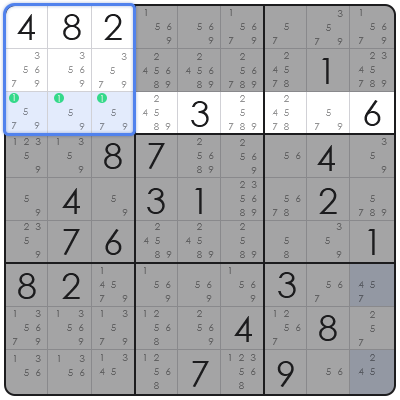
Sudoku techniques swordfish represent an advanced logical deduction strategy used to eliminate candidates from specific cells within a Sudoku grid. This powerful technique, often considered a step beyond simpler methods like X-Wings, significantly aids in solving complex Sudoku puzzles where direct elimination is no longer sufficient. For competitive solvers, mastering the Swordfish is crucial for shaving precious seconds off their solve times, while for casual players, it unlocks the ability to tackle more challenging grids and deepen their appreciation for the puzzle’s intricate logic. The Swordfish strategy is a prime example of how understanding the grid topology and cell constraints can lead to elegant solutions. By identifying a specific pattern across rows or columns, players can make significant progress in candidate elimination, often breaking through stubborn blocks in their solve path. Its effectiveness lies in its ability to identify candidates that *must* exist in certain positions, thereby allowing for the elimination of those candidates elsewhere. This article provides a comprehensive deep dive into the Sudoku Swordfish technique, breaking down its logic, offering a step-by-step guide to its application, comparing it with other strategies, and highlighting common pitfalls to avoid. Our aim is to equip you with the knowledge to confidently identify and apply this sophisticated tool in your Sudoku endeavors, fostering a true ‘Logic-First’ approach to puzzle mastery.
The Logic Behind Sudoku Techniques Swordfish
The Sudoku Swordfish technique operates on the principle of restricted candidate placement across multiple rows and columns. It is a bi-value cell constraint strategy that extends the logic of the X-Wing pattern. At its core, the Swordfish identifies a candidate number that is restricted to exactly two cells in three different rows, with those cells falling within three distinct columns. This structural necessity dictates that the candidate must appear in one of the two cells in each of these three rows. Crucially, if these cells are aligned across three columns, the candidate can then be eliminated from all other cells within those specific columns that do not lie within the identified rows.
Mathematically, the Swordfish leverages the fact that each row, column, and 3×3 box must contain the digits 1 through 9 exactly once. When a specific candidate number is found in only two possible cells within three separate rows, and these two cells in each row fall within only three columns in total, a pattern emerges. This pattern implies that the candidate *must* occupy one of these ‘swordfish’ cells within each of the three rows. Consequently, all other instances of that candidate in the three involved columns (but outside of the swordfish rows) can be definitively eliminated. The utility of this technique lies in its ability to perform these indirect eliminations, clearing candidates that are not directly linked to the cells being considered.
The ‘topology’ of the grid is key to recognizing this pattern. The Swordfish relies on the interplay between row and column constraints. Imagine a candidate, say ‘5’. If you find ‘5’ as a possibility in only two cells in Row 1 (e.g., R1C2 and R1C5), only two cells in Row 3 (e.g., R3C2 and R3C8), and only two cells in Row 7 (e.g., R7C5 and R7C8), and importantly, these candidate cells utilize only three columns (C2, C5, and C8), then you have identified a Swordfish for the candidate ‘5’. The ‘fish’ are formed by the candidate’s possible locations in the rows, and the ‘sword’ is the set of columns through which these possibilities are funneled.
Step-by-Step Implementation of Sudoku Swordfish
To effectively implement Sudoku techniques swordfish, begin by meticulously scanning the grid for candidates that appear in only two cells within a given row. This is the foundational step, akin to preparing for simpler strategies but on a larger scale. You are looking for a pattern of two possibilities across multiple rows. Utilizing clear pencil marks is essential here, as it allows for rapid identification of these bi-value cells.
Once you have identified multiple rows where a specific candidate appears in just two cells, examine the columns these cells occupy. The critical condition for a Swordfish is that the candidate must be confined to only *three* distinct columns across *three* different rows. For example, if Candidate ‘7’ is restricted to two cells in Row 2 (Columns 3 and 8), two cells in Row 5 (Columns 3 and 9), and two cells in Row 9 (Columns 8 and 9), you have a potential Swordfish. Here, the candidate ‘7’ is restricted to cells within Columns 3, 8, and 9 across these three rows.
With the Swordfish pattern identified for a candidate across three rows and three columns, the next step is candidate elimination. For the candidate ‘7’ in our example, you can now eliminate ‘7’ as a possibility from all *other* cells within Columns 3, 8, and 9 that are *not* part of the Swordfish rows (Rows 2, 5, and 9). This logical deduction allows you to prune the possibilities and often reveal the next steps in solving the puzzle.
Always double-check your identified pattern before proceeding with eliminations. Ensure that the candidate truly appears in only two cells in each of the three chosen rows and that these cells fall within only three columns. A single misidentified candidate or an incorrect cell can invalidate the entire application of the technique and lead to incorrect deductions.
Comparative Analysis of Sudoku Strategies
| Strategy | Difficulty Level | Frequency of Use | Logical Complexity |
|———————|——————|——————|——————–|
| Naked Pairs | Easy | Very High | Low |
| X-Wing | Medium | High | Medium |
| **Sudoku Swordfish**| **Hard** | **Medium-Low** | **High** |
| Jellyfish | Very Hard | Low | Very High |
The Naked Pair strategy involves identifying two cells within the same unit (row, column, or box) that contain only the same two candidates. This is a fundamental technique. The X-Wing, a precursor to the Swordfish, involves a candidate restricted to two cells in two rows, which then allows elimination in those two columns. The Swordfish, as detailed, expands this to three rows and three columns. The Jellyfish is a further extension, involving four rows and four columns. Each successive technique demands greater pattern recognition and a deeper understanding of candidate interactions.
Based on logic-chain analysis, the frequency of use for advanced techniques like Swordfish decreases as their complexity increases. While simpler strategies are applicable in nearly every puzzle, advanced patterns are reserved for more challenging grids. The logical complexity of the Swordfish lies in its multi-unit dependency and the indirect nature of its eliminations, requiring a solver to think several steps ahead and visualize the implications across different parts of the grid. This makes it a crucial tool for moving beyond basic Sudoku solving.
Common Pitfalls When Applying Sudoku Swordfish
One of the most common mistakes is misidentifying the candidate’s possible locations. Players might overlook a hidden candidate in a cell or incorrectly mark a cell as bi-value. This often stems from incomplete pencil marking or a lapse in concentration. To avoid this, maintain meticulous and consistent pencil marking throughout the solve, and always re-verify the candidate count in each relevant cell before declaring a Swordfish.
Another frequent error is incorrectly identifying the columns involved. The Swordfish requires the candidate to be confined to *exactly* three columns across the three rows. If the candidate appears in a fourth column in any of the Swordfish rows, it is not a valid Swordfish for that set of rows. Consequently, eliminations based on an incorrectly identified column set will be erroneous. Always count the unique columns involved and ensure it matches the number of rows (for a standard Swordfish).
Finally, applying the eliminations too broadly is a significant pitfall. Remember, eliminations are only valid in the columns *outside* of the Swordfish rows. Eliminating candidates from cells within the Swordfish rows themselves, or from columns not part of the identified pattern, is incorrect logic. Stick strictly to the rule: eliminate the candidate from all other cells in the shared columns that do not belong to the identified rows.
Frequently Asked Questions about Sudoku Swordfish
What is the primary purpose of the Sudoku Swordfish technique? The Sudoku Swordfish technique is an advanced candidate elimination strategy used to solve complex Sudoku puzzles by identifying a specific pattern across rows and columns, allowing for the removal of unwarranted candidates.
How is a Swordfish different from an X-Wing? A Swordfish is an extension of the X-Wing. While an X-Wing involves a candidate restricted to two cells in two rows and two columns, a Swordfish extends this to three rows and three columns, making it applicable to more complex grid configurations.
When should I start looking for Swordfish patterns? Look for Swordfish patterns when simpler techniques like singles, pairs, and X-Wings have been exhausted, and you are facing a puzzle that seems stuck. It is most effective on harder difficulty Sudoku puzzles.
What is the minimum number of rows and columns involved in a Swordfish? A standard Sudoku Swordfish involves exactly three rows and exactly three columns where a specific candidate is restricted to two cells within each of those rows, and those cells fall within the identified three columns.
Can the Swordfish technique be applied to numbers other than 2? Yes, the Swordfish logic applies to any candidate number (1-9) that exhibits the required pattern of restricted placement across the specified rows and columns.
Mastering Sudoku techniques swordfish is a significant milestone in a solver’s journey, moving beyond basic candidate elimination to a more sophisticated level of logical deduction. By understanding the structural necessities and the precise application of this technique, players can systematically break through challenging Sudoku puzzles. The ‘Logic-First’ approach, embodied by strategies like the Swordfish, emphasizes careful analysis and pattern recognition over trial-and-error, leading to more confident and efficient solving.