

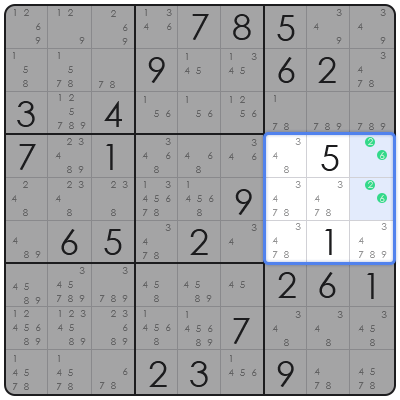
The sudoku swordfish strategy is an advanced logical deduction technique used to solve complex Sudoku puzzles by identifying and eliminating candidate numbers across multiple rows and columns. This powerful technique is invaluable for both competitive solvers aiming for speed and accuracy, and for dedicated hobbyists looking to conquer more challenging grids. Understanding the swordfish significantly elevates one’s ability to navigate intricate cell constraints and unlock seemingly impossible moves, moving beyond basic candidate elimination. While it shares foundational principles with other Sudoku strategies like the X-Wing, the swordfish applies these to a broader scope, involving three rows or columns, thereby offering a unique and potent method for grid analysis.
The Underlying Logic of the Sudoku Swordfish Strategy
The sudoku swordfish strategy operates on the principle of candidate reduction by identifying a specific pattern within the grid topology that forces a number to be placed in a limited set of cells, thereby allowing for eliminations elsewhere.
Mathematically, the swordfish is an extension of the X-Wing pattern. It requires a specific number (the ‘target candidate’) to appear in exactly two or three cells within each of a set of three rows (or columns). Crucially, the columns (or rows) containing these candidates must align such that the target candidate appears in only three distinct columns across these three rows. The logic dictates that if the target candidate is in any of these three rows, it *must* be in one of the identified columns for that row. Since the target candidate can only appear once per column, this constraint forces the candidate to be present in precisely those three columns across all three rows. Therefore, the target candidate can be eliminated from all other cells in those three specific columns.
The structural necessity of the swordfish lies in its ability to leverage the global constraints of the Sudoku grid. By focusing on a single candidate and its placement possibilities across multiple rows and columns simultaneously, it uncovers deductions that simpler methods, like Naked Pairs or Hidden Singles, cannot reveal. This makes it a cornerstone for tackling difficulty levels that require a deeper understanding of interlocking cell constraints.
Step-by-Step Implementation of the Sudoku Swordfish Strategy
To effectively implement the sudoku swordfish strategy, begin by scanning the grid for a candidate number that appears in precisely two or three cells in multiple rows. This candidate should ideally have a moderate number of remaining possibilities across the grid, making it a good subject for further analysis.
Identify three rows (let’s call them R1, R2, R3) where the target candidate appears in exactly two or three cells each. The critical step is to check if the columns containing these candidates form a specific alignment: the candidate must be confined to only three distinct columns across these three rows. For example, if in R1 the candidate is in C1 and C4, in R2 it’s in C4 and C7, and in R3 it’s in C1 and C7, this forms a swordfish pattern. Notice that the candidate appears in only three unique columns (C1, C4, C7) across these three rows.
Once the swordfish pattern is confirmed, perform candidate elimination. The target candidate *must* exist in one of the ‘swordfish’ columns (C1, C4, C7 in our example) within each of the identified rows (R1, R2, R3). Since each column can only contain the target candidate once, you can confidently eliminate this candidate from all other cells within these three columns (C1, C4, C7) that are *not* part of the swordfish pattern (i.e., not in R1, R2, or R3). This often opens up new single candidates or pairs, allowing the puzzle to progress.
Comparative Analysis of Sudoku Strategies
The following table compares the sudoku swordfish strategy with other common advanced Sudoku techniques.
| Strategy | Difficulty Level | Frequency of Use | Logical Complexity |
|—|—|—|—|
| Naked Pairs | Medium | High | Moderate |
| X-Wing | High | Medium | High |
| Sudoku Swordfish Strategy | Very High | Low to Medium | Very High |
| Jellyfish Strategy | Extremely High | Very Low | Extremely High |
The ‘Frequency of Use’ indicates how often these patterns are typically encountered in puzzles of increasing difficulty. The ‘Logical Complexity’ reflects the number of steps and interdependencies required to identify and apply the strategy. The swordfish, while less frequent than the X-Wing, offers a more powerful deduction when applicable due to its extended scope across three rows/columns.
Common Pitfalls and How to Avoid Them
A frequent mistake when applying the sudoku swordfish strategy is miscounting the number of possible locations for the target candidate in a row or column. Players might incorrectly identify a row as having only two or three candidates when it actually has more, thus invalidating the pattern. Always double-check your pencil marks to ensure the candidate count is exact for all involved rows and columns.
Another pitfall is incorrectly identifying the three essential columns. The pattern only works if the target candidate is restricted to *exactly* the same three columns across the three chosen rows. If the candidate appears in a fourth column in any of the three rows, it’s not a swordfish. Meticulously verify that the intersecting columns align perfectly and contain only those three candidates.
Finally, players may sometimes apply the eliminations incorrectly, removing the candidate from cells that are part of the swordfish pattern itself. Remember, the swordfish strategy’s power comes from eliminating the target candidate from cells *outside* the identified pattern within the swordfish columns. Focus on cells in the swordfish columns but *outside* the three swordfish rows.
Frequently Asked Questions about Sudoku Swordfish Strategy
What is a Sudoku Swordfish? A Sudoku swordfish is an advanced technique where a specific digit has only two or three possible candidates in each of three different rows, and these candidates fall within only three columns. This pattern allows for eliminations in those columns.
How is a Swordfish different from an X-Wing? An X-Wing involves a candidate appearing in exactly two cells in two different rows (and consequently, two columns), whereas a swordfish extends this to three rows and three columns. The core logic of candidate restriction across intersecting lines is similar.
When should I look for a Sudoku Swordfish? Look for a swordfish when you are stuck on a difficult puzzle and have exhausted simpler techniques. Focus on candidates with a moderate number of remaining possibilities scattered across several rows or columns.
Does a Swordfish guarantee a solution? No Sudoku strategy guarantees an immediate solution. However, successfully applying a swordfish often clears a significant number of candidates, revealing hidden singles or pairs that lead closer to solving the puzzle.
Is the Swordfish strategy only for experts? While it is an advanced technique, any player willing to meticulously track candidates and understand grid topology can learn and apply the swordfish strategy with practice.
Mastering the sudoku swordfish strategy is a significant milestone in a solver’s journey, demonstrating a deep comprehension of Sudoku’s logical structure. It is a testament to the power of systematic candidate elimination and pattern recognition beyond the basics. By understanding and applying the swordfish, players can break through challenging puzzles and enhance their overall logical deduction skills. Remember, the ‘Logic-First’ approach, even with advanced techniques like the swordfish, is the most reliable path to Sudoku mastery.