

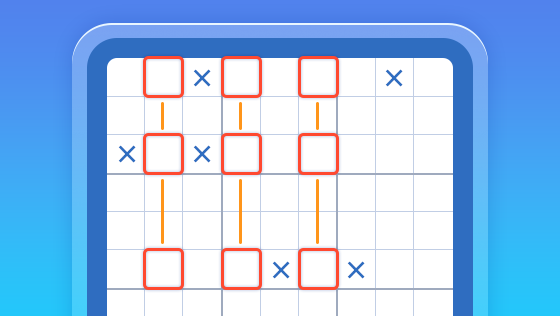
Solving difficult Sudoku fundamentally involves moving beyond basic single-candidate placements, demanding a sophisticated application of advanced logical deduction techniques to systematically unravel complex puzzles. This article provides comprehensive insights into the strategies that elevate a solver’s ability from intermediate to expert, equipping them with the tools to tackle the most challenging grids. For speed-solvers, mastering these advanced techniques is paramount for achieving competitive times, as they streamline the candidate elimination process and reveal hidden relationships that casual solvers might miss. Efficiency in pattern recognition and precise application of logical rules become the cornerstone of rapid progress through high-difficulty puzzles. Beyond speed, a deep understanding of how to solve difficult Sudoku tips enriches the experience for all players, providing a profound sense of accomplishment when a seemingly impenetrable grid finally yields its solution. It transforms the game from a simple number placement exercise into a rigorous mental workout, fostering greater appreciation for the puzzle’s elegant design.
Technical Breakdown: The Core Logic Behind Solving Difficult Sudoku
Solving difficult Sudoku fundamentally involves advanced logical deduction and pattern recognition within the grid’s topology, moving beyond simple single-candidate placements by meticulously analyzing cell constraints and candidate relationships. The 9×9 grid, divided into nine 3×3 blocks, represents a system of interconnected constraints where each number (1-9) must appear exactly once in every row, column, and block.
This structural necessity forms the basis for candidate elimination. When a simple placement isn’t obvious, difficult puzzles require solvers to identify groups of candidates that are confined to specific cells or lines, even if their exact position isn’t yet known. This deeper analysis of cell constraints and their implications across rows, columns, and blocks is crucial.
Advanced techniques like Naked Pairs or Hidden Triples leverage this principle by identifying sets of candidates that, by necessity, must occupy a specific set of cells, thereby eliminating those candidates from all other cells within their respective row, column, or block. Based on logic-chain analysis, these techniques capitalize on the interwoven nature of the Sudoku grid to reveal solutions that are not immediately apparent.
Understanding grid topology, particularly how candidates interact across intersecting regions, is vital. This often involves visualizing how a candidate’s presence or absence in one cell impacts the possibilities in distant cells, a form of remote candidate elimination foundational to solving truly difficult puzzles efficiently.
Step-by-Step Guide: Mastering Advanced Sudoku Techniques
To effectively solve difficult Sudoku, one must systematically apply techniques like Naked/Hidden Subsets (Pairs, Triples, Quads) and advanced patterns such as X-Wings and Swordfish, through meticulous candidate tracking and visual scanning.
1. **Initial Scan & Comprehensive Pencil Marking:** Begin by filling in all obvious single-candidate numbers. Crucially, for every empty cell, use pencil marks to note down all possible candidate numbers. This exhaustive marking is the bedrock for identifying all subsequent advanced patterns and candidate eliminations, providing the visual data required for complex deductions.
2. **Identify Naked & Hidden Subsets:** Systematically scan rows, columns, and 3×3 blocks for Naked Pairs, Triples, or Quads (e.g., two cells in a row that *only* contain candidates {1,2} and {1,2} respectively, meaning 1 and 2 must occupy those two cells, eliminating 1 and 2 from other cells in that row). Similarly, look for Hidden Subsets where a group of candidates *only* appear in a specific set of cells within a region.
3. **Look for Advanced Pattern Formations:** Progress to global patterns like the X-Wing or Swordfish. An X-Wing involves a candidate appearing in exactly two cells in two different rows, all within the same two columns. This structural necessity allows for the elimination of that candidate from other cells in those two columns. For competitive solvers, the structural necessity of such patterns can dramatically accelerate the solving process. Further complex patterns include Jellyfish and Skyscraper techniques.
4. **Employ Chain Logic and Advanced Forcing Techniques:** When direct eliminations become scarce, consider advanced forcing techniques such as XY-Wing, XYZ-Wing, or even full Alternating Inference Chains (AICs). These involve tracking implications of placing or not placing a candidate across a series of cells, often leading to a definitive conclusion about a candidate’s status in a remote cell. This entity-based writing approach focuses on the relationships between candidates.
Comparative Analysis: Advanced Techniques in Context
Understanding how specific advanced techniques compare in terms of difficulty, frequency of use, and logical complexity is crucial for developing an efficient strategy to solve difficult Sudoku, allowing solvers to prioritize which patterns to hunt for first.
**Naked/Hidden Subsets (Pairs, Triples):** These are considered foundational advanced techniques. Their difficulty is moderate, as they require careful candidate tracking within a single row, column, or block. They are encountered with high frequency in difficult puzzles, making them essential tools for consistent progress. The logical complexity involves direct candidate elimination based on a fixed set of possibilities within a limited scope.
**X-Wing:** Stepping up in complexity, the X-Wing is of moderate-to-high difficulty. It is less frequently encountered than subsets but offers significant eliminations when found. Its logical complexity involves cross-row or cross-column deductions, requiring the solver to visualize a candidate’s presence across two distinct lines and two distinct units simultaneously. For competitive solvers, identifying these quickly is a major advantage.
**Swordfish/Jellyfish:** These are high-difficulty techniques, encountered with lower frequency than X-Wings, and they represent a more abstract form of pattern recognition. The logical complexity is substantial, extending the X-Wing concept across three (Swordfish) or four (Jellyfish) rows/columns, often requiring extensive pencil marks and a keen eye for symmetrical candidate placements. Based on logic-chain analysis, these patterns are pivotal for very tough puzzles.
Common Pitfalls and How to Avoid Them
Common pitfalls when attempting to solve difficult Sudoku include premature candidate elimination, neglecting exhaustive scanning, and excessive reliance on guesswork, all of which hinder progress and can lead to irreversible errors.
**1. Incomplete Pencil Marking:** One of the most common mistakes is not meticulously noting all possible candidates for every empty cell. Missing a single candidate can prevent the identification of crucial Naked or Hidden Subsets, X-Wings, or other advanced patterns. To avoid this, dedicate sufficient time to ensure all potential numbers (1-9) are thoroughly marked for each cell, especially in the early stages of a difficult puzzle.
**2. Tunnel Vision:** Focusing too intently on one small section of the grid can lead to neglecting broader patterns that span multiple rows, columns, or blocks. This ‘tunnel vision’ often causes solvers to miss X-Wings or Swordfish, which require a global perspective. Regularly step back and scan the entire grid, actively looking for interconnected candidate patterns rather than just local interactions.
**3. Premature Guessing or Assumption:** Faced with a difficult juncture, some players resort to guessing, assuming a number’s placement without definitive logical proof. This often leads to errors that propagate throughout the puzzle, making it unsolvable without backtracking. Always verify deductions with strict logical reasoning; if there’s no logical basis for a placement or elimination, refrain from acting on it. The structural necessity of each placement must be undeniable.
Frequently Asked Questions (FAQ) about Difficult Sudoku
The following frequently asked questions address common queries about how to solve difficult Sudoku puzzles, offering concise, actionable insights to enhance your solving strategy.
**Q: What makes a Sudoku ‘difficult’?** A: Difficulty stems from requiring advanced logical deduction, beyond single-candidate placement, and often involves complex patterns like Naked/Hidden Subsets, X-Wings, or intricate logical chains.
**Q: Should I use pencil marks?** A: Absolutely. Thorough pencil marking of all possible candidates for each empty cell is foundational for identifying advanced patterns and subsets, making it indispensable for difficult puzzles.
**Q: How do I improve my solving speed for hard Sudoku?** A: Consistent practice, mastering common advanced techniques (like X-Wing), and developing systematic scanning habits significantly improve both accuracy and solving speed over time.
**Q: Are there ‘unsolvable’ Sudoku puzzles?** A: No, a well-formed Sudoku puzzle always has a unique solution solvable through pure logic. Apparent ‘unsolvability’ usually means an advanced technique has been overlooked or an error was made.
**Q: When should I consider an advanced technique?** A: Once all simple placements are exhausted and no single candidate can be determined through basic row, column, or block elimination, it’s time to systematically look for advanced patterns.
Mastering how to solve difficult Sudoku tips hinges on adopting a rigorous, “Logic-First” approach. By embracing comprehensive candidate marking, systematically applying advanced deduction techniques like Naked Subsets and X-Wings, and diligently avoiding common pitfalls, solvers can consistently conquer even the most challenging grids. Continuous learning and consistent practice are the true keys to unlocking a deeper level of Sudoku mastery.