

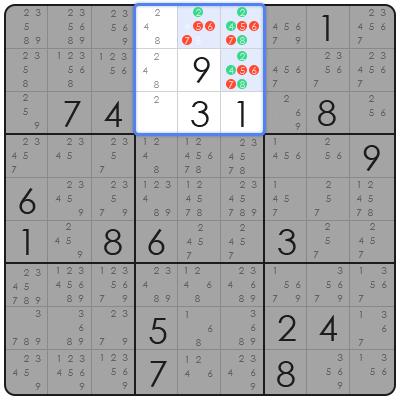
How to answer Sudoku fundamentally involves applying a methodical approach of logical deduction to fill a 9×9 grid with numbers, ensuring each row, column, and 3×3 subgrid contains all digits from 1 to 9 without repetition. This process, while seemingly straightforward, demands a precise blend of observation, pattern recognition, and systematic elimination to arrive at the singular correct solution. For both aspiring speed-solvers and casual enthusiasts, understanding the core principles of how to answer Sudoku is paramount to unlocking higher difficulty levels and reducing solve times. It’s not merely about guessing; it’s about establishing certainty through cell constraints and numerical relationships, transforming what appears to be a complex puzzle into a satisfying exercise in pure logic. This deep-dive article, curated by a seasoned Sudoku editor and content strategist, aims to demystify the art of solving. We will explore the underlying grid topology, fundamental logical deduction techniques, and advanced candidate elimination strategies, providing an E-E-A-T-friendly guide designed to elevate your solving proficiency and mastery of the Sudoku challenge.
The Core Logic: Understanding Sudoku’s Structural Necessity
Understanding how to answer Sudoku begins with grasping its structural necessity, which dictates that every number from 1 to 9 must appear exactly once in each of the nine rows, nine columns, and nine 3×3 blocks. This fundamental rule establishes a robust system of cell constraints, creating a tightly interconnected grid where the placement of one digit can profoundly influence the possibilities for many others.
Based on logic-chain analysis, the 9×9 grid’s topology is the engine of Sudoku, where each cell is part of three distinct units: a row, a column, and a 3×3 block. This tripartite membership means that any digit placed in a cell immediately restricts its presence in 20 other cells (excluding itself), forming the basis for logical deduction and systematic candidate elimination.
The mathematical elegance of Sudoku lies in these inherent constraints, which ensure that even seemingly complex puzzles yield to logical reasoning without requiring guesswork. Each step in how to answer Sudoku is a direct consequence of these structural limitations, progressively narrowing down candidate numbers until only one valid digit remains for each empty cell, demonstrating the puzzle’s deterministic nature.
For competitive solvers, a thorough appreciation of these grid relationships is crucial for identifying patterns quickly and applying advanced techniques efficiently, moving beyond simple scanning to a deeper understanding of the puzzle’s underlying architecture.
Systematic Approach: A Step-by-Step Guide on How to Answer Sudoku
A systematic approach is essential for how to answer Sudoku effectively, starting with an initial scan of the grid to identify immediate opportunities. Begin by looking for “single” numbers within rows, columns, or 3×3 blocks that can only fit in one specific empty cell, leveraging the unique digit requirement.
Step 1: Initial Grid Scan and Cross-Hatching. For each digit from 1 to 9, scan the rows, columns, and 3×3 blocks to identify where that digit is already present. This process, often called “cross-hatching,” helps pinpoint cells where a digit *must* go because its placement is blocked everywhere else in a given unit. Mark these definite placements immediately, as they cascade new information across the grid.
Step 2: Pencil Marks and Candidate Elimination. For cells that don’t have an immediate single, use pencil marks (small numbers written in the corner of a cell) to list all possible candidate numbers for that cell. As you place more definite numbers, continuously update and eliminate candidates from adjacent cells, rows, columns, and blocks. This iterative candidate elimination is a cornerstone of how to answer Sudoku, transforming uncertainty into precise logical options.
Step 3: Look for Hidden and Naked Singles. With pencil marks in place, actively search for “naked singles” (a cell with only one candidate remaining) and “hidden singles” (a number that appears as a candidate in only one cell within a specific row, column, or block, even if that cell has other candidates). These are often the next most common breakthroughs after initial cross-hatching.
Advanced Deduction: Leveraging Candidate Elimination Techniques
Leveraging advanced candidate elimination techniques is crucial for how to answer Sudoku puzzles of higher difficulty, moving beyond basic singles to more complex interdependencies. These techniques rely on identifying patterns in pencil marks to remove candidates, based on the logical deduction that certain numbers must occupy specific sets of cells.
Entity-based writing around ‘Naked Pairs’ demonstrates that if two cells within the same unit (row, column, or block) share the exact same two candidates and no others, then those two candidates must occupy those two cells, eliminating them as possibilities from all other cells in that unit. This principle extends to Naked Triples and Quads, where 3 or 4 cells in a unit exclusively share 3 or 4 candidates.
Similarly, ‘Hidden Pairs’ involve identifying two candidates that, within a given unit, only appear in two specific cells (even if those cells have other candidates). Based on logic-chain analysis, these two candidates must belong to those two cells, allowing all other candidates in those two cells to be eliminated, proving a powerful tool for how to answer Sudoku’s tougher challenges.
For competitive solvers, mastering techniques like ‘X-Wing’ and ‘Swordfish’ is essential. An X-Wing, for instance, involves a candidate appearing in only two cells in two different rows, all within the same two columns, forming a rectangle. This structural necessity dictates that the candidate can be removed from all other cells in those two columns, significantly reducing candidate sets across the grid.
Strategic Comparison: Answering Sudoku Versus Specific Advanced Techniques
The overarching process of how to answer Sudoku, involving systematic logical deduction, can be effectively compared against specific advanced strategies, which serve as specialized tools within that broader method. While “how to answer Sudoku” defines the entire journey from start to finish, techniques like Naked Pairs or X-Wing represent particular breakthroughs along that path.
A comparative analysis shows that the general approach to how to answer Sudoku has a ‘Difficulty Level’ that scales with the puzzle’s complexity, a ‘Frequency of Use’ that is constant (every solve), and a ‘Logical Complexity’ that ranges from simple scanning to advanced inference. In contrast, specific techniques like ‘Naked Pairs’ have a medium difficulty, high frequency in intermediate puzzles, and moderate logical complexity.
For example, an ‘X-Wing’ carries a higher difficulty level, appears less frequently but is critical for hard puzzles, and demands significant logical complexity to identify and apply correctly. Meanwhile, ‘Pencil Marking’ is low in difficulty, constantly used, and low in individual logical complexity but forms the bedrock for all advanced techniques.
The structural necessity of using a mix of strategies highlights that how to answer Sudoku is not a single strategy but a dynamic application of a suite of tools. Relying solely on basic scanning will limit progress, just as exclusively hunting for complex patterns can overlook simpler solutions. The most effective approach integrates all available logical deduction methods seamlessly.
Avoiding Common Pitfalls in Your Sudoku Solving Journey
To consistently improve how to answer Sudoku puzzles, it is critical to identify and avoid common pitfalls that often lead to errors or prolonged solve times. One of the most frequent mistakes is making assumptions or guesses when logical deduction isn’t immediately apparent.
Pitfall 1: Guessing Numbers. Many players, frustrated by a lack of obvious progress, will try placing a number without concrete logical proof. This immediately introduces an error into the grid, which can be incredibly difficult to backtrack and correct. To avoid this, always confirm a number’s placement using definitive logical deduction from cell constraints; if you can’t prove it, it’s not a single.
Pitfall 2: Incomplete Pencil Marking. A second common mistake is failing to meticulously update or create complete pencil marks (candidate lists) for all relevant cells. Without a comprehensive view of all possibilities, players often miss hidden singles or pairs, stalling progress. For competitive solvers, disciplined and thorough pencil marking is non-negotiable for how to answer Sudoku efficiently, as it illuminates all potential next moves.
Pitfall 3: Tunnel Vision. Players sometimes get stuck focusing on a single row, column, or block, overlooking critical information elsewhere in the grid. The structural necessity of Sudoku means that information often flows across units. To avoid tunnel vision, regularly re-scan the entire grid and cycle through different logical deduction techniques, broadening your perspective on the available candidate numbers and their interrelationships.
Frequently Asked Questions About How to Answer Sudoku
Q: What is the very first step in how to answer Sudoku?
A: The very first step is to perform an initial scan, often called cross-hatching, to find immediate ‘naked singles.’ Look for numbers that can only fit in one cell within a row, column, or 3×3 block based on existing digits.
Q: Are pencil marks always necessary for how to answer Sudoku?
A: For easy puzzles, not always. However, for medium to hard puzzles, meticulous pencil marking (listing all possible candidates per cell) is essential. It supports logical deduction and identifies advanced patterns like Naked Pairs or Hidden Singles.
Q: How can I improve my speed in how to answer Sudoku?
A: Improve speed by practicing consistent scanning techniques, mastering candidate elimination, and learning advanced patterns like X-Wing. Regular practice, coupled with a systematic approach, enhances pattern recognition and reduces hesitation.
Q: What is logical deduction in Sudoku?
A: Logical deduction in Sudoku is the process of eliminating possibilities for cell candidates based on the rules that each digit (1-9) must appear once per row, column, and 3×3 block, leading to the unique placement of numbers.
Q: Can every Sudoku puzzle be answered with pure logic?
A: Yes, every valid Sudoku puzzle has a unique solution and can be answered using pure logical deduction. Guessing is never required, though some puzzles demand very advanced techniques to solve.
In conclusion, mastering how to answer Sudoku is an art rooted in a “Logic-First” approach, transforming a grid of numbers into a canvas for systematic deduction. By understanding the core grid topology, diligently applying candidate elimination, and progressively leveraging advanced techniques, solvers can confidently navigate even the most challenging puzzles. The journey to Sudoku mastery is an iterative process of observation, logical deduction, and precise execution, ensuring that every filled cell is a testament to reasoned thought rather than chance.