

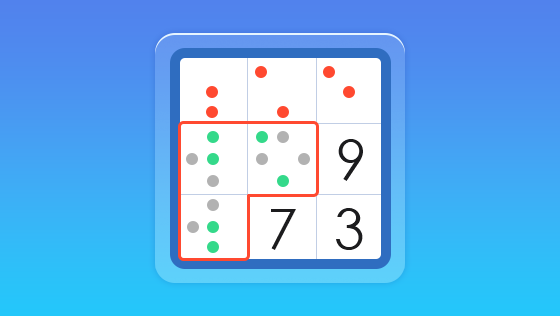
Learning how to do Sudoku involves systematic logical deduction to fill a 9×9 grid, ensuring each row, column, and 3×3 block contains all digits 1-9 without repetition. This mastery offers speed-solvers a competitive edge and casual players a deeply satisfying mental exercise. It sharpens cognitive functions, providing a rewarding sense of accomplishment. Based on logic-chain analysis, mastering how to do Sudoku transcends trial-and-error. It cultivates an analytical mindset essential for tackling puzzles, making it an invaluable skill for any logic enthusiast.
Technical Breakdown: The Core Logic of Sudoku
The core logic of how to do Sudoku is a constraint satisfaction problem. The 9×9 grid demands each of 81 cells adheres to three cardinal rules: no repeated digits in any row, column, or 3×3 subgrid.
This triple-constraint system creates complex interdependencies. Placing a digit influences other cells, driving logical deduction by eliminating impossible candidates until only one valid option remains, based on grid topology.
Each cell exists at a unique intersection of these three domains. Placing a digit removes it as a possibility from all other cells in its associated row, column, and block, reducing the overall candidate pool systematically.
Step-by-Step: Mastering Basic Sudoku Techniques
The first step in how to do Sudoku is scanning to identify single candidates: cells where only one digit can be placed based on existing numbers in its row, column, and 3×3 block.
Utilize pencil marks for empty cells, noting all possible candidate digits. This systematic candidate elimination is pivotal, especially for harder puzzles, revealing implicit relationships for advanced deductions.
Continuously re-evaluate the grid after placing new numbers. Each new digit reduces candidate options elsewhere, often creating new single candidates, triggering a chain reaction of logical deduction that progresses the puzzle.
Advanced Strategies: Unlocking Complex Sudokus
Unlocking complex Sudokus requires advanced techniques like Naked Pairs, Hidden Pairs, and X-Wing. These rely on observing patterns within pencil marks to strategically eliminate candidates, moving beyond basic scanning.
A Naked Pair involves two cells in the same row, column, or block containing only the exact same two candidate digits (e.g., {2,7} and {2,7}). These digits must occupy those cells, allowing elimination from other domain cells.
The X-Wing involves four cells forming a rectangle across two rows and two columns. If a candidate appears twice in each of two rows (or columns) and aligns, that digit can be eliminated from other cells in those columns (or rows). Based on logic-chain analysis, it’s powerful.
Comparative Analysis: Sudoku Techniques at a Glance
Comparing Sudoku techniques reveals distinct approaches to how to do Sudoku, varying in difficulty, frequency, and logical complexity, offering a diversified toolkit for all solvers.
Single Candidate elimination is frequent and simple. Naked/Hidden Pairs offer intermediate complexity, requiring systematic pencil marking. These are moderate in frequency and demand greater pattern recognition.
Advanced strategies like X-Wing and Swordfish are for expert puzzles. Their frequency is lower, but logical complexity is very high, demanding deep understanding of candidate relationships across cell constraints for efficient application. For competitive solvers, choosing the right tool is paramount.
Common Pitfalls: Avoiding Solver Traps
Successfully learning how to do Sudoku involves recognizing and avoiding common pitfalls that lead to errors, such as premature guessing or incomplete candidate management, which undermine logical deduction.
A major pitfall is *guessing*. Never place a digit without absolute logical certainty. An incorrect guess propagates errors, making the puzzle unsolvable without extensive, inefficient backtracking. Rely solely on pure logical deduction.
Another common mistake is *incomplete pencil marking*. Skipping detailed candidate notation, especially in harder puzzles, hinders identifying advanced patterns. Comprehensive pencil marks are your visual map of all cell constraints.
Sudoku Solver’s FAQ
How to do Sudoku more quickly? Practice regularly to build pattern recognition. Focus on scanning for single candidates first, then consistently apply pencil marks. Speed comes with familiarity and efficient deduction.
What are pencil marks in Sudoku? Pencil marks are small numbers written in a cell representing all possible valid candidates for that cell. They are crucial for identifying advanced patterns and systematic candidate elimination.
Can you guess in Sudoku? No, guessing is not how to do Sudoku. The puzzle is solvable purely through logical deduction. Any guess introduces the risk of error, requiring extensive backtracking or starting over.
What is the hardest Sudoku technique? Techniques like X-Wing, Swordfish, and various chain methods (e.g., XY-Wing) are among the hardest. They require complex logical deduction across multiple cells and often ‘what-if’ analysis.
Is Sudoku good for your brain? Yes, based on cognitive research, Sudoku sharpens logical reasoning, memory, and concentration. It’s a beneficial mental exercise that actively engages problem-solving circuits.
Ultimately, mastering how to do Sudoku embodies a ‘Logic-First’ approach, where every digit placement and candidate elimination is justified by the grid’s unbreakable rules. This systematic logical deduction, paired with diligent candidate management via pencil marks and understanding cell constraints, transforms the 9×9 matrix into a canvas for analytical thought. Precision and commitment to logic ensure consistent success for all solvers.