

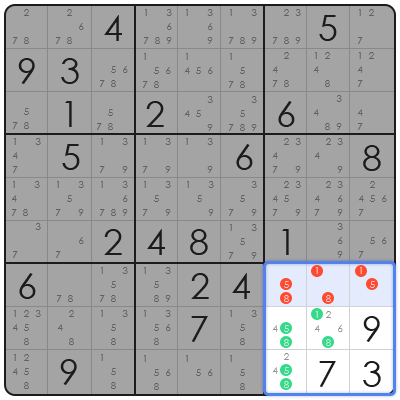
How to play Sudoku hard involves employing sophisticated logical deduction techniques beyond simple cross-hatching and single-candidate elimination to solve grids with fewer initial clues. For both speed-solvers aiming for competitive times and casual players seeking intellectual stimulation, understanding these advanced methods is paramount to conquering the most challenging puzzles. The journey from beginner to expert in Sudoku is marked by the acquisition and fluid application of an increasingly complex toolkit of strategies that exploit the inherent constraints of the 9×9 grid. Mastering how to play Sudoku hard requires a disciplined approach to candidate tracking, often utilizing “pencil marks” to document all possible numbers for each empty cell. This foundational practice enables the identification of patterns and relationships that are invisible at first glance, forming the basis for more intricate logical deductions. Without meticulously tracking potential numbers, solvers would quickly hit a wall, unable to proceed with the advanced techniques necessary for these tougher puzzles. The inherent structure of Sudoku, with its rows, columns, and 3×3 blocks, creates a rich environment for these advanced logical inferences. Hard Sudoku puzzles are designed to resist straightforward solutions, forcing players to look for implicit relationships and exclusions across multiple cells simultaneously. This article will delve into the specific techniques and mindset required to consistently solve even the most formidable hard Sudoku challenges.
Technical Breakdown: Deconstructing Hard Sudoku Logic
How to play Sudoku hard technically relies on the principle of constraint propagation and the systematic identification of unique candidate sets within the grid’s topology. Hard Sudoku puzzles exploit the interconnectedness of cells, often presenting scenarios where a number’s position cannot be determined by local inspection alone, but rather by analyzing its implications across multiple intersecting units (rows, columns, and blocks). The structural necessity of placing a number in a specific cell due to the impossibility of placing it anywhere else within its related units forms the core of advanced logical deduction.
The mathematical underpinning of how to play Sudoku hard involves finding “forced” placements through various forms of “candidate elimination.” This is not just about ruling out numbers already present; it extends to identifying situations where a candidate number, if placed elsewhere, would lead to a contradiction within the grid. This often manifests as Naked Pairs, Triples, or Quads within a unit, where a set of cells can only contain a specific set of numbers, thereby excluding those numbers as candidates from other cells in that same unit. Understanding these intricate dependencies is critical for progressing through the tougher stages of a hard Sudoku.
Based on logic-chain analysis, hard Sudoku techniques leverage the concept of “uniqueness” or “exclusivity.” For example, an X-Wing pattern identifies a number that, if it appears as a candidate in specific cells across two rows and two columns, implies its removal from other cells in those same rows and columns. This multi-cell, multi-unit analysis is what differentiates how to play Sudoku hard from easier variants, demanding a deeper understanding of the grid’s global constraints rather than just its local ones. For competitive solvers, the rapid identification of these complex patterns is a key skill.
Fundamental Techniques for How to Play Sudoku Hard
To effectively learn how to play Sudoku hard, players must first master comprehensive candidate elimination and the diligent use of pencil marks. These fundamental steps are non-negotiable for tackling puzzles that offer minimal obvious solutions, as they provide the visual data necessary to uncover more complex patterns. Every empty cell should be considered, and all possible numbers (candidates) that could fit within its row, column, and 3×3 block should be noted, typically in small numbers within the cell itself.
Beyond basic single-candidate elimination (where a cell has only one possible number), the next crucial step in how to play Sudoku hard involves “Hidden Singles” and “Naked Singles.” A Hidden Single occurs when a candidate number is the *only* possible number for a specific cell within its row, column, or block, even if that cell has other candidates listed. Conversely, a Naked Single is a cell that, after all other candidate eliminations, is left with only one possible number. Identifying these singles systematically is the bedrock upon which all harder techniques are built, establishing initial footholds in challenging grids.
Furthermore, “Pointing Pairs” and “Claiming Pairs” are essential early-stage techniques for how to play Sudoku hard. A Pointing Pair happens when a candidate number appears only in two or three cells within a block, and those cells are all confined to a single row or column. This “points” to the fact that the candidate cannot exist anywhere else in that row or column outside of that block. Claiming Pairs are the inverse, where a candidate appears only in two or three cells within a row or column, and those cells are all confined to a single block, thus “claiming” that candidate for that block and eliminating it from other cells in the block.
Advanced Strategies for How to Play Sudoku Hard
Successfully learning how to play Sudoku hard often necessitates the application of advanced strategies such as Naked/Hidden Pairs, Triples, and Quads. A Naked Pair, for instance, involves two cells in the same unit (row, column, or block) that share exactly the same two candidate numbers, and no other candidates. Once identified, these two numbers can be eliminated as candidates from all other cells within that same unit because they are “claimed” by the Naked Pair cells. This concept extends to three cells (Naked Triple) or four cells (Naked Quad) sharing three or four candidates respectively.
Hidden Pairs, Triples, and Quads are more elusive, but equally powerful, techniques for how to play Sudoku hard. A Hidden Pair consists of two numbers that appear as candidates in only two cells within a unit, and those two cells contain other candidates as well. The key insight is that because only these two cells can contain these two specific numbers, all other candidates within those two cells can be eliminated. This “unhides” the pair. Similarly, Hidden Triples involve three numbers that appear as candidates in only three cells within a unit, and Hidden Quads involve four numbers in four cells. Identifying these requires careful observation of candidate lists.
The “X-Wing” is another cornerstone technique for how to play Sudoku hard, leveraging grid topology to eliminate candidates across multiple units. An X-Wing occurs when a specific candidate number appears in exactly two cells in one row, and those two cells share the same two columns as the only candidates for that number in a *second* row. This forms a rectangular pattern. When such a pattern is found, the candidate can be eliminated from all other cells in those two columns, outside of the X-Wing rows. This powerful logical deduction highlights the interconnectedness of the entire 9×9 grid, making it an indispensable tool for competitive solvers.
Step-by-Step Guide: Implementing Advanced Solves
To implement advanced Sudoku solving techniques when learning how to play Sudoku hard, follow a structured, iterative process.
1. **Initial Scan and Pencil Marks:** Begin by filling in all obvious numbers. Then, for every empty cell, meticulously list all possible candidates (pencil marks) by eliminating numbers already present in its row, column, and 3×3 block. This creates your candidate grid, which is essential for all further steps. 2. **Identify Naked/Hidden Singles:** Systematically scan the entire grid for cells that have only one candidate (Naked Single) or cells where a candidate appears only once in its unit (Hidden Single). Fill in these numbers and update all affected pencil marks. Repeat until no more singles can be found. 3. **Search for Naked Pairs/Triples/Quads:** Carefully examine each row, column, and 3×3 block for sets of two, three, or four cells that exclusively share a corresponding set of two, three, or four candidates. When identified, eliminate these candidates from all other cells within that unit.
4. **Uncover Hidden Pairs/Triples/Quads:** This step requires more vigilance. For each unit, look for sets of two, three, or four candidates that appear *only* in a corresponding set of two, three, or four cells. Once found, eliminate all *other* candidates from those specific cells, effectively revealing the Hidden Set. 5. **Look for X-Wings and Other Advanced Patterns:** Progress to advanced patterns like X-Wings, Swordfish, and Jellyfish. These involve identifying a candidate that appears in specific, structured ways across multiple rows/columns, allowing for broad candidate elimination. This requires a keen eye for symmetrical or repeating candidate distributions. 6. **Iterate and Re-evaluate:** After applying any advanced technique, always return to Step 2. The elimination of candidates from one pattern often reveals new singles, pairs, or other patterns that were previously hidden. Hard Sudoku often requires multiple passes through these techniques, building a solution piece by piece through relentless logical deduction.
Comparative Analysis of Sudoku Difficulties
Understanding how to play Sudoku hard is best framed by comparing it with other difficulty levels, revealing the incremental complexity of logical deduction required.
| Strategy Type | Difficulty Level | Frequency of Use | Logical Complexity | | :— | :— | :— | :— | | Basic Cross-Hatching | Easy | High | Simple exclusion; local cell analysis | | Single Candidate Elim| Easy/Medium | High | Direct application of row/column/block constraints | | Naked/Hidden Singles | Medium | Very High | Identifying unique positions within units | | Naked/Hidden Pairs | Medium/Hard | High | Deductions based on shared candidate sets in units| | Pointing/Claiming Pairs| Medium/Hard | Medium | Inter-unit candidate restriction | | X-Wing | Hard | Medium | Cross-unit logical deduction via grid topology | | Swordfish/Jellyfish | Very Hard | Low | Advanced multi-unit candidate removal patterns |
This table illustrates that how to play Sudoku hard inherently demands moving beyond singular cell analysis to multi-cell and multi-unit pattern recognition. The logical complexity escalates significantly as the number of initial clues decreases, requiring a more systematic and layered approach to candidate elimination. For competitive solvers, the ability to rapidly transition between these strategies is key.
Common Pitfalls in Hard Sudoku Solving
When learning how to play Sudoku hard, players frequently encounter specific traps that can derail their progress and lead to frustration. Understanding these common pitfalls is the first step toward avoiding them.
One of the most prevalent mistakes is **incomplete pencil marking**. Many players, in their eagerness to solve, either skip pencil marking entirely or only mark obvious candidates, failing to document *all* possibilities for a cell. This invariably leads to missing crucial Hidden Singles, Pairs, or Triples, making advanced pattern recognition impossible. The solution is rigorous, methodical pencil marking for every empty cell, accepting that this initial setup is a necessary investment of time. The structural necessity of complete candidate lists cannot be overstated.
Another significant pitfall is **premature guessing**. Faced with a seemingly intractable section, some solvers resort to “what-if” scenarios without a logical basis, essentially guessing a number. While this might work accidentally on easier puzzles, it almost guarantees failure in hard Sudoku, creating a cascade of incorrect deductions. Based on logic-chain analysis, every placement in hard Sudoku must be provable through direct logical deduction. If no logical step presents itself, it means a subtler pattern has been overlooked, not that a guess is warranted. Revisit your pencil marks and scan for new patterns.
Finally, **failure to update candidate lists** after each successful number placement or significant candidate elimination is a common error. When a number is placed, it eliminates candidates from its row, column, and block. Similarly, an X-Wing or Naked Pair elimination changes numerous candidate lists. Neglecting to meticulously update these can lead to contradictory information, making subsequent deductions flawed. For competitive solvers, developing a habit of immediate and thorough updates is crucial for maintaining a clean and accurate solving environment.
Frequently Asked Questions about How to Play Sudoku Hard
How do you start a hard Sudoku puzzle? Begin by meticulously filling in all possible candidate numbers (pencil marks) for every empty cell. This initial setup is crucial for identifying the advanced logical patterns required to break through challenging sections.
What is the hardest Sudoku technique? Techniques like Swordfish, Jellyfish, and other forms of “chaining” or “coloring” are generally considered the hardest. They involve intricate multi-unit candidate relationships and often require backtracking or complex mental tracking.
Can AI solve hard Sudoku? Yes, AI algorithms can solve hard Sudoku with extreme efficiency. They leverage advanced search algorithms and constraint satisfaction problem-solving techniques, easily identifying complex logical deductions that challenge human players.
How many solutions does a hard Sudoku have? A properly constructed hard Sudoku, like any valid Sudoku puzzle, must have only one unique solution. Puzzles with multiple solutions are considered poorly designed and do not represent true Sudoku challenges.
Is there a trick to how to play Sudoku hard? There is no single “trick” but rather a mastery of advanced logical deduction techniques such as Naked/Hidden Pairs, X-Wings, and diligent candidate elimination. Consistent practice and patience are key.
Mastering how to play Sudoku hard is a testament to persistent logical deduction and meticulous attention to detail. The journey from recognizing basic singles to fluently identifying complex X-Wings and Hidden Triples transforms a casual player into a formidable solver. By adopting a “Logic-First” approach, where every cell’s value is determined by irrefutable reasoning rather than speculation, players can conquer even the most daunting 9×9 grids. Consistent practice, coupled with a deep understanding of grid topology and candidate constraints, is the definitive path to true Sudoku mastery. Embrace the challenge, refine your techniques, and let logic guide your way to becoming a Sudoku expert.