

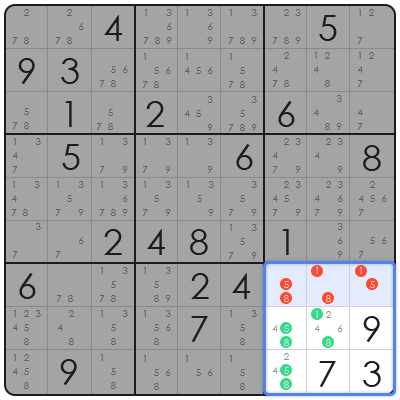
how to solve a sudoku puzzle fast refers to the systematic application of advanced logical deduction techniques and pattern recognition to complete a Sudoku grid significantly quicker than traditional trial-and-error methods. This approach transcends mere cell-by-cell filling, aiming instead for broad strategic insights that unlock multiple solutions simultaneously across the 9×9 grid. From a framework perspective, mastering rapid Sudoku resolution is highly significant in the field of Cognitive Strategy & Logic Games, as it exemplifies optimized problem-solving under constraints. It shifts the focus from simple computation to efficient algorithm selection and execution within the human mind, showcasing the brain’s capacity for complex logical inference. The primary problem it solves in the current landscape of logic puzzles is the inefficiency and frustration associated with brute-force methods or getting ‘stuck’ on harder puzzles. By providing a structured, methodical pathway, fast Sudoku solving transforms a potentially tedious task into an engaging exercise in deductive reasoning, dramatically reducing completion times and enhancing the solver’s enjoyment.
The Core Mechanics of Rapid Sudoku Resolution
The core mechanics of rapid Sudoku resolution involve advanced logical deduction techniques and pattern recognition that allow solvers to identify multiple cell values or candidate eliminations efficiently. Based on structural analysis, these mechanics leverage the inherent constraints of the 9×9 grid, where each row, column, and 3×3 block must contain digits 1-9 exactly once. Key techniques include ‘Naked Singles’ and ‘Hidden Singles’, which are foundational, moving to more complex ‘Naked Pairs/Triples/Quadruples’ and ‘Hidden Pairs/Triples/Quadruples’.
In practical application, these mechanics rely heavily on meticulous candidate tracking—often through pencil marking—to visualize potential numbers for each empty cell. Advanced techniques such as ‘Pointing Pairs/Triples’ (where candidates are restricted to a single row or column within a block, allowing their elimination from the rest of that row/column) and ‘Box-Line Reduction’ (the inverse of pointing) are crucial. These methods systematically reduce the pool of possibilities, guiding the solver toward the correct digits with minimal guesswork.
Further components for accelerated solving include ‘X-Wing’ and ‘Swordfish’ patterns, which are global strategies that identify candidate numbers that can only exist in specific cells across multiple rows/columns. From a structural analysis, recognizing these intricate patterns requires an ability to see beyond local constraints and understand the interconnectedness of the entire grid. The efficiency gain from these techniques is substantial, often unlocking several difficult deductions simultaneously.
Implementing Fast Sudoku Solving Strategies
Implementing fast Sudoku solving strategies requires a systematic approach to identifying and applying specific logical rules, moving from the simplest deductions to the most complex in an iterative process. This method ensures that no obvious opportunities are missed and that the solver builds a solid foundation of known values before tackling more intricate patterns.
1. **Initial Grid Scan & Basic Deductions:** Begin by scanning the grid for ‘Naked Singles’—cells where only one candidate number is possible based on existing numbers in its row, column, and block. Concurrently, look for ‘Hidden Singles’—where a number can only go into one specific cell within a row, column, or block, even if that cell has multiple candidates. This initial pass often fills 10-20% of the grid quickly.
2. **Pencil Marking Candidates:** For all remaining empty cells, meticulously fill in all possible candidate numbers. This exhaustive marking is crucial; it visualizes the entire solution space and is the bedrock for identifying advanced patterns. Maintain neatness and consistency in your pencil marks to avoid errors and confusion.
3. **Identify & Eliminate Advanced Patterns:** Based on your candidate marks, systematically search for ‘Naked/Hidden Pairs’, ‘Triples’, and ‘Quadruples’ within rows, columns, and blocks. Progress to ‘Pointing Pairs/Triples’ and ‘Box-Line Reduction’. For highly challenging puzzles, look for ‘X-Wing’, ‘Swordfish’, and even ‘Jellyfish’ patterns, which leverage candidate eliminations across multiple rows or columns. Each successful identification will remove candidates, simplifying other cells.
4. **Iterate and Re-evaluate:** After applying any deduction, re-scan the grid for new ‘Naked/Hidden Singles’ that might have emerged due to candidate eliminations. This iterative process is vital; solving one part of the puzzle often reveals new opportunities elsewhere. If stuck, review your work for errors or consider a ‘forcing chain’ strategy, though this is generally a last resort due to its complexity and potential for error.
Comparative Analysis: Fast Sudoku vs. Traditional Methods
Fast Sudoku solving techniques distinguish themselves from traditional methods primarily through their emphasis on proactive pattern recognition and advanced logical inference rather than brute-force trial and error. This fundamental difference leads to significant discrepancies across several key dimensions, as evidenced by expert competitive solvers in Cognitive Strategy & Logic Games.
| Method | Complexity (Learning Curve) | Efficiency (Time to Solve) | Error Rate (Potential) | Time Investment (Per Puzzle) |
|:—————————|:—————————-|:—————————|:———————–|:—————————–|
| Brute Force / Guessing | Very Low | Very Low | High | Very High |
| Basic Deduction (Singles) | Low-Medium | Medium | Medium | Medium-High |
| Advanced Deduction (Fast) | High | High | Low-Medium | Low-Medium |
This comparative analysis highlights that while brute force or simple deduction methods may seem less complex to initially grasp, their efficiency is severely limited, and their error rates are prohibitively high, especially on difficult puzzles. Conversely, investing time in learning advanced deduction techniques for how to solve a sudoku puzzle fast, despite a higher initial complexity, yields superior efficiency and significantly lower error rates in the long run. From a framework perspective, this is a clear trade-off between upfront learning investment and sustained operational efficiency.
Avoiding Common Obstacles in Accelerated Sudoku Solving
Common obstacles in accelerated Sudoku solving often stem from overlooking fundamental patterns or misapplying advanced techniques, which can be mitigated with structured practice and focused self-correction. One frequent mistake is ‘tunnel vision’, where solvers focus too intensely on a single area of the grid, missing easier deductions elsewhere. The solution is a disciplined, grid-wide scanning habit, constantly moving your eyes across rows, columns, and blocks to spot new singles or pairs.
Another pitfall is ‘messy or incomplete candidate marking’. In practical application, haphazard pencil marks lead to confusion, incorrect eliminations, and ultimately, errors. Professional advice is to develop a consistent, legible system for marking candidates, perhaps using smaller numbers or a specific corner for each digit. Regularly review and erase candidates as numbers are placed, keeping the visual field as clean as possible.
Finally, getting ‘stuck’ without identifying an advanced pattern is a common barrier to fast solving. This often indicates a gap in knowledge or a failure to connect disparate pieces of information. The solution involves systematically re-checking all rows, columns, and blocks for hidden or naked sets, and for pointing pairs/triples. If still stuck, deliberately look for X-Wings or Swordfish, as these global patterns are often the key to breaking highly resistant puzzles. Consistent practice with a variety of puzzle difficulties is essential for developing this pattern recognition.
Frequently Asked Questions on Fast Sudoku Techniques
**Q: What is the fastest method for solving Sudoku?**A: The fastest method combines a systematic approach to basic deductions (singles) with advanced pattern recognition (naked/hidden sets, pointing pairs, X-Wings) to efficiently eliminate candidates and place numbers. Consistent practice is key.
**Q: How long does it take to learn advanced Sudoku strategies?**A: Learning foundational advanced strategies can take a few weeks of dedicated practice. Mastering complex patterns like X-Wings or Swordfish and integrating them fluidly may require several months, depending on individual cognitive aptitude and commitment.
**Q: Can fast Sudoku solving improve cognitive function?**A: Yes, regularly engaging in fast Sudoku solving can enhance logical reasoning, pattern recognition, working memory, and focus, making it a beneficial exercise for overall cognitive health.
**Q: Are there specific tools that aid fast Sudoku solving?**A: While mental dexterity is paramount, tools like online Sudoku solvers with candidate marking features or physical paper with ample space for pencil marks can aid learning and practice. However, reliance on automated solvers for answers should be minimized.
In conclusion, mastering how to solve a sudoku puzzle fast is not merely about completing a puzzle quickly; it represents a sophisticated application of cognitive strategy and logical deduction that has significant implications for problem-solving across various domains. By moving beyond rudimentary methods to embrace advanced pattern recognition and systematic elimination techniques, solvers can transform a challenging task into an efficient and rewarding intellectual exercise. The long-term strategic value lies in the development of enhanced analytical skills, improved focus, and a structured approach to complex problems, qualities that are highly transferable and invaluable in the Cognitive Strategy & Logic Games industry and beyond. Based on structural analysis, the future of optimized problem-solving points towards an increasing integration of such structured, entity-based reasoning to tackle intricate challenges.