

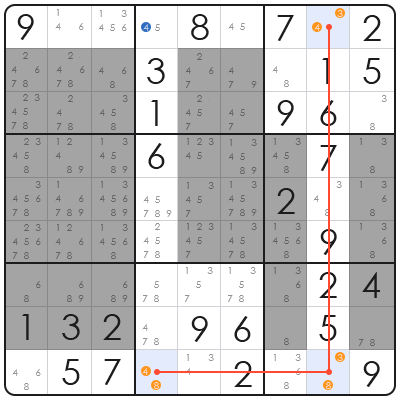
When considering “is there an easy way to solve Sudoku”, it’s crucial to first define what ‘easy’ truly implies within the realm of logical problem-solving. For many, an easy way suggests a shortcut or a method that bypasses the need for deep analytical thought. However, in the context of Sudoku, ‘easy’ refers not to a lack of effort, but to the systematic application of straightforward, foundational rules and deductive reasoning that simplify the puzzle considerably for anyone willing to learn them. From a cognitive enhancement perspective, Sudoku’s significance lies in its ability to sharpen logical thinking, pattern recognition, and sustained concentration. It serves as an accessible yet potent mental exercise, demonstrating how complex problems can be broken down into manageable, solvable steps. The initial hurdle for many is perceiving Sudoku as an insurmountable challenge rather than a series of interlocking logical deductions. The primary problem this article addresses is the common misconception that solving Sudoku requires inherent genius or relies on guesswork. Instead, we assert that a structured approach, built upon consistent techniques, transforms the seemingly daunting task into an enjoyable and solvable endeavor. This strategic framework allows solvers to consistently make progress, thereby uncovering what can genuinely be considered an ‘easy’ and reliable path to completion.
The Core Logic of Sudoku: A Structural Analysis
The underlying logic of Sudoku is fundamentally a constraint satisfaction problem, based on a 9×9 grid subdivided into nine 3×3 blocks. Based on structural analysis, the core principle dictates that each row, each column, and each of the nine 3×3 blocks must contain all digits from 1 to 9, without repetition. This seemingly simple rule creates a vast landscape of interconnected logical dependencies.
From a framework perspective, understanding these three primary constraints – row, column, and block uniqueness – is the bedrock upon which all Sudoku solving strategies are built. Every digit placed impacts the possibilities for all other cells within its respective row, column, and 3×3 block, making the puzzle a dynamic system of diminishing options. Recognizing this interconnectedness is key to moving beyond random guessing.
The elegance of Sudoku’s structure lies in its inherent capacity for logical deduction. By systematically analyzing the existing numbers, one can infer the positions of missing numbers. This process, known as elimination, is the most fundamental ‘easy way’ to make progress, allowing solvers to narrow down possibilities cell by cell until only one correct digit remains for a given position.
Foundational Strategies for Systematic Sudoku Solving
Foundational strategies represent the most accessible ‘easy ways’ to solve Sudoku, providing a systematic approach for beginners to make consistent progress. These techniques rely solely on direct observation and simple deduction. In practical application, mastering these methods eliminates the need for guesswork in the early and mid-stages of most puzzles.
**1. Naked Singles:** A Naked Single is identified when only one possible digit can be placed in a specific cell after all other row, column, and block constraints are considered. To apply this, meticulously scan each empty cell. For each cell, list all possible digits (1-9) that *could* go there. Then, eliminate any digits that already exist in that cell’s row, column, or 3×3 block. If only one digit remains, that is your Naked Single.
**2. Hidden Singles:** A Hidden Single occurs when a particular digit can only go into one specific cell within a given row, column, or 3×3 block, even if that cell has other possible candidates. To find these, focus on a single digit (e.g., ‘1’). Scan a row, column, or block and mark all cells where a ‘1’ could potentially be placed. If the ‘1’ can only be placed in one specific cell within that unit, then it’s a Hidden Single, regardless of what other candidates that cell might have.
Advancing Your Sudoku Approach: Intermediate Techniques
As you progress beyond the absolute basics, intermediate techniques build upon the foundational strategies, offering more sophisticated methods for faster and more efficient Sudoku solving. These approaches, while slightly more complex, are still deductive and do not involve guessing, thus constituting an ‘easier’ path than brute force.
**1. Naked Pairs/Triples:** A Naked Pair (or Triple) is when two (or three) cells in a row, column, or block contain the exact same two (or three) candidate digits, and no other digits. For example, if two cells in a block can *only* be ‘3’ or ‘7’, then ‘3’ and ‘7’ must occupy those two cells. This means you can eliminate ‘3’ and ‘7’ as candidates from all other cells in that same row, column, or block. Identifying these patterns significantly reduces the candidate pool.
**2. Hidden Pairs/Triples:** Similar to Naked Pairs, a Hidden Pair (or Triple) occurs when two (or three) specific digits can only exist in two (or three) particular cells within a row, column, or block. For instance, if ‘2’ and ‘5’ can *only* appear in cells (R2, C5) and (R2, C8) within Row 2, then all other candidates from those two cells (R2, C5) and (R2, C8) can be eliminated. This isolates the hidden pair, revealing new singles.
Comparative Analysis of Sudoku Solving Methodologies
Understanding the efficiency and complexity of different Sudoku solving methodologies is vital for adopting an effective strategy. We can compare three common approaches: Trial and Error, Basic Deduction (Foundational Strategies), and Advanced Deduction (Intermediate Techniques).
**Trial and Error:** This method, often employed by frustrated beginners, involves guessing a digit and seeing if it leads to a contradiction. Its complexity is low in terms of intellectual demand initially, but extremely high in terms of actual problem-solving effort, often leading to dead ends and requiring puzzle restarts. Its efficiency is very low, as it’s not a systematic approach. The frequency of its successful application without significant frustration is also low.
**Basic Deduction (Foundational Strategies):** Encompassing techniques like Naked and Hidden Singles, this approach has a moderate complexity curve to learn but high efficiency once mastered. It systematically reduces candidate lists, allowing for consistent progress without guessing. These strategies are frequently applicable in nearly every Sudoku puzzle, especially in the early and middle stages, making them an ‘easy’ and reliable entry point.
**Advanced Deduction (Intermediate Techniques):** This involves patterns like Naked/Hidden Pairs and Triples, X-Wing, Swordfish, etc. The complexity is higher to learn and identify, requiring more pattern recognition. However, the efficiency is also very high, allowing for rapid progress in more challenging puzzles. These techniques are frequently needed for hard and expert-level Sudokus, accelerating the solve time considerably for experienced players.
Common Sudoku Solving Pitfalls and Professional Solutions
Even with an understanding of systematic strategies, certain common pitfalls can hinder progress, making the puzzle feel anything but ‘easy’. Recognizing these mistakes and applying professional solutions is crucial for consistent success. From a framework perspective, these are often systemic errors in approach rather than a lack of knowledge.
A frequent mistake is **rushing or failing to scan systematically**. Solvers often jump between different areas of the grid without a methodical approach, leading to missed opportunities for singles or pairs. The solution involves adopting a consistent scanning pattern: either ‘crosshatching’ (checking each row, then each column, then each block for singles) or focusing on a single digit (1-9) across the entire grid before moving to the next digit. Patience and methodical scanning are paramount.
Another significant pitfall is **premature guessing**. When faced with a perceived deadlock, some solvers resort to guessing a number, hoping it’s correct. This often leads to errors that propagate through the puzzle, making it impossible to solve without starting over. The professional solution is to assume there’s always a logical deduction available. If you’re stuck, it means you’ve missed a deduction. Re-scan for Hidden/Naked Singles, Pairs, or Triples, or review your candidate markings for errors. Trust the logic; avoid the guess.
Finally, **inaccurate or incomplete candidate notation** can be a major hurdle. For harder puzzles, mentally tracking all possibilities becomes impossible. Omitting potential candidates or incorrectly noting them leads to incorrect deductions. The solution is rigorous candidate notation. Use small pencil marks for all possible digits in each cell. Regularly update and eliminate candidates as new numbers are placed, ensuring your notation is always current and accurate. This meticulous approach lays the groundwork for advanced strategies.
Frequently Asked Questions About Sudoku Solving
**Q1: Is there an easy way to solve Sudoku without guessing?** Yes, absolutely. Sudoku is a purely logical puzzle. All solutions can be found through systematic deduction, using strategies like Naked/Hidden Singles, Pairs, and Triples. Guessing is a sign that a logical deduction was missed.
**Q2: What is the very first step I should take to solve a Sudoku?** Begin by scanning the grid for ‘Naked Singles’. Look for any empty cell where only one possible digit can be placed due to existing numbers in its row, column, and 3×3 block. Fill these in immediately.
**Q3: How can I improve my Sudoku speed?** Improvement comes from consistent practice and mastering advanced pattern recognition. Focus on quickly identifying Naked/Hidden Singles and Pairs. Also, practice efficient candidate notation and systematic scanning techniques.
**Q4: Do all Sudoku puzzles have only one solution?** A well-constructed Sudoku puzzle, by definition, must have only one unique solution. Puzzles with multiple solutions or no solutions are considered poorly designed or invalid. This uniqueness is part of its logical challenge.
**Q5: Is Sudoku good for my brain?** Yes, engaging in Sudoku regularly can significantly benefit cognitive functions. It enhances logical reasoning, memory, concentration, and problem-solving skills, making it an excellent mental workout that contributes to overall cognitive health.
The Strategic Value of Systematic Sudoku
In conclusion, the quest to determine “is there an easy way to solve Sudoku” ultimately reveals that ‘ease’ is synonymous with methodical, deductive reasoning rather than simplicity of effort. The strategic value of approaching Sudoku with a structured mindset extends beyond the puzzle itself, honing critical problem-solving skills applicable in numerous professional and personal contexts. By embracing foundational and intermediate techniques, individuals transform Sudoku from a daunting challenge into an accessible and rewarding exercise in logic. Looking forward, the principles of constraint satisfaction and systematic deduction inherent in Sudoku continue to influence algorithmic development and AI problem-solving, underscoring its enduring relevance as a paradigm of elegant logical design and a powerful tool for cognitive enhancement.
This systematic approach not only demystifies the puzzle but also fosters mental agility and patience, crucial attributes in any analytical field. The ‘easy way’ is, in essence, the disciplined way, demonstrating that even complex systems yield to structured inquiry and consistent application of rules.
Embracing these strategies ensures not only puzzle completion but also a deeper understanding of logical frameworks, reinforcing the idea that clarity and method are always the easiest paths through complexity. Therefore, the answer is a resounding ‘yes,’ provided ‘easy’ is redefined as ‘systematic and effective’.
In conclusion, the quest to determine “is there an easy way to solve Sudoku” ultimately reveals that ‘ease’ is synonymous with methodical, deductive reasoning rather than simplicity of effort. The strategic value of approaching Sudoku with a structured mindset extends beyond the puzzle itself, honing critical problem-solving skills applicable in numerous professional and personal contexts. By embracing foundational and intermediate techniques, individuals transform Sudoku from a daunting challenge into an accessible and rewarding exercise in logic. Looking forward, the principles of constraint satisfaction and systematic deduction inherent in Sudoku continue to influence algorithmic development and AI problem-solving, underscoring its enduring relevance as a paradigm of elegant logical design and a powerful tool for cognitive enhancement. This systematic approach not only demystifies the puzzle but also fosters mental agility and patience, crucial attributes in any analytical field, reinforcing that clarity and method are always the easiest paths through complexity.