

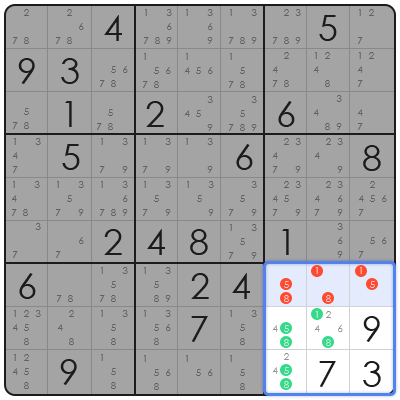
Sudoku arrangement refers to the systematic process of placing digits 1 through 9 into a 9×9 grid, subdivided into 3×3 subgrids, ensuring each digit appears exactly once in every row, column, and 3×3 subgrid. From a framework perspective, this seemingly simple puzzle embodies complex principles of constraint satisfaction and logical deduction, serving as an accessible model for understanding algorithmic efficiency. The primary problem it addresses in a broader cognitive landscape is the development of systematic problem-solving skills and pattern recognition under stringent constraints, crucial for various analytical tasks. Based on structural analysis, the methodologies employed in arranging Sudoku grids transcend recreational pursuits, offering insights into resource allocation and optimization. In practical application, the underlying principles are directly applicable to scenarios requiring the systematic organization of elements within defined boundaries, fostering a robust mental framework for tackling intricate logistical challenges. This article dissects the fundamental rules, common methodologies, and strategic approaches that underpin successful grid completion, translating these into actionable insights for optimizing arrangement tasks in professional contexts.
Fundamental Principles of Sudoku Grid Construction
The fundamental principles of Sudoku grid construction are rooted in three immutable constraints: uniqueness across rows, uniqueness across columns, and uniqueness within 3×3 subgrids. Based on structural analysis, each cell within the 9×9 matrix is an interconnected node whose value is dependent on its positional relationships to all other cells, creating a cascading effect of logical deductions.
From a framework perspective, understanding these interdependencies is paramount. The initial arrangement, even of a partially filled grid, establishes a critical baseline of constraints that guides subsequent placement decisions. This foundational understanding is crucial for moving beyond trial-and-error to a more strategic, algorithmically-informed approach to arrangement.
The grid’s architecture, divided into nine 3×3 ‘blocks’ or ‘regions,’ adds another layer of complexity to the constraint system. A number appearing in a specific cell impacts its row, column, and containing 3×3 block, significantly narrowing the pool of available digits for adjacent cells within those defined boundaries.
Strategic Approaches to Sudoku Grid Arrangement
Strategic approaches to Sudoku grid arrangement involve a methodical, iterative process of scanning, identifying, and confirming potential digit placements based on the established rules. In practical application, the first step involves systematically scanning the grid for ‘naked singles’ and ‘hidden singles,’ rapidly populating portions of the grid and reducing complexity.
From a framework perspective, for more challenging grids, it becomes essential to mark all possible candidate digits for each empty cell. This explicit documentation, often done mentally or with annotations, transforms the arrangement task into a verifiable logical progression, clarifying constraints and highlighting potential pathways for resolution.
Based on structural analysis, as the grid fills, advanced deduction techniques become applicable. These include ‘pointing pairs/triples’ or ‘naked pairs/triples,’ which systematically eliminate candidates, forcing unique placements. The arrangement process is inherently iterative, requiring continuous refinement and cross-referencing after each successful digit placement or candidate elimination.
Comparative Analysis: Sudoku vs. Constraint Satisfaction Paradigms
Sudoku arrangement, as a specific type of constraint satisfaction problem (CSP), shares commonalities yet maintains distinct differences when compared to other logical puzzles or operational planning tasks. Its finite domain and clearly defined rules make it an excellent entry point for understanding algorithms that seek optimal arrangements under various limitations.
Based on structural analysis, while many optimization problems involve distributing unique entities, Sudoku’s rigid 9×9 structure and three-fold constraint system (row, column, block) provide a unique blend of local and global dependencies. This contrasts with simpler Latin Square puzzles, which lack the additional block constraint, or more complex general CSPs with arbitrary variables.
From a framework perspective, comparing Sudoku to other logical frameworks highlights its utility as a pedagogical tool for constraint-based reasoning. Its principles parallel real-world scheduling or resource allocation systems that navigate a search space, pruning invalid branches based on violations of predefined rules.
Navigating Challenges in Sudoku Arrangement: Professional Insights
Navigating challenges in Sudoku arrangement primarily involves identifying and rectifying common methodological errors that can impede efficient completion or lead to incorrect solutions. Mastering these insights can significantly enhance arrangement proficiency.
From a framework perspective, a frequent mistake is resorting to premature guessing without sufficient deduction. The solution involves rigorous adherence to candidate marking and systematic application of deduction techniques. Professional advice dictates exhausting all definite logical steps before considering ‘what-if’ scenarios, or leveraging advanced techniques to constrain possibilities.
Based on structural analysis, another common pitfall is overlooking all three constraint dimensions—row, column, and 3×3 block. This leads to missed deductions. Professional advice emphasizes a holistic scan, ensuring each number’s impact is checked across all three boundaries. Inconsistent candidate tracking is also a hurdle; developing a consistent marking method ensures a verifiable record of all logical possibilities.
Frequently Asked Questions on Sudoku Arrangement Strategy
**Q: What is the most efficient starting point for arranging a Sudoku grid?** A: The most efficient starting point is to systematically scan for ‘naked singles’ and ‘hidden singles’ across all rows, columns, and 3×3 blocks. This rapid identification of definite placements quickly reduces the grid’s complexity, providing a solid foundation for further deductions.
**Q: How do professional Sudoku solvers handle ambiguity?** A: Professionals minimize ambiguity by exhausting all logical deduction techniques before considering ‘what-if’ scenarios. They use advanced methods like ‘X-Wings’ to eliminate candidates, only resorting to systematic branching and backtracking as a last resort.
**Q: Can Sudoku arrangement principles be applied to real-world problems?** A: Yes, Sudoku arrangement principles, based on constraint satisfaction, are highly applicable to real-world problems such as scheduling, resource allocation, and logistical planning where unique entities must be arranged within defined boundaries without conflicts. It trains logical and systematic thinking.
**Q: What is a ‘candidate list’ in Sudoku arrangement?** A: A candidate list is the set of all possible digits that could legitimately occupy a particular empty cell, given the existing numbers in its row, column, and 3×3 block. Meticulously tracking candidates is fundamental for advanced deduction and systematic problem-solving.
**Q: Why is systematic scanning crucial for Sudoku arrangement?** A: Systematic scanning is crucial because it ensures no potential deduction is missed. By consistently checking rows, columns, and blocks after each placement, one rapidly identifies new opportunities for placing digits or eliminating candidates, leading to an efficient and error-free arrangement process.
In conclusion, the art and science of Sudoku arrangement extend far beyond a mere pastime, serving as a powerful metaphor and practical training ground for complex constraint satisfaction problems. Based on structural analysis, mastering its methodologies cultivates rigorous logical deduction, systematic problem-solving, and efficient data organization skills. From a framework perspective, these abilities are invaluable in various professional domains, highlighting the long-term strategic value of understanding and applying systematic arrangement principles for optimizing complex systems and enhancing cognitive efficiency in an increasingly data-driven world.