

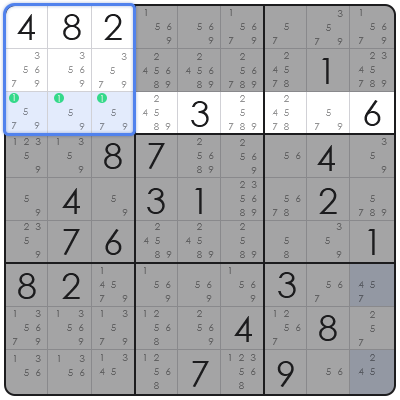
An X-Wing in Sudoku represents an advanced logical deduction strategy crucial for solving complex puzzles. This technique empowers solvers to eliminate specific candidate numbers from multiple cells by identifying a unique rectangular pattern within the grid. It acts as a powerful analytical tool when basic elimination methods have been exhausted. The significance of mastering the X-Wing lies in its ability to systematically reduce the pool of potential numbers in critical sections of the Sudoku grid. This reduction often uncovers hidden singles or pairs, thereby paving the way for further deductions and ultimately leading to the solution of otherwise intractable puzzles. It’s a cornerstone for moving beyond intermediate difficulty. The primary problem the X-Wing solves is the stagnation faced by solvers when no direct singles or obvious pairs/triplets are visible. It provides a structured, systematic approach to progress without resorting to guesswork, ensuring that every deduction is based on sound logical principles inherent to Sudoku’s rules. This strategic approach is vital for efficiency.
The Core Mechanics of Sudoku X-Wing
An X-Wing in Sudoku is a candidate elimination technique where a specific candidate number appears in exactly two cells within two different rows (or columns), aligned in the same two columns (or rows). This forms a visual 2×2 square or rectangle of potential positions for that candidate.
Based on structural analysis, the strength of the X-Wing lies in its logical implication: if the candidate is true in one pair of diagonal cells within the X-Wing, it must be false in the other pair, and vice versa. This forces the candidate into one of two possible positions within each of the involved rows or columns, allowing for eliminations in the shared column/row cells not part of the X-Wing.
From a framework perspective, identifying an X-Wing requires a systematic scan of the entire grid for candidate patterns, typically focusing on a single candidate number at a time. The technique relies on the principle of restricted choices, creating a logical ‘rectangle’ of possibilities that forces the candidate to one of two positions, irrespective of which diagonal is chosen.
This intricate dependency across two rows and two columns provides a powerful mechanism for pruning the candidate list. It ensures that the candidate cannot exist in any other cell within the affected columns (or rows), thereby simplifying the grid and revealing new pathways for logical deduction.
Identifying an X-Wing Formation
Identifying an X-Wing involves carefully scanning candidate numbers within the Sudoku grid to locate the specific 2×2 rectangular pattern where a single candidate is exclusively restricted to two positions in two parallel lines.
Step 1: Choose a candidate number (e.g., ‘4’) and systematically scan all rows. Look for two distinct rows where the candidate ‘4’ appears exactly twice, and crucially, these two occurrences in each row are positioned in the *same two columns*. For example, if ‘4’ is only in (R1C2, R1C7) and (R5C2, R5C7), this forms an X-Wing.
Step 2: Once two such rows are found, verify that the chosen candidate appears *only* in these two cells within those specific columns in those two rows. In practical application, this often means ensuring that no other ‘4’ candidates exist in cells C2 or C7 within R1 or R5, outside of the identified X-Wing cells.
Applying the X-Wing Elimination Rule
Applying the X-Wing rule allows for the elimination of the candidate number from all other cells within the shared columns (or rows) that are *not* part of the X-Wing formation, providing a significant step forward in solving.
Step 3: Once the X-Wing is confirmed (e.g., candidate ‘4’ in (R1C2, R1C7) and (R5C2, R5C7)), you can logically eliminate ‘4’ from all other candidate lists in Column 2 (C2) and Column 7 (C7), *excluding* rows 1 and 5. This is because if ‘4’ is not in R1C2, it must be in R1C7; if ‘4’ is not in R1C7, it must be in R1C2, and so on.
The logical underpinning dictates that the candidate must occupy one of the two cells in the first row and one of the two cells in the second row, ensuring that the candidate is present exactly once in each of the two involved columns. This process significantly prunes the candidate list, often revealing new singles or more straightforward patterns for subsequent deductions and advancing the puzzle state.
Comparative Analysis: X-Wing vs. Other Advanced Techniques
The Sudoku X-Wing strategy stands out from other advanced techniques like Swordfish and Jellyfish by its specific 2×2 row/column alignment pattern. While conceptually related, their structural complexity and frequency of appearance differ significantly.
From a framework perspective, Swordfish and Jellyfish can be viewed as extensions of the X-Wing concept, applying the same principle to 3×3 or 4×4 patterns respectively. However, the X-Wing remains the foundational building block for these larger, more intricate forced-candidate formations.
Based on structural analysis, here’s a comparative overview of these advanced techniques. In practical application, X-Wings are encountered more frequently in difficult puzzles, making them an essential early advanced tool for solvers: | Feature | X-Wing | Swordfish | Jellyfish |
|—|—|—|—|
| Complexity | Moderate | High | Very High |
| Efficiency (Eliminations) | Significant | More Extensive | Most Extensive |
| Frequency (Occurrence) | Common | Less Common | Rare |
Common Pitfalls and Strategic Solutions
Common pitfalls in applying the X-Wing strategy include misidentifying the pattern, failing to verify candidate exclusivity, and incorrectly applying the resulting eliminations. These errors can lead to invalid deductions or a ‘broken’ puzzle state.
**Pitfall 1: Incorrect Identification.** Solvers often confuse an X-Wing with similar-looking patterns or fail to ensure the candidate appears *only* twice in each relevant row/column and is perfectly aligned. Solution: Based on structural analysis, meticulously double-check the two rows and the two columns for the chosen candidate. Ensure no other cells in those specific rows or columns contain that candidate outside the identified 2×2 formation.
**Pitfall 2: Overlooking Candidate Exclusivity.** An X-Wing relies on the candidate being the *only* possibility in those two cells within their respective base lines. If there are other occurrences of the candidate in those rows (even if not aligned with the columns), it invalidates the X-Wing for that candidate. Solution: From a framework perspective, always confirm that the candidate appears *exactly twice* in each of the two base rows (or columns) and that these occurrences share *exactly two* common columns (or rows).
**Pitfall 3: Incorrect Elimination.** A frequent error is eliminating the candidate from the wrong cells, sometimes even from the X-Wing cells themselves or cells outside the involved columns/rows. Solution: In practical application, remember that eliminations occur only in the *shared columns* (if the X-Wing is row-based) or *shared rows* (if the X-Wing is column-based), and crucially, *only from cells not part of the X-Wing itself*.
Frequently Asked Questions (FAQ) about Sudoku X-Wing
This section addresses common queries regarding the X-Wing strategy in Sudoku, providing concise answers for quick reference and reinforcing understanding of this advanced technique.
**Q1: What is the primary purpose of an X-Wing?** A1: An X-Wing aims to eliminate a specific candidate number from cells in two columns (or rows) by leveraging its unique 2×2 pattern across two corresponding rows (or columns), significantly simplifying the puzzle and enabling further deductions.
**Q2: Can an X-Wing be formed using columns instead of rows?** A2: Yes, absolutely. An X-Wing can be column-based, where a candidate appears twice in two different columns, aligned in the same two rows. The underlying logic and elimination principles apply symmetrically.
**Q3: Is an X-Wing considered an advanced Sudoku technique?** A3: An X-Wing is indeed an intermediate to advanced Sudoku technique, typically employed when simpler strategies like hidden singles or naked pairs no longer yield immediate progress in more challenging puzzles.
**Q4: How often do X-Wings appear in Sudoku puzzles?** A4: X-Wings appear with reasonable frequency in difficult and expert-level Sudoku puzzles. Recognizing them is a crucial skill for experienced solvers to progress through complex logical deadlocks.
**Q5: What’s the difference between an X-Wing and a Naked Pair?** A5: A Naked Pair involves two candidates restricted to two cells within a single row, column, or block. An X-Wing, however, involves one candidate spanning two cells in two *different* rows/columns and *two different* columns/rows, creating a global elimination opportunity.
In conclusion, the Sudoku X-Wing is a powerful and systematic deduction tool that stands as a vital technique for advanced solvers. Its ability to logically eliminate candidates across rows and columns, based on a distinct 2×2 pattern, is instrumental in breaking through the most challenging puzzles. The mastery of such patterns is critical for competitive Sudoku solving and demonstrates a deeper understanding of logical matrix reduction principles. From a framework perspective, incorporating the X-Wing into one’s solving repertoire signifies a significant leap in analytical prowess, offering long-term strategic value in tackling complex combinatorial problems.