

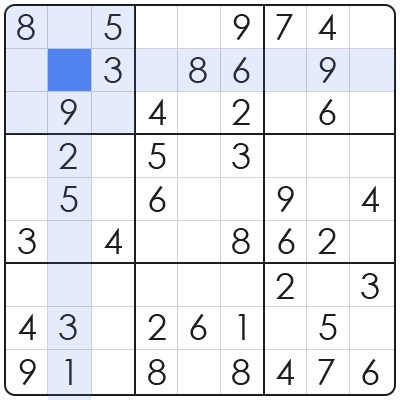
How to find out Sudoku refers to the systematic methods and analytical frameworks employed to solve the popular number-placement puzzle. This process is not merely about guessing but involves a deep understanding of logical deduction, pattern recognition, and constraint satisfaction within a 9×9 grid. The significance of mastering this methodology extends beyond mere entertainment, serving as a fundamental exercise in critical thinking and systematic problem-solving, which are invaluable skills in various professional fields. From a cognitive strategy perspective, “finding out” Sudoku primarily addresses the challenge of resolving a complex system with a finite set of rules and a singular correct solution. It provides a structured approach to tackle intricate problems by breaking them down into manageable sub-problems, a technique widely applicable in software development, project management, and scientific research. The primary problem it solves in the current landscape is fostering a methodical mindset, countering the tendency towards superficial analysis by demanding precise, step-by-step reasoning. This article will delve into the underlying mechanics and advanced strategies for effectively solving Sudoku, transitioning from basic principles to more sophisticated techniques. We will explore the structural components of the puzzle, provide a practical implementation guide, compare its complexity with other logic puzzles, and identify common pitfalls. Ultimately, understanding how to find out Sudoku cultivates mental discipline and enhances one’s capacity for sustained analytical thought, making it a valuable endeavor for anyone seeking to sharpen their cognitive abilities.
Technical & Structural Breakdown of Sudoku Resolution
How to find out Sudoku hinges on a few core logical principles that govern the placement of numbers within its 9×9 grid, which is subdivided into nine 3×3 subgrids, rows, and columns. The fundamental rule states that each row, each column, and each of the nine 3×3 subgrids must contain all digits from 1 to 9, with no repetition. Based on structural analysis, the puzzle’s solvability relies entirely on these interlocking constraints, creating a complex web of dependencies that, when systematically untangled, reveal the unique solution.
From a framework perspective, the most basic mechanics involve ‘scanning’ for ‘naked singles’ and ‘hidden singles’. A naked single is a cell where only one number can possibly fit, given the existing numbers in its row, column, and 3×3 block. A hidden single occurs when a specific number can only be placed in one cell within a given row, column, or block, even if that cell has other potential candidates. These initial deductions form the bedrock upon which more advanced techniques are built, systematically reducing the possible candidates for each empty cell.
Further technical components include ‘candidate elimination’ methods, such as ‘pointing pairs/triples’ and ‘locked candidates’. Pointing pairs/triples occur when two or three candidate numbers for a specific digit are confined to a single row or column within a 3×3 block. This implies that the digit must exist in that row or column, allowing its elimination as a candidate from other cells in that row or column outside the block. Conversely, locked candidates involve a digit restricted to a single block’s row or column, enabling elimination from other cells in that block outside the specific row or column. These inter-block and intra-block relationships are critical for progressing through more challenging puzzles.
Step-by-Step Implementation for Solving Sudoku
Implementing a systematic approach is essential for how to find out Sudoku effectively, moving from foundational observations to complex deductions. The process begins with a thorough initial scan for obvious placements. First, identify all given numbers and pencil in all possible candidate numbers (1-9) for every empty cell. This comprehensive initial step provides a visual map of the puzzle’s complexity and potential pathways for resolution. The goal here is to establish a complete state of knowns and unknowns.
Second, systematically apply basic elimination strategies: start with ‘naked singles’ by checking each empty cell for unique candidate values based on its row, column, and 3×3 block. Once all naked singles are placed, proceed to ‘hidden singles’ by scanning each row, column, and 3×3 block to see if any number (1-9) can only fit into one specific cell within that unit. After each successful placement, update all affected candidate lists. This iterative process of finding and eliminating candidates is the core engine of Sudoku solving, steadily narrowing down the possibilities.
Third, advance to intermediate techniques such as ‘naked pairs/triples/quads’ and ‘hidden pairs/triples/quads’. Naked pairs, for instance, are two cells in a unit (row, column, or block) that share the exact same two candidate numbers, and no other number can be in either cell. This allows those two candidates to be removed from all other cells within that unit. Following this, implement ‘pointing pairs/triples’ and ‘locked candidates’ as detailed previously, which leverage cross-unit influences. If progress stalls, ‘X-Wing’ or ‘Swordfish’ strategies, involving more complex intersecting patterns across multiple rows and columns, may be required. In practical application, consistency in applying these strategies is paramount, ensuring no logical deduction is overlooked, leading reliably to the puzzle’s unique solution.
Comparative Analysis: Sudoku vs. Other Logic Puzzles
To contextualize how to find out Sudoku within the broader landscape of logic puzzles, a comparative analysis against related intellectual challenges highlights its unique characteristics and strategic demands. Sudoku is characterized by its combinatorial nature and rigid numerical constraints, often demanding exhaustive candidate tracking. This structured comparison reveals its distinct position among cognitive challenges:
| Feature | Sudoku | Crossword Puzzles | Jigsaw Puzzles | KenKen Puzzles |
|————|————————————–|——————————————–|——————————————|———————————————-|
| Complexity | High (deductive logic, constraint propagation) | Medium (vocabulary, cultural knowledge, pattern recognition) | Low-Medium (spatial reasoning, visual matching) | High (arithmetic, deductive logic, unique number constraints) |
| Efficiency | Requires systematic candidate elimination and advanced patterns | Relies on quick recall and contextual inference | Based on visual cues and edge/corner identification | Demands arithmetic precision and combinatorial exploration |
| Cost | Zero (pencil & paper, free apps) | Minimal (newspapers, puzzle books) | Varied (physical puzzles range widely) | Zero (pencil & paper, free apps) |
| Frequency | Daily (online, newspapers) | Daily (online, newspapers) | Occasional (leisure activity) | Daily (online, specialized books) |
Based on this analysis, Sudoku’s primary demand is pure deductive reasoning within a fixed numerical and spatial system, offering a distinct mental workout compared to language-dependent crosswords or visually oriented jigsaws. KenKen shares Sudoku’s numerical constraint but adds an arithmetic layer, making it arguably more complex in certain aspects. The efficiency of solving Sudoku is directly proportional to the solver’s mastery of its specific logical patterns and elimination techniques, making it a highly rewarding endeavor for those seeking to refine their analytical capabilities.
Common Pitfalls and Expert Solutions in Sudoku Solving
Even experienced solvers encounter common pitfalls when learning how to find out Sudoku, which can lead to frustration and incorrect solutions. One frequent mistake is inconsistent candidate tracking. Many novices attempt to hold all possibilities in their head, inevitably leading to missed eliminations or incorrect assumptions. This significantly increases the likelihood of errors, especially in complex puzzles where a single wrong deduction can cascade into a completely unsolvable state.
To address inconsistent candidate tracking, professional advice dictates the meticulous use of ‘pencil marks’ or an equivalent digital feature to note all possible candidates for every empty cell. This externalizes the cognitive load, ensuring no potential number is overlooked for a given cell. Furthermore, after every number placement or candidate elimination, it is crucial to review all affected rows, columns, and 3×3 blocks to update their candidate lists accordingly. This iterative re-evaluation minimizes the propagation of errors and maintains the integrity of the solution path.
Another significant pitfall is rushing into ‘guessing’ or ‘trial-and-error’ when logical deductions become less obvious. While advanced techniques like ‘X-Wings’ or ‘XY-Chains’ might seem complex, they are purely logical extensions of the basic rules. Resorting to guessing breaks the deterministic nature of Sudoku and often leads to dead ends, requiring a complete restart. The solution is to cultivate patience and systematically explore all available logical strategies. When stuck, revisit the puzzle with fresh eyes, perhaps focusing on a different section or re-scanning for hidden singles that might have been missed. There is always a logical step forward in a properly constructed Sudoku puzzle, eliminating the need for arbitrary guesses. Trust in the underlying structure of the puzzle and the power of consistent, methodical deduction.
FAQ: “How to Find Out Sudoku” Key Insights
Here are concise answers to frequently asked questions about how to find out Sudoku, optimized for quick understanding:
1. **What is the core principle of finding out Sudoku?** The core principle is unique placement: each digit from 1-9 must appear exactly once in each row, column, and 3×3 subgrid. Solving involves systematic deduction based on these constraints.
2. **What are ‘naked singles’ in Sudoku?** Naked singles are cells where only one number can logically fit after considering all existing numbers in its corresponding row, column, and 3×3 block. They are foundational to early progress.
3. **How do advanced techniques help solve Sudoku?** Techniques like ‘pointing pairs’ or ‘X-Wings’ leverage interlocking patterns across multiple units to eliminate candidates, allowing progress when basic methods no longer yield direct placements. They are logical extensions of fundamental rules.
4. **Is guessing an effective Sudoku strategy?** No, guessing is counterproductive. Every Sudoku puzzle (if properly constructed) has a unique, logically derivable solution. Pure deduction, not trial-and-error, is the path to solving.
5. **Why is Sudoku considered a good brain exercise?** Sudoku enhances logical reasoning, pattern recognition, and systematic problem-solving skills. It trains the brain to process multiple constraints simultaneously and to deduce solutions methodically, improving overall cognitive agility.
Understanding the strategies for how to find out Sudoku cultivates mental discipline and enhances one’s capacity for sustained analytical thought, making it a valuable endeavor for anyone seeking to sharpen their cognitive abilities. The consistent application of these methods proves that even complex problems can be unraveled through structured logical reasoning. This framework of methodical exploration is transferable far beyond the puzzle itself, into professional and personal challenges.
The efficiency of solving Sudoku is directly proportional to the solver’s mastery of its specific logical patterns and elimination techniques, making it a highly rewarding endeavor for those seeking to refine their analytical capabilities.
In conclusion, how to find out Sudoku is far more than a casual pastime; it is a rigorous exercise in applied logic and systematic problem-solving. By embracing structured analytical methods, from identifying basic naked singles to mastering advanced elimination techniques like X-Wings, individuals can consistently and efficiently unravel even the most complex puzzles. This engagement not only provides intellectual gratification but also hones critical thinking skills, offering a transferable blueprint for tackling intricate challenges in any professional or personal domain. The long-term strategic value lies in cultivating a mind primed for methodical deduction and resilient problem resolution, ensuring that the process of “finding out” extends well beyond the confines of the 9×9 grid, into the broader landscape of cognitive excellence.