

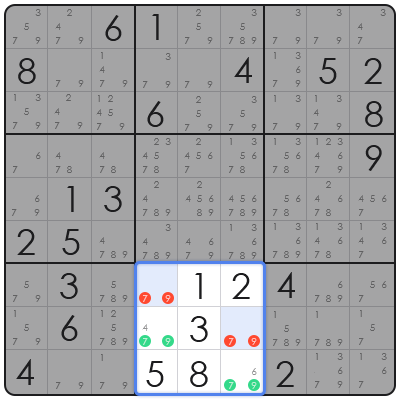
A Sudoku mistake, often seemingly innocuous, represents a critical deviation from the puzzle’s foundational rules, directly compromising its logical structure and solvability. What might appear as a minor misplacement of a single digit rapidly escalates into a complex network of inconsistencies, rendering subsequent deductions invalid and the pursuit of a correct solution futile. This article delves into the precise methodologies and strategic insights required to effectively identify, diagnose, and rectify such errors, transforming moments of frustration into opportunities for reinforced understanding of the puzzle’s intricate mechanics. The significance of mastering error correction in Sudoku extends beyond merely completing a puzzle; it hones a solver’s analytical precision, pattern recognition, and systematic problem-solving capabilities. In the broader landscape of cognitive skill development, the ability to pinpoint and correct logical flaws in a structured system is a highly transferable skill. It underpins effective debugging in programming, diagnostic reasoning in complex systems, and critical evaluation in various professional domains. The primary problem that a systematic approach to fixing Sudoku mistakes solves is the common pitfall of abandoning a puzzle or resorting to a complete restart. Instead of succumbing to grid-wide chaos, a structured error-correction framework empowers solvers to maintain progress, minimize wasted effort, and learn from their missteps. This strategic intervention preserves the flow of logical deduction, ensuring that the integrity of the puzzle-solving experience remains intact even in the face of initial inaccuracies.
The Anatomy of a Sudoku Error
A Sudoku mistake, at its core, represents a violation of the puzzle’s fundamental rules: each row, column, and 3×3 block must contain the digits 1 through 9 exactly once. This initial erroneous entry, often a simple misplacement, acts as a primary anomaly that can cascade, leading to a series of subsequent incorrect deductions and entries. Based on structural analysis, this disruption often manifests as conflicting numbers within a given unit (row, column, or block), rendering further logical progression impossible without correction.
The impact of an undetected error extends beyond the immediate cell; it compromises the entire deterministic nature of Sudoku. What appears as a minor oversight quickly propagates, creating a web of invalid possibilities and eliminating correct pathways. From a framework perspective, the grid’s integrity is compromised, transforming a solvable problem into an intractable one until the root inconsistency is addressed. Understanding this propagation is key to efficient debugging.
Identifying the initial point of failure is crucial. Often, solvers detect an error only when they encounter an unresolvable conflict much later in the puzzle. This indicates a deeper structural issue rather than a new one. The challenge lies in distinguishing between a new, isolated mistake and the symptomatic manifestation of an older, unaddressed error.
Methodologies for Error Identification
Effectively identifying a Sudoku error begins with systematic validation. One proven method involves scanning each completed row, column, and 3×3 block, looking for duplicate numbers. This visual inspection can quickly highlight obvious rule violations where a digit appears more than once within a given unit. In practical application, this is often the first line of defense against compounding errors, providing a rapid sanity check.
A more advanced technique, particularly useful when initial scans yield no immediate duplicates, involves cross-referencing completed cells with their potential candidate lists (pencil marks) in adjacent cells. If a completed number in a row, column, or block contradicts a pre-existing pencil mark in an empty cell within the same unit, it often points to an earlier misplacement. From a framework perspective, this leverages the puzzle’s internal logic to expose inconsistencies that might otherwise remain hidden.
When a specific area becomes challenging or seems to have no valid solutions, it’s often a strong indicator of an error in the vicinity. This ‘bottleneck’ effect suggests that previous entries have removed all legitimate possibilities for a particular cell or group of cells. This method requires a more intuitive understanding of the puzzle’s flow but can pinpoint the general area where a mistake resides, allowing for a focused backtracking effort.
A Systematic Guide to Correcting Sudoku Mistakes
**Step 1: Halt and Assess.** The immediate action upon suspecting an error is to stop making further entries. Continuing to fill cells based on an incorrect premise only compounds the problem and makes backtracking significantly harder. Take a moment to calm down and objectively assess the situation, focusing on the areas where the conflict or impossibility became apparent.
**Step 2: Isolate the Anomaly.** Begin by carefully reviewing the last few numbers entered or the section where the conflict was first noticed. Systematically check rows, columns, and 3×3 blocks containing these numbers for any duplicates or logical impossibilities. If the error isn’t immediately obvious, expand the search backwards, cell by cell, reviewing each entry against the core Sudoku rules. This systematic isolation is critical for efficiency.
**Step 3: Erase and Re-evaluate.** Once the erroneous entry (or entries) is identified, erase it completely. Then, critically re-evaluate all pencil marks and any subsequent numbers that were derived directly from the incorrect entry. These derived numbers are also likely incorrect and must be removed. From a framework perspective, this is a cleansing process, restoring the affected areas to a state of logical consistency.
**Step 4: Reconstruct with Certainty.** With the incorrect entries removed, carefully reconsider the possibilities for the now-empty cells. Use established Sudoku strategies (single candidates, hidden singles, naked pairs, etc.) to deduce the correct numbers. This step often feels like restarting a mini-puzzle within the larger grid, ensuring each new entry is based on verifiable logic.
**Step 5: Validate and Proceed.** After re-entering corrected numbers, perform a quick scan of the affected rows, columns, and blocks to confirm that no new conflicts have been introduced. Only when confidence is restored in the integrity of the corrected section should one proceed with the remainder of the puzzle. In practical application, this iterative validation prevents a recurrence of the initial problem.
Comparative Strategies for Grid Restoration
When confronted with a Sudoku error, solvers have several strategic approaches to restore the grid’s integrity, each with distinct advantages and drawbacks. The primary focus of this discussion, direct error correction, aims to surgically remove and replace the offending entry. However, other methods exist, such as restarting the entire puzzle or utilizing external validation tools, particularly for digital formats.
A comparative analysis reveals the strategic positioning of direct error correction relative to alternative approaches. While a full puzzle restart eliminates all uncertainty, it sacrifices all progress, making it highly inefficient for complex grids. Software-assisted validation, conversely, offers unparalleled speed but diminishes the cognitive challenge and the satisfaction of self-correction. The choice of strategy often depends on the solver’s goal, the puzzle’s difficulty, and the time available.
Based on structural analysis, the table below outlines key dimensions for evaluating these grid restoration strategies. From a framework perspective, understanding these differences informs a solver’s decision-making process, aligning their approach with their desired outcome and skill level.
| Strategy | Complexity | Efficiency | Frequency of Use |
|—|—|—|—|
| Direct Error Correction | Moderate | High (if identified early) | High |
| Full Puzzle Restart | Low | Low | Low (for experienced solvers) |
| Software-Assisted Validation | Low | Very High | Variable |
Mitigating Common Sudoku Pitfalls
Even experienced solvers encounter errors, often stemming from a few recurring pitfalls. One common mistake is ‘premature commitment,’ where a solver confidently places a number without thoroughly verifying all constraints across its row, column, and block. This often happens under time pressure or when a number seems ‘obvious,’ leading to an immediate, hard-to-spot violation. Professional advice dictates always double-checking a cell’s validity from all three perspectives before finalizing an entry.
Another frequent issue is ‘pencil mark proliferation’ without regular review. Over-reliance on extensive pencil marking without periodically eliminating impossible candidates can lead to a cluttered grid where the correct solution becomes obscured or, worse, an incorrect candidate is mistakenly elevated to a solution. From a framework perspective, regularly reviewing and pruning pencil marks ensures clarity and prevents erroneous deductions based on outdated possibilities.
The propagation of an early, subtle error is perhaps the most insidious pitfall. A small oversight at the beginning of the puzzle can create a ripple effect, invalidating large sections of the grid without the solver immediately realizing the root cause. This often leads to frustration when later cells appear to have no valid solutions. In practical application, pausing periodically to re-verify highly constrained sections, especially after several initial entries, can pre-empt such widespread issues.
Essential FAQs on Sudoku Error Resolution
**Q: What’s the fastest way to spot a Sudoku error?** A: The fastest method is a systematic scan of each completed row, column, and 3×3 block for duplicate numbers. This direct visual check often reveals obvious rule violations quickly, pinpointing the conflict.
**Q: Should I restart if I find a mistake?** A: Generally, no. While a full restart is an option, it’s usually more efficient to backtrack from the point of conflict, erase the error, and re-evaluate affected cells. Restarting sacrifices all progress.
**Q: How do pencil marks help in error prevention?** A: Pencil marks (candidate numbers) provide a clear visual record of possibilities. Regularly updating and eliminating candidates helps maintain logical consistency, making it harder to place an invalid number and easier to spot conflicts.
**Q: Can a single error invalidate an entire Sudoku?** A: Yes, absolutely. A single incorrect entry, if it’s foundational or propagates through several deductions, can render the entire puzzle unsolvable or lead to a grid where no valid solution can be found.
**Q: Is it better to erase or cross out mistakes?** A: It’s always better to erase mistakes completely. Crossing out can lead to visual clutter, making the grid harder to read and increasing the likelihood of further errors or confusion. A clean grid aids clear thinking.
In conclusion, the ability to effectively fix a Sudoku mistake is not merely a remedial action but a cornerstone of advanced puzzle-solving discipline and cognitive resilience. By adopting a systematic approach to error identification and correction, solvers transform potential setbacks into valuable learning experiences, reinforcing their understanding of logical constraints and strategic deduction. The principles explored—from structural analysis of errors to comparative strategies for grid restoration—offer a transferable framework applicable to debugging complex systems in various professional contexts. As we look forward, the mastery of self-correction in Sudoku stands as a testament to the enduring strategic value of meticulous problem-solving, fostering a proactive mindset essential for navigating intricate challenges in any field.