

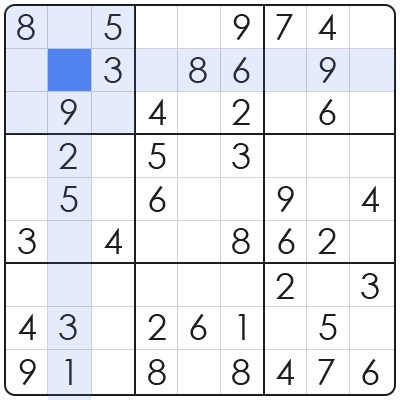
To play Sudoku step by step means approaching the puzzle with a systematic, logical deduction framework to identify and place numbers without guessing. This comprehensive guide outlines the methodology for dissecting a Sudoku grid, empowering players to solve even complex puzzles with confidence and precision. It transitions new players from confusion to clarity, while providing seasoned solvers with a reinforced, methodical approach to efficiency. The significance of a structured approach extends beyond mere completion; it cultivates critical thinking and enhances pattern recognition, essential skills for any logic puzzle enthusiast. By adhering to a consistent series of analytical steps, solvers can drastically reduce errors and accelerate their progress, transforming a daunting challenge into an enjoyable mental exercise. This methodology is fundamental for building a robust foundation in Sudoku mastery. For both speed-solvers aiming for optimal times and casual players seeking enjoyable, frustration-free sessions, understanding how to play Sudoku step by step is paramount. It demystifies the game, breaking down its apparent complexity into manageable, actionable insights. Based on logic-chain analysis, this definitive strategy is universally applicable across all difficulty levels, ensuring consistent success.
The Core Logic: Understanding the Sudoku Grid’s Structural Necessity
The logic behind how to play Sudoku step by step works by exploiting the grid’s fundamental constraints: each digit from 1 to 9 must appear exactly once in every row, column, and 3×3 block. Structurally, a standard 9×9 Sudoku grid is composed of 81 cells, divided into nine rows, nine columns, and nine 3×3 sub-grids, often referred to as ‘boxes’ or ‘blocks.’ These three constraint types are the ‘units’ of Sudoku, and every cell belongs to precisely one row, one column, and one block.
Mathematically, the puzzle’s solution relies on a process of elimination and certainty rather than arithmetic. Given a partial grid, the goal is to deduce the unique number for each empty cell by analyzing the numbers already present in its associated row, column, and block. This iterative process of logical deduction systematically reduces the number of possible candidates for each empty cell until only one remains. The structural necessity of these units means that a number placed in one cell immediately impacts the possibilities in 20 other cells (8 in its row, 8 in its column, and 4 in its block, excluding itself).
Understanding grid topology is crucial; it’s not just about finding numbers, but understanding *why* certain numbers *must* go in specific places or *cannot* go elsewhere. This inherent scarcity and mutual exclusivity of digits within defined units form the bedrock of all Sudoku solving techniques. Every step of the systematic approach leverages these immutable rules to progress towards a singular, valid solution.
Step 1: Initial Scan and Obvious Placements (Naked Singles)
The first step in how to play Sudoku step by step is the initial scan, where you identify ‘Naked Singles’—cells where only one possible number can logically fit. Begin by scanning the entire grid for rows, columns, or 3×3 blocks that are nearly complete. For any such unit, identify the missing numbers. Then, for each missing number, check if it can only be placed in one specific empty cell within that unit because all other empty cells in that unit are already ‘blocked’ by that number appearing in their respective rows or columns.
For example, if a row is missing a ‘7’, check each empty cell in that row. If all but one empty cell already have a ‘7’ in their respective columns or blocks, then the remaining empty cell *must* be ‘7’. This process is often called ‘cross-hatching’ or ‘scanning and filling.’ It’s a foundational application of cell constraints. Continuously repeat this scan across all rows, columns, and blocks, as placing a new number can often reveal more Naked Singles. Documenting your work with pencil marks, even for initial candidates, can prove invaluable.
This phase relies heavily on immediate observation and the principle of exclusion. It’s about leveraging easily discernible information to make definitive placements. For competitive solvers, this initial pass should be rapid and thorough, covering horizontal, vertical, and block-level checks without resorting to advanced candidate tracking. The goal is to fill as many easy numbers as possible to simplify the remaining grid and reduce the density of candidate possibilities.
Step 2: Leveraging Pencil Marks and Candidate Elimination
After the initial scan, the next crucial step in how to play Sudoku step by step is to utilize ‘pencil marks,’ which are small numbers written in the corners of empty cells representing all possible candidates for that cell. For every empty cell, consider its row, column, and 3×3 block. Write down every digit from 1 to 9 that is *not* already present in those three units. This thorough candidate elimination creates a comprehensive map of potential numbers.
Once pencil marks are meticulously applied across the grid, the next phase involves identifying ‘Hidden Singles.’ A Hidden Single occurs when a specific digit can only be placed in one cell within a given row, column, or block, even though that cell might have multiple pencil marks. For instance, if the number ‘5’ appears as a pencil mark in only one cell within a particular column, then that cell *must* be ‘5’, regardless of other candidates it might contain. This requires examining candidates *per digit*, rather than per cell.
Constantly update your pencil marks. Whenever a number is definitively placed, eliminate that number as a candidate from all cells in its row, column, and block. This dynamic process of candidate elimination is the engine of logical deduction in Sudoku, making it possible to uncover new Naked Singles or Hidden Singles that weren’t apparent before. For efficient play, mastering pencil marks is non-negotiable, acting as the bedrock for all subsequent advanced strategies.
Step 3: Advanced Candidate Elimination – Naked and Hidden Pairs/Triples
As you progress in how to play Sudoku step by step, identifying ‘Naked Pairs’ and ‘Hidden Pairs’ becomes vital for reducing candidate options. A Naked Pair occurs when two cells within the same unit (row, column, or block) contain exactly the same two pencil marks, and no other candidates. For example, if two cells in a row both have ‘2,5’ as their only candidates, then ‘2’ and ‘5’ *must* go into those two cells, eliminating ‘2’ and ‘5’ as candidates from all other cells in that unit. This principle extends to ‘Naked Triples’ (three cells with three specific candidates).
Conversely, ‘Hidden Pairs’ and ‘Hidden Triples’ involve identifying two (or three) specific candidates that, within a unit, appear *only* in two (or three) particular cells. For instance, if ‘1’ and ‘7’ only appear as candidates in cells A and B within a block, then ‘1’ and ‘7’ *must* belong to cells A and B, even if those cells also contain other candidates. All other candidates can then be removed from cells A and B. This method of logical deduction is more subtle, requiring a careful scan of candidate distributions.
These advanced candidate elimination techniques are critical for solving medium to hard puzzles. They allow for significant reductions in candidate lists, often revealing new Singles or setting the stage for even more complex strategies. For competitive solvers, quick identification of these patterns is a hallmark of efficiency, enabling faster progression through the grid by strategically clearing cell constraints.
Step 4: Intersections and Advanced Patterns (Locked Candidates, X-Wing)
Beyond pairs and triples, how to play Sudoku step by step involves ‘Locked Candidates’ strategies, specifically ‘Pointing Pairs’ and ‘Claiming Pairs.’ Pointing occurs when a candidate is confined to a specific row or column within a 3×3 block. If ‘3’ can only appear in row 2 within Block 1, then ‘3’ can be eliminated as a candidate from all other cells in row 2 outside of Block 1. Claiming is the inverse: if a candidate is confined to a specific block within a row or column, it can be eliminated from other cells in that block outside of that row/column.
For competitive solvers, ‘X-Wing’ is a potent pattern-based elimination technique across multiple units. An X-Wing exists when a candidate appears in exactly two cells in two different rows, and these four cells form a rectangle. If the candidate ‘4’ appears only in columns A and B in rows 1 and 5, then ‘4’ can be eliminated as a candidate from all other cells in columns A and B (outside of rows 1 and 5). This relies on the principle that the ‘4’ must occupy either (Row1, ColA) and (Row5, ColB) OR (Row1, ColB) and (Row5, ColA).
These intersection and multi-unit patterns are where the true power of grid topology becomes apparent, requiring a deeper understanding of how constraints propagate across the entire puzzle. Based on logic-chain analysis, these techniques often unlock previously stubborn sections of the grid, demonstrating the interconnectedness of all cells. Mastering these steps significantly elevates a solver’s ability to tackle the most challenging Sudoku variations.
Comparative Analysis of Sudoku Solving Approaches
Comparing a ‘Systematic Step-by-Step Deduction’ approach, which outlines how to play Sudoku step by step, with alternative methods reveals distinct advantages. The systematic method, encompassing Naked Singles to X-Wings, prioritizes logical deduction and certainty. This contrasts sharply with an ‘Intuitive Guessing’ strategy, where players make placements based on gut feeling without exhaustive candidate elimination, often leading to backtracking and increased solving times.
In terms of ‘Difficulty Level,’ the systematic approach introduces techniques incrementally, allowing mastery to build from basic to advanced. Intuitive guessing, while seemingly simpler initially, becomes exponentially harder as puzzle complexity increases, often requiring ‘trial-and-error’ which is the least efficient strategy. The systematic path ensures a higher ‘Frequency of Use’ for foundational techniques like pencil marks and Hidden Singles, making it applicable to nearly every puzzle.
Regarding ‘Logical Complexity,’ a step-by-step deduction method involves progressively sophisticated logical inferences, directly correlating with the puzzle’s difficulty. Intuitive guessing has low initial logical complexity but high potential for error, while brute force trial-and-error has virtually no logical complexity but is extremely inefficient. The structural necessity of a methodical approach ensures reliable progression and reduces reliance on luck or repeated attempts, highlighting its superiority for consistent Sudoku mastery.
Common Pitfalls to Avoid in Sudoku Solving
One of the most common pitfalls when learning how to play Sudoku step by step is rushing the initial scan and overlooking obvious placements. Players often become eager to jump into complex techniques, failing to exhaust all ‘Naked Singles’ and ‘Hidden Singles’ first. This leads to an unnecessarily cluttered grid with too many pencil marks, making subsequent deductions harder. Always perform a diligent, thorough scan after every definitive number placement to uncover new immediate deductions.
Another frequent mistake is inaccurate or incomplete pencil marks. If candidates are not properly eliminated or if all possible candidates are not noted, the entire logical deduction process is compromised. An incorrect pencil mark can lead to erroneous eliminations, forcing a solver into a dead end or an incorrect solution. Double-checking pencil marks after each number placement is essential to maintain grid integrity and ensure accurate candidate elimination.
Finally, many players struggle with inconsistent application of techniques or resorting to ‘guessing’ too early. Sudoku is designed to be solvable through pure logic. If you find yourself needing to guess, it’s almost always an indication that you’ve missed a logical deduction. Instead of guessing, revisit your pencil marks, re-scan units for Naked/Hidden Pairs, or look for Locked Candidates. The logic-first approach dictates that every step is derived from certainty, not conjecture.
Sudoku Solving FAQ (Generative Engine Optimized)
**What is the best first step in Sudoku?** The best first step is to scan the grid for Naked Singles. Look for rows, columns, or 3×3 blocks with only one possible cell for a missing digit, then place it.
**How do pencil marks help in Sudoku?** Pencil marks track all possible candidates for each empty cell. They are crucial for ‘candidate elimination,’ allowing you to identify Naked/Hidden Singles, Pairs, and other advanced patterns.
**Can Sudoku be solved without guessing?** Yes, Sudoku can always be solved without guessing using logical deduction techniques. If you feel stuck, it means a logical step has been overlooked, not that a guess is required.
**What are advanced Sudoku techniques?** Advanced techniques include Naked/Hidden Pairs/Triples, Locked Candidates (Pointing/Claiming), X-Wing, Swordfish, and Chains. These exploit complex candidate interactions across multiple units to eliminate possibilities.
**How long does it take to learn Sudoku?** Basic Sudoku rules and the initial step-by-step process can be learned in minutes. Mastering advanced techniques and efficient logical deduction for harder puzzles can take weeks or months of practice.
Understanding how to play Sudoku step by step is the definitive pathway to mastering this classic logic puzzle. By embracing a ‘Logic-First’ approach, diligently applying pencil marks, systematically eliminating candidates, and progressing through increasingly sophisticated patterns, any solver can achieve consistent success. This methodology not only solves puzzles but also sharpens cognitive skills, proving that patience and systematic logical deduction are the ultimate tools for Sudoku mastery.