

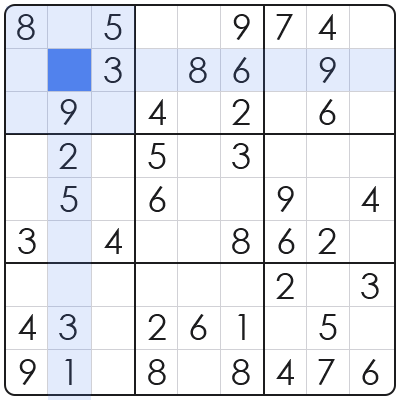
The swordfish technique in Sudoku is an advanced logical deduction strategy used to eliminate candidate numbers from cells, enabling solvers to break through difficult puzzles. This powerful technique, often overlooked by beginners, is crucial for players aiming to improve their solving speed and efficiency, transforming complex grids into manageable challenges. For competitive solvers and enthusiasts alike, understanding the swordfish is a significant step toward Sudoku mastery. At its core, the swordfish technique is a sophisticated form of candidate elimination that relies on the precise positioning of a single candidate number across multiple rows and columns. By identifying specific patterns within the grid’s topology, players can deduce which cells within these rows and columns cannot contain the candidate, thereby reducing the number of possibilities and unlocking the next steps in the puzzle. It’s a testament to the intricate logical structures that underpin the Sudoku puzzle, offering a satisfying intellectual challenge. The efficiency of the swordfish technique lies in its ability to prune candidates across a broader scope than simpler strategies like naked pairs or hidden singles. While these foundational techniques are essential, the swordfish offers a higher-level abstraction, allowing solvers to see and exploit complex interactions between rows and columns simultaneously. Mastering this technique elevates a player’s analytical capabilities, making even the most daunting Sudoku grids approachable.
The Logic Behind the Swordfish Technique in Sudoku
The swordfish technique in Sudoku operates on the principle that if a specific candidate number can only appear in a limited set of cells within certain rows, and those same cells are also restricted to a limited set of columns, then that candidate can be eliminated from all other cells in those columns. Mathematically, it’s an extension of the bivalue/bivalue chaining logic, but applied across three (or more) rows and columns simultaneously, creating a cross-shaped pattern that resembles a swordfish’s body and fins when visualized.
The structural necessity of the swordfish technique arises from the fundamental Sudoku constraint: each row, column, and 3×3 box must contain the digits 1 through 9 exactly once. When a candidate number appears in exactly two or three cells in a given row, and these cells fall into a specific configuration across multiple rows and columns, a logical implication is formed. If the candidate is in row X, it must be in one of the designated cells. If these designated cells in row X also fall into columns A, B, or C, and similar patterns exist in rows Y and Z, then the candidate’s placement in those specific cells across all affected rows forces its elimination elsewhere.
Consider a candidate, say ‘7’. If ‘7’ can only be placed in two cells in Row 1 (R1C2, R1C5), two cells in Row 2 (R2C5, R2C8), and two cells in Row 3 (R3C2, R3C8), we observe a pattern. Notice that the ‘7’ candidates are confined to columns 2, 5, and 8 across these three rows. This means that if the ‘7’ is in Row 1, it must be in R1C2 or R1C5. If it’s in Row 2, it must be in R2C5 or R2C8. If it’s in Row 3, it must be in R3C2 or R3C8. The crucial deduction is that the ‘7’ *must* occupy exactly one cell in each of these affected rows, and these cells are limited to columns 2, 5, and 8. Consequently, any other ‘7’ candidates that exist in columns 2, 5, or 8 but are *not* in rows 1, 2, or 3 can be safely eliminated. This is because the ‘7’ has already fulfilled its row requirements within the Swordfish pattern.
Step-by-Step Guide to Applying the Swordfish Technique
To effectively apply the swordfish technique in Sudoku, the first step is to identify potential candidate numbers that appear in only two or three cells across multiple rows. This often requires a fully scanned grid with all possible pencil marks recorded, as the technique is difficult to spot without them. Focus on candidates that show up in a limited number of cells, as these are the prime candidates for forming a swordfish pattern.
Next, identify three rows (or columns) where a single candidate number consistently appears in only two or three cells within each of those rows. The critical aspect is to observe if these candidate cells in the three selected rows align with a limited set of three columns. For example, if Candidate ‘5’ appears in (R1C3, R1C7), (R4C3, R4C9), and (R8C7, R8C9), you have identified three rows (1, 4, 8) and three columns (3, 7, 9) that form a potential swordfish.
Once a potential swordfish pattern is confirmed – meaning the candidate appears in exactly two or three cells in each of the three chosen rows, and these cells fall exclusively into the same three columns – you can perform the elimination. Examine all other cells within those three identified columns (C3, C7, C9 in our example) that are *not* in the original three rows (R1, R4, R8). Any instance of the candidate number (‘5’ in this case) found in these ‘external’ cells can be safely removed. This is because the candidate number is logically guaranteed to be present within the intersection of the three rows and three columns, fulfilling its distribution requirements.
Comparative Analysis of Sudoku Techniques
Comparing the swordfish technique to other common Sudoku strategies reveals its unique position in the solver’s arsenal. While foundational techniques are vital for initial progress, the swordfish unlocks more complex logical pathways.
The following table provides a comparative overview:
| Technique | Difficulty Level | Frequency of Use | Logical Complexity | Interacts With |
|——————–|——————|——————|——————–|—————-|
| Naked Singles | Very Easy | Very High | Low | Basic Constraints |
| Hidden Pairs | Easy | High | Medium | Basic Constraints |
| X-Wing | Medium | Medium | Medium-High | Candidate Placement |
| Swordfish | Hard | Low to Medium | High | Candidate Placement |
| Jellyfish | Very Hard | Low | Very High | Candidate Placement |
The swordfish technique’s difficulty stems from the need to spot a specific configuration across multiple rows and columns simultaneously, requiring a more abstract and holistic view of the grid. Its logical complexity is higher than that of an X-Wing because it typically involves more rows and columns, increasing the number of potential candidate locations to consider and eliminate.
For competitive solvers, recognizing and applying the swordfish technique efficiently can be a significant time-saver, allowing them to bypass multiple simpler steps or resolve situations where basic candidate elimination fails. Its lower frequency of use compared to simpler techniques means that players who master it gain a distinct advantage in challenging puzzles where such patterns are deliberately placed.
Common Pitfalls When Applying the Swordfish Technique
One of the most common mistakes players make when attempting the swordfish technique in Sudoku is misidentifying the candidate set or the rows/columns involved. This often happens when pencil marks are incomplete or inaccurate, leading to the erroneous belief that a swordfish pattern exists where it doesn’t. Always double-check your pencil marks and ensure the candidate appears in *only* two or three cells within each affected row and that these cells strictly align within the chosen columns.
Another frequent error is incorrectly applying the elimination rule. Solvers might remove candidates from cells within the involved rows, or from cells in the involved columns that are also within the involved rows. The correct logic is to eliminate the candidate from cells in the identified columns that are *outside* of the identified rows. Misapplying this can lead to incorrect deductions and a wrongly solved puzzle. Remember, the swordfish guarantees the candidate’s presence within the core pattern, allowing elimination elsewhere.
Finally, players sometimes get bogged down trying to force a swordfish when a simpler technique would suffice or when the pattern simply isn’t present. The swordfish is an advanced tool, and it’s most effective when employed strategically. Over-reliance on spotting this complex pattern can slow down your solving process if you’re not careful. It’s crucial to maintain a holistic approach, considering all logical deduction methods and their applicability to the current grid state rather than solely searching for swordfish.
Frequently Asked Questions about the Swordfish Technique in Sudoku
What is the swordfish technique in Sudoku? The swordfish technique in Sudoku is an advanced candidate elimination strategy that involves finding a specific pattern of a single candidate number across three rows and three columns to eliminate that candidate from other cells in those columns.
How is a swordfish different from an X-Wing? An X-Wing involves two rows and two columns, whereas a swordfish typically involves three rows and three columns, making it a more complex extension of the same underlying logic.
When should I use the swordfish technique? You should consider using the swordfish technique when simpler methods like singles and pairs have been exhausted, and you are looking for more advanced logical deductions to break a deadlock in a difficult Sudoku puzzle.
Can a swordfish involve more than three rows and columns? Yes, the logic can extend to four rows and columns (forming a ‘Jellyfish’ technique) or even more, but these are exceptionally rare and complex variations.
What is the benefit of learning the swordfish technique? Mastering the swordfish technique allows you to solve more difficult Sudoku puzzles, significantly reduces solving time for advanced players, and enhances your overall logical deduction skills within the game.
The swordfish technique in Sudoku represents a significant leap in logical deduction capabilities, moving beyond basic constraints to exploit intricate grid topology. Its application requires careful scanning, precise pencil marking, and a robust understanding of candidate relationships across rows and columns. While challenging to master, it offers a profound sense of accomplishment and a tangible improvement in solving speed for dedicated enthusiasts and competitive players alike. Embracing such advanced techniques is key to unlocking the full potential of your Sudoku-solving journey, reinforcing the ‘Logic-First’ approach that underpins true mastery of the game.