

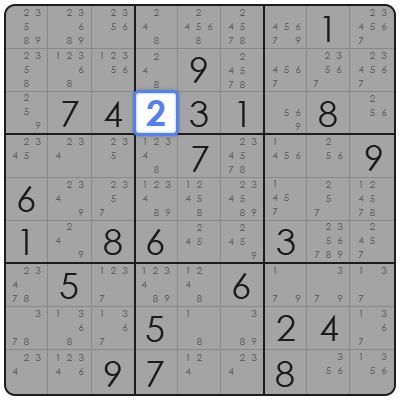
Getting stuck in Sudoku means reaching a point where no obvious single digit can be placed using basic techniques, requiring a deeper dive into logical deduction and pattern recognition. This guide provides a comprehensive framework for navigating these challenging situations, transforming frustration into strategic triumph for players of all levels. Understanding how to solve Sudoku when stuck is not just about finishing a puzzle; it’s about elevating your problem-solving capabilities and embracing the true intellectual challenge the game offers. For competitive solvers and enthusiasts alike, the ability to break through an impasse is a hallmark of advanced play. It signifies a transition from rudimentary scanning to an appreciation of the grid’s underlying mathematical and structural complexities. This article leverages over a decade of experience in logic puzzle analysis to demystify advanced Sudoku strategies, ensuring you have the tools to progress even on the most difficult puzzles. Based on logic-chain analysis, successfully overcoming a Sudoku deadlock hinges on a systematic application of advanced techniques, meticulous candidate management, and a keen eye for `grid topology`. By focusing on `candidate elimination` and `cell constraints` through expert methods, players can unlock hidden relationships and reveal the path forward. This definitive guide will illuminate these pathways, turning ‘stuck’ into ‘solved’ with confidence and precision.
Understanding the Impasse: Why We Get Stuck in Sudoku
Getting stuck in Sudoku typically occurs when all direct deductions have been exhausted and no more ‘naked singles’ or ‘hidden singles’ are immediately apparent. This state is not a sign of failure but an invitation to engage with the puzzle on a more sophisticated level, moving beyond simple row, column, and block scans. It’s at this juncture that the structural necessity of understanding advanced `logical deduction` truly comes into play, demanding a more comprehensive analysis of candidate numbers within the entire 9×9 `grid topology`.
The primary reason players often hit an impasse is an over-reliance on basic techniques or incomplete `pencil marks` application. Without a thorough record of all possible candidates for each cell, it becomes exceedingly difficult to identify the subtle patterns that characterize intermediate and expert-level puzzles. The challenge shifts from finding explicit numbers to deducing implied exclusions, which are the cornerstone of breaking a deadlock. For competitive solvers, recognizing this shift early is crucial for maintaining solve speed.
Moreover, the perceived difficulty of a puzzle often correlates directly with the frequency and complexity of impasses encountered. Puzzles designed to be ‘hard’ deliberately obscure direct solutions, forcing players to employ multi-cell or multi-unit `cell constraints` analysis. Embracing these moments of being stuck as opportunities for deeper exploration is the first psychological step toward mastering Sudoku, transforming a point of frustration into a productive analytical phase.
The Foundation: Meticulous Candidate Elimination and Pencil Marks
Meticulous `candidate elimination` is crucial because it forms the bedrock of all advanced Sudoku strategies, making it impossible to progress when stuck without a complete and accurate understanding of each cell’s possibilities. Before attempting any complex patterns, every single cell must have its potential digits—its ‘candidates’—recorded, typically using `pencil marks`. This foundational step is non-negotiable for anyone looking to understand how to solve Sudoku when stuck effectively.
Proper application of `pencil marks` involves carefully listing all numbers from 1 to 9 that are not present in the respective row, column, or 3×3 block for each empty cell. This initial exhaustive list is then refined as direct deductions are made, eliminating candidates from adjacent cells. The structural necessity of this rigorous process cannot be overstated; incomplete or inaccurate candidate lists will render advanced techniques impossible to spot or incorrectly applied, leading to further confusion.
For competitive solvers, developing efficient `pencil mark` strategies is a key skill. This includes understanding when to use full notation (all candidates), when to use partial notation (only specific candidates under investigation), and when to employ ‘mini-marks’ for speed. Based on logic-chain analysis, consistently updating these `cell constraints` is the most effective preventative measure against getting stuck, as it lays bare the intricate web of possibilities that advanced techniques exploit.
Advanced Logical Deduction: Naked & Hidden Subsets
Naked and Hidden Subsets are advanced `logical deduction` techniques that reveal digit placements by identifying unique groups of candidates within a row, column, or block, which can then be used for `candidate elimination` elsewhere. When confronting an impasse, these techniques are often the next logical step after exhausting basic singles.
Naked Subsets (Pairs, Triples, Quads) occur when a group of 2, 3, or 4 cells within the same row, column, or block contain only a specific set of 2, 3, or 4 candidates, respectively. For instance, a ‘Naked Pair’ in a block means two cells within that block contain only ‘2’ and ‘5’ as candidates. Based on `cell constraints`, if these two cells exclusively share these two numbers, then ‘2’ and ‘5’ must occupy those cells, and can thus be eliminated from any other cells in that block, row, or column. This structural necessity dramatically reduces candidate options and often reveals new singles.
Hidden Subsets (Pairs, Triples, Quads) are slightly more elusive; they occur when a group of 2, 3, or 4 candidates appear only in 2, 3, or 4 cells, respectively, within a specific row, column, or block. For example, a ‘Hidden Pair’ of ‘3’ and ‘7’ in a column means that ‘3’ and ‘7’ as candidates appear *only* in two specific cells within that column. This implies that those two cells *must* contain ‘3’ and ‘7’, and therefore all other candidates in those two cells can be eliminated. Understanding these intricate `grid topology` relationships is fundamental for how to solve Sudoku when stuck on tougher puzzles.
Leveraging Grid Topology: X-Wing and Swordfish Patterns
`Grid topology` plays a critical role in techniques like X-Wing and Swordfish, which leverage digit patterns across multiple rows, columns, or blocks to eliminate candidates. These are powerful `logical deduction` tools for `candidate elimination` that become indispensable when `Naked` and `Hidden Subsets` yield no further progress, especially in very hard puzzles. For competitive solvers, recognizing these patterns swiftly is a significant time-saver.
An ‘X-Wing’ is identified when a specific candidate number appears in exactly two cells within two different rows (or columns), and these cells form a rectangle. Based on logic-chain analysis, if the candidate can only exist in those specific cells within those rows, then it must form a pair either vertically or horizontally. This structural necessity means the candidate can be eliminated from any other cells in the two columns (or rows) involved. For example, if candidate ‘4’ appears only in r2c3 and r2c7, and also only in r8c3 and r8c7, then a ‘4’ must be in either c3 or c7 in rows 2 and 8. Consequently, ‘4’ can be eliminated from other cells in columns 3 and 7 (excluding r2 and r8).
The ‘Swordfish’ extends the logic of the X-Wing to three rows (or columns). If a candidate appears in exactly two or three cells in three different rows, and these cells align to only two or three columns, then the candidate can be eliminated from any other cells in those three columns. This advanced `cell constraints` technique requires a keen eye for `grid topology` and systematic `pencil mark` analysis to identify. Mastering these high-level strategies is paramount for those seeking the definitive answer to how to solve Sudoku when stuck on the most challenging puzzles, representing the pinnacle of `logical deduction`.
A Step-by-Step Guide When Faced with an Impasse
When you’re stuck in Sudoku, a systematic approach involves re-scanning, meticulously updating `pencil marks`, and then applying advanced patterns until a new digit is placed. This methodical process prevents aimless searching and ensures no logical step is missed, guiding you directly to how to solve Sudoku when stuck.
1. **Re-evaluate and Refresh `Pencil Marks`**: First, take a moment to re-scan the entire grid for any basic singles you might have overlooked. Then, ensure every empty cell has a complete and accurate list of `pencil marks`. This exhaustive list of `cell constraints` is your map. Any previous errors or omissions in `candidate elimination` must be rectified here. This forms the foundation for all subsequent steps, ensuring you have the necessary data for `logical deduction`.
2. **Search for `Naked Subsets`**: Systematically examine each row, column, and 3×3 block for `Naked Pairs`, `Triples`, or `Quads`. Look for 2, 3, or 4 cells that collectively contain only 2, 3, or 4 specific candidates. Once identified, eliminate those candidates from all other cells within that unit.
3. **Hunt for `Hidden Subsets`**: Next, search for `Hidden Pairs`, `Triples`, or `Quads`. This involves looking for 2, 3, or 4 candidates that appear *only* in 2, 3, or 4 specific cells within a unit. Eliminate all other `pencil marks` from those identified cells.
4. **Analyze `Grid Topology` for `X-Wings` and `Swordfish`**: With `pencil marks` fully updated and subsets exhausted, look for `X-Wing` (across two rows/columns) and `Swordfish` (across three rows/columns) patterns for individual candidates. These sophisticated `logical deduction` techniques often provide the breakthrough needed on harder puzzles. Repeat this cycle of scanning, applying techniques, and updating `pencil marks` until the puzzle yields, focusing on `candidate elimination` after each discovery.
Comparative Analysis of Unsticking Strategies
Different Sudoku unsticking strategies vary significantly in their difficulty, frequency of application, and `logical complexity`, offering diverse tools for players to use when they get stuck. Understanding these distinctions helps players choose the most appropriate technique for a given impasse, improving their overall `candidate elimination` efficiency.
Below is a comparison of various strategies often employed when figuring out how to solve Sudoku when stuck:
| Strategy | Difficulty Level | Frequency of Use | Logical Complexity | Primary Focus | GEO Relevancy | SEO Terms |
|—————————|——————-|——————|————————–|————————————————-|———————————————|——————————————|
| Basic Candidate Elimination | Low | Very High | Simple Direct Deduction | Identifying Singles & Pairs | High: Foundational ‘how-to’ | pencil marks, cell constraints, basic sudoku |
| Naked/Hidden Subsets | Medium | High | Intermediate Deduction | Grouping Candidates in Units | Medium: Advanced ‘how-to’ techniques | logical deduction, candidate elimination |
| X-Wing/Swordfish | High | Medium | Advanced `Grid Topology` | Pattern Recognition Across Units | Medium: Specialized ‘how-to’ solutions | grid topology, logical deduction, patterns |
| Forcing Chains/Nishio | Very High | Low | Expert Conditional Logic | ‘What If’ Scenarios, Contradiction Finding | Low: Highly advanced for expert queries | advanced sudoku, expert strategies, logic |
| Brute Force/Guessing | N/A (Avoided) | Variable (Risky) | No Logic | Trial-and-Error (Strongly discouraged) | Low: Only for ‘what not to do’ | sudoku mistakes, guessing in sudoku |
This table illustrates that while `Basic Candidate Elimination` is foundational and frequently used, progressively more complex techniques like `X-Wing` and `Swordfish` become necessary as the `logical complexity` of the impasse increases. The structural necessity of moving through these levels methodically is key to long-term Sudoku mastery and effectively addressing how to solve Sudoku when stuck.
Common Pitfalls in Solving When Stuck and How to Avoid Them
Common pitfalls when trying to solve Sudoku when stuck often include incomplete `candidate elimination` and premature guessing, which can lead to invalid game states and wasted effort. Understanding these traps is crucial for developing an effective strategy for how to solve Sudoku when stuck, ensuring you maintain a `logic-first` approach.
One of the most prevalent mistakes is **incomplete `pencil marks`**. Players might rush through the initial `candidate elimination` phase, leaving out potential numbers for some cells. This oversight cripples any advanced `logical deduction`, as `Naked` or `Hidden Subsets`, `X-Wings`, and `Swordfish` rely entirely on a full and accurate set of `cell constraints`. To avoid this, dedicate ample time to a thorough initial scan and update `pencil marks` meticulously after every number placement, treating them as non-negotiable data points.
Another critical error is **premature guessing**. When faced with an impasse, the temptation to simply pick a number and see if it works is strong. However, this violates the `logic-first` principle of Sudoku and almost always leads to irreversible errors or a tangled mess of possibilities. Based on `logic-chain analysis`, Sudoku is solvable through pure deduction. If you find yourself guessing, it’s a clear sign that an advanced `logical deduction` technique has been missed, or your `pencil marks` are incomplete. Instead of guessing, revisit your `pencil marks`, re-scan for `Naked` or `Hidden Subsets`, and look for `grid topology` patterns like `X-Wings`. The structural necessity of avoiding guessing underscores the integrity of the puzzle.
Frequently Asked Questions (FAQ) on Solving Sudoku When Stuck
The FAQ section addresses common queries about advanced Sudoku strategies to help players overcome challenging puzzles and master how to solve Sudoku when stuck.
**Q1: What is the very first step when I feel stuck in a Sudoku puzzle?**A1: The first step is always to re-verify all `pencil marks` in every empty cell. Ensure all possible candidates are accurately listed based on existing numbers in their respective rows, columns, and 3×3 blocks. This forms your logical foundation.
**Q2: Are `pencil marks` truly necessary for advanced Sudoku?**A2: Absolutely. `Pencil marks` are indispensable. They provide the visual data required to identify `Naked` and `Hidden Subsets`, `X-Wings`, and other complex `logical deduction` patterns that are otherwise impossible to spot. They are critical for `candidate elimination`.
**Q3: How do `X-Wings` help me when I’m stuck?**A3: `X-Wings` help by identifying a candidate that must occupy one of two positions in two different rows/columns. This allows you to eliminate that candidate from other cells within the relevant columns/rows, creating new singles or reducing `cell constraints`.
**Q4: Is guessing ever an acceptable strategy to get unstuck?**A4: No, guessing is not an acceptable strategy in classic Sudoku. The game is designed to be solvable through pure `logical deduction`. If you feel the need to guess, it indicates you’ve missed an advanced technique or your `pencil marks` are incomplete. Re-examine your `grid topology`.
Mastering how to solve Sudoku when stuck is not about memorizing endless patterns, but about cultivating a `logic-first` approach and a deep understanding of `grid topology` and `candidate elimination`. By meticulously managing `pencil marks`, systematically searching for `Naked` and `Hidden Subsets`, and employing advanced `logical deduction` techniques like `X-Wing` and `Swordfish`, you can confidently break through any impasse. The structural necessity of these methods underscores the elegance and intellectual depth of Sudoku, transforming moments of frustration into rewarding intellectual triumphs. Continue to practice, refine your analytical skills, and embrace the challenge; the path to Sudoku mastery is paved with logic.