

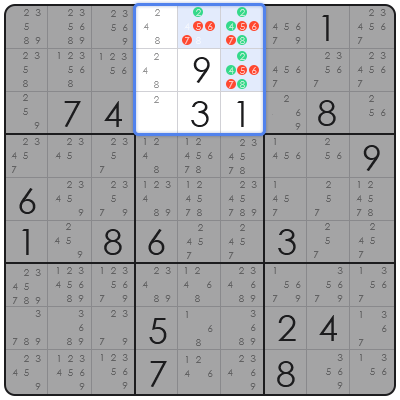
Eliminating possibilities in Sudoku refers to the systematic process of reducing the number of potential candidates for each empty cell based on the rules of the puzzle. This fundamental approach is the bedrock of solving Sudoku puzzles of all difficulties, transforming seemingly complex grids into manageable logical challenges. Without a structured method for possibility elimination, most Sudoku puzzles would remain intractable, relying purely on trial and error. From a framework perspective, possibility elimination in Sudoku is a prime example of deductive reasoning applied to a constrained system. It involves meticulously scanning rows, columns, and 3×3 blocks to identify which numbers (1-9) cannot possibly reside in a given cell due to existing numbers in its intersecting units. This iterative process allows solvers to confidently place numbers and further narrow down options across the entire grid. In practical application, mastering these elimination techniques is not just about solving puzzles faster; it’s about developing a robust analytical mindset. The techniques force a solver to observe patterns, identify constraints, and make inferences based on available data, skills highly transferable to complex problem-solving in various professional domains. This article will delve into the core mechanics and advanced strategies involved in effectively eliminating possibilities in Sudoku.
Understanding the Core Mechanics of Possibility Elimination
Understanding the core mechanics of possibility elimination in Sudoku begins with grasping the fundamental rules that govern number placement: each row, each column, and each of the nine 3×3 blocks must contain all digits from 1 to 9 exactly once. Based on structural analysis, every empty cell initially has nine possible candidates (1-9). The act of elimination involves removing candidates from a cell’s potential list if that candidate already exists within its respective row, column, or 3×3 block.
This initial sweep is often referred to as ‘candidate marking’ or ‘pencil marking,’ where solvers write down all potential numbers in miniature within each empty cell. For instance, if a cell is in a row containing ‘5’, a column containing ‘5’, and a block containing ‘5’, then ‘5’ is immediately eliminated as a candidate for that cell. This systematic reduction forms the basis for identifying ‘Naked Singles,’ where only one candidate remains for a cell, thus revealing its definite value.
Beyond simple intersection, the process extends to observing numbers within individual units. If a number can only appear in one specific cell within a row, column, or block because all other cells in that unit already contain that number or cannot contain it due to other units, it becomes a ‘Hidden Single.’ These foundational mechanics are critical for establishing a baseline of definite numbers before progressing to more complex elimination strategies.
Applying Basic Elimination Techniques: A Practical Guide
Applying basic elimination techniques in Sudoku follows a clear, structured methodology designed to systematically uncover definite numbers. From a framework perspective, the process starts with a full grid scan for obvious eliminations and progresses to identifying cells with unique candidates.
1. **Candidate Listing**: Begin by marking all possible candidates (1-9) for every empty cell. This is typically done by ‘pencil marking’ small numbers in each cell. For example, if a cell is in a row with 1, 3, 4, a column with 2, 5, 6, and a block with 7, 8, 9, its candidates would initially be 1,2,3,4,5,6,7,8,9. After considering existing numbers, its candidates might reduce to 1,3,4,2,5,6.
2. **Cross-Hatching and Naked Singles**: After initial candidate listing, scan the grid for any cell where only one candidate remains. This is a ‘Naked Single’ and can be immediately filled in. Simultaneously, as numbers are placed, perform ‘cross-hatching’: eliminate that newly placed number as a candidate from all other cells in its row, column, and 3×3 block. This often reveals new Naked Singles.
3. **Hidden Singles**: Once Naked Singles are exhausted, look for ‘Hidden Singles’. This involves scanning each row, column, and 3×3 block for a number that can only be placed in one specific cell within that unit, even if that cell has other candidates. For instance, if the number ‘7’ can only be placed in cell R2C5 within its 3×3 block (because all other cells in that block cannot contain ‘7’ due to its presence in their respective rows or columns), then R2C5 must be ‘7’.
Beyond the Basics: Advanced Sudoku Elimination Patterns
Beyond the basics, advanced Sudoku elimination patterns leverage multiple cells and candidate interactions to uncover hidden relationships and further reduce possibilities. Based on structural analysis, these techniques move past individual cell analysis to examine groups of candidates within intersecting units, enabling more profound deductions.
One critical set of advanced techniques involves ‘Naked Pairs,’ ‘Naked Triples,’ and ‘Naked Quads.’ A Naked Pair occurs when two cells in the same unit (row, column, or block) share exactly two identical candidates, and no other candidates. For example, if two cells in a row both have candidates {2,5} and no others, then 2 and 5 must occupy those two cells. Therefore, 2 and 5 can be eliminated as candidates from all other cells in that same row. Naked Triples and Quads follow similar logic for three or four cells sharing three or four candidates.
Another powerful set are ‘Hidden Pairs,’ ‘Hidden Triples,’ and ‘Hidden Quads.’ A Hidden Pair, for instance, exists when two candidates (e.g., 1 and 7) appear *only* in two specific cells within a unit, even if those cells have other candidates. This implies that 1 and 7 *must* reside in those two cells, allowing all other candidates to be removed from those two cells. Advanced ‘X-Wing’ and ‘Swordfish’ patterns extend this logic across multiple rows and columns, identifying candidates that must reside in specific positions, thereby enabling their elimination from other non-aligned cells. These complex deductions are essential for tackling expert-level Sudoku puzzles, demonstrating the intricate nature of possibility elimination.
Comparing Elimination Methods: Efficiency and Application
Comparing elimination methods reveals distinct differences in complexity, efficiency, and frequency of application, highlighting their roles in a comprehensive Sudoku solving strategy. From a framework perspective, simpler techniques are highly frequent and low complexity, forming the foundation, while advanced techniques are less frequent but crucial for difficult puzzles.
Basic techniques like Naked Singles and Hidden Singles are characterized by high frequency and low complexity. They are highly efficient for initial grid filling, often solving 60-80% of an easy-to-medium puzzle. Their application involves direct observation and minimal mental tracking, making them the first line of attack. In contrast, techniques such as Naked Pairs/Triples and Hidden Pairs/Triples represent an intermediate level of complexity and frequency. They require identifying specific candidate groupings and are moderately efficient, often unlocking further basic singles.
Advanced techniques like X-Wing, Swordfish, and Remote Pairs possess higher complexity and lower frequency. While less common, their application can be critically efficient in breaking deadlocks in hard and expert puzzles. These methods demand significant pattern recognition across multiple units and can be more time-consuming to identify, but they offer substantial reductions in possibilities once found. In practical application, a solver must fluidly transition between these levels of elimination based on the state of the puzzle, moving from simpler, high-frequency techniques to more complex, lower-frequency ones as needed.
Navigating Challenges in Sudoku Possibility Elimination
Navigating challenges in Sudoku possibility elimination often involves encountering common pitfalls that can hinder progress or lead to errors. Based on structural analysis, a frequent mistake is ‘premature guessing,’ where a solver fills in a cell without absolute certainty, assuming it’s the only option. This can lead to a cascade of incorrect placements, making the puzzle unsolvable or requiring extensive backtracking.
Another common pitfall is ‘overlooking candidates’ or failing to fully update candidate lists after placing a new number. This typically occurs when a solver places a number and forgets to eliminate it from all related cells (its row, column, and 3×3 block), leading to incorrect candidate counts and missed opportunities for identifying new singles or pairs. This lack of thoroughness can stall progress on a puzzle that might otherwise be solvable with basic techniques.
In practical application, professional advice to avoid these mistakes centers on systematic diligence. Always double-check every number placement by confirming it doesn’t violate any rules and by meticulously removing it from all affected cells’ candidate lists. For advanced puzzles, resisting the urge to guess is paramount; if no direct deduction is apparent, it’s time to re-evaluate the entire grid for hidden patterns or to apply a more sophisticated elimination technique. Maintaining a clear and up-to-date ‘pencil mark’ record for all cells is the best defense against overlooked candidates and enables more complex analyses.
Frequently Asked Questions about Sudoku Elimination
Understanding common queries about Sudoku elimination helps clarify key concepts and reinforces effective solving strategies. These concise answers aim for ‘Position Zero’ eligibility, providing quick insights into challenging aspects.
**Q1: What is the very first step in eliminating possibilities in Sudoku?** The first step is to ‘pencil mark’ all possible candidate numbers (1-9) for every empty cell, based on numbers already present in its row, column, and 3×3 block. This establishes the initial set of possibilities.
**Q2: How do ‘Naked Singles’ differ from ‘Hidden Singles’?** A Naked Single is a cell where only one candidate remains after considering all existing numbers. A Hidden Single is a number that can only be placed in one specific cell within a unit (row, column, or block), even if that cell has other candidates.
The Strategic Value of Systematic Sudoku Elimination
The strategic value of systematic Sudoku elimination extends far beyond recreational puzzle-solving, offering profound lessons in logical deduction and problem-solving methodologies. From a framework perspective, the iterative process of identifying constraints, eliminating non-viable options, and inferring definite solutions mirrors the approach taken in complex analytical tasks across various domains. It reinforces the importance of meticulous data analysis and pattern recognition.
Based on structural analysis, the mastery of Sudoku elimination techniques cultivates a systematic thought process, teaching patience and precision. It demonstrates that even seemingly overwhelming problems can be broken down into smaller, manageable deductions. This translates into an enhanced ability to approach real-world scenarios, where identifying and eliminating irrelevant variables or unfeasible solutions is often the quickest path to an optimal outcome.
In practical application, the ability to systematically eliminate possibilities is a cornerstone of effective decision-making and strategic planning. It encourages a disciplined approach to information processing, reducing cognitive load by focusing on what *can* be true rather than what *might* be true. The principles honed through Sudoku elimination serve as a potent metaphor for analytical rigor, fostering a mindset crucial for navigating intricate challenges in any field requiring logical precision.
In conclusion, the systematic elimination of possibilities in Sudoku is more than just a puzzle-solving technique; it’s a foundational skill for deductive reasoning and analytical thinking. By meticulously reducing candidates, identifying patterns from basic singles to advanced X-Wings, and navigating common pitfalls with disciplined application, solvers not only conquer complex grids but also sharpen cognitive abilities. This structured approach to problem-solving, emphasizing precision and iterative refinement, holds significant long-term strategic value, offering a tangible framework for tackling intricate challenges in any logical domain.