

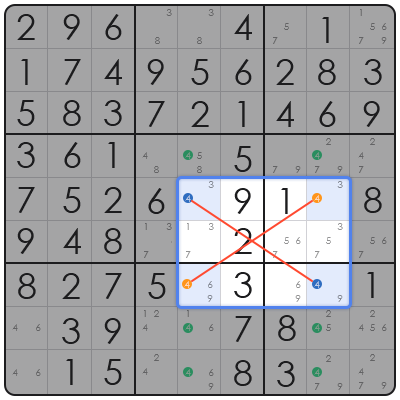
Expert Sudoku represents the pinnacle of logical puzzle-solving, introducing complexities that transcend basic elimination and demand a sophisticated understanding of numerical relationships within a constrained grid. This advanced variant of the classic game serves as a significant cognitive challenge, often requiring players to identify subtle patterns and employ multi-step deductions that are not immediately apparent. The significance of mastering how to beat expert sudoku extends beyond mere entertainment; it cultivates and sharpens critical analytical rigor, systematic thinking, and pattern recognition skills. These cognitive faculties are invaluable assets, directly transferable to strategic problem-solving and decision-making processes across various professional domains. The primary problem expert sudoku solves in the current landscape of logical challenges is overcoming seemingly intractable configurations through a structured, systematic methodology. It forces the solver to move beyond intuitive leaps and embrace a rigorous, deductive framework, making it an excellent training ground for complex analytical tasks.
Deconstructing Expert Sudoku: Advanced Logical Foundations
Deconstructing expert sudoku reveals a foundation built upon intricate logical interdependencies that extend far beyond simple row, column, and block constraints. Based on structural analysis, these puzzles are characterized by a higher density of hidden singles, naked/hidden pairs/triples/quads, and more elaborate cell interactions that deliberately obscure immediate solutions, often presenting an initial appearance of an impasse.
From a framework perspective, effectively beating expert sudoku involves understanding and applying a hierarchical set of techniques, starting from meticulous candidate marking and progressing to highly sophisticated chaining and remote pair identifications. The core mechanics leverage the unique constraint propagation inherent to the 3×3 blocks, rows, and columns, where each number 1-9 must appear precisely once, driving all possible deductive pathways.
In practical application, the underlying components include a robust system for candidate elimination, meticulously tracking all potential numbers for every empty cell. This systematic tracking is not merely about identification but forms the crucial data layer for revealing less obvious deductions and advanced patterns like X-Wing, Swordfish, and Jellyfish, which are fundamental to expert-level strategies.
Systematic Strategy: A Step-by-Step Guide for Expert Puzzles
Implementing a winning strategy for expert sudoku requires a disciplined, multi-stage process that systematically reduces the solution space through pure logic. In practical application, this means a sequential application of techniques, starting with the most straightforward and incrementally progressing to the most complex, ensuring no potential deduction is overlooked at any stage.
**1. Foundational Candidate Marking and Basic Elimination.** Begin by meticulously filling in all possible candidates (1-9) for every empty cell. This comprehensive initial pass, from a framework perspective, establishes the baseline data for all subsequent deductions. Following this, systematically scan rows, columns, and 3×3 blocks for naked singles (cells with only one candidate) and hidden singles (numbers that can only appear in one cell within a unit), significantly pruning the candidate lists.
**2. Identifying Naked and Hidden Groups (Pairs, Triples, Quads).** Progress by looking for groups of 2, 3, or 4 cells within a unit that share the exact same 2, 3, or 4 candidates, respectively (naked groups). Conversely, identify 2, 3, or 4 numbers that can only appear in 2, 3, or 4 specific cells within a unit (hidden groups). Based on structural analysis, these patterns allow for the elimination of those candidates from other cells within the affected unit.
**3. Advanced Chaining Techniques (X-Wing, Swordfish, Jellyfish).** These sophisticated methods involve identifying candidate patterns that span multiple rows or columns. For example, an X-Wing identifies a candidate that can only be present in two cells across two different rows, but those cells are confined to the same two columns, enabling eliminations in those shared columns. Mastery of these patterns is essential for how to beat expert sudoku.
**4. Recursive Application and Advanced Chains.** Continuously re-apply all techniques after each number placement or candidate elimination. For the most challenging expert puzzles, employ advanced chains like Remote Pairs, Alternating Inference Chains (AICs), or Unique Rectangles. These strategies rely on conditional logic and hypothetical scenario testing to break impasses and reveal solutions where simpler methods fall short.
Comparative Analysis: Expert Sudoku vs. Cognitive Logic Challenges
Expert Sudoku serves as a powerful benchmark for complex logical deduction, offering valuable insights when rigorously compared to other analytical frameworks and cognitive challenges. Its unique demands for unwavering precision and systematic thinking set it apart within the realm of problem-solving exercises.
From a framework perspective, the process of beating expert sudoku distinctly differs from simpler puzzles like basic KenKen or Kakuro. While those puzzles often rely on arithmetic sums and basic unique constraints, expert sudoku demands a deeper dive into spatial reasoning, multi-layered candidate elimination, and recursive pattern recognition, directly addressing the core intricacies of ‘how to beat expert sudoku’.
Comparing expert sudoku to a basic Constraint Satisfaction Problem (CSP) in computational theory highlights Sudoku’s inherent deterministic path to a solution through pure logical deduction, minimizing the need for brute-force guessing if sufficient logical methods are applied. Its complexity, based on structural analysis, arises from the dense, interconnected nature of the grid’s constraints, paralleling the challenge of optimizing resource allocation within a fixed-parameter system without external variables.
Navigating Common Pitfalls for Expert Sudoku Success
Based on structural analysis, several recurring errors frequently impede progress when learning how to beat expert sudoku, often leading to significant frustration and incorrect solutions. Professional advice strongly emphasizes proactive recognition and rigorous mitigation of these common pitfalls for achieving consistent success and efficiency.
**Pitfall 1: Premature Guessing and Tunnel Vision.** A critical error is resorting to guessing when logical deductions become difficult, which almost invariably leads to errors and necessitates restarting. Equally detrimental is focusing solely on one type of deduction (e.g., only looking for naked pairs) and ignoring the broader spectrum of advanced techniques, creating analytical blind spots.
**Solution:** In practical application, cultivate meticulous candidate tracking, employing a robust notation system. After every deduction, immediately re-scan all affected rows, columns, and 3×3 blocks for new opportunities. From a framework perspective, adopt a layered, systematic approach, cycling through all known techniques rather than fixating on a single method.
**Pitfall 2: Inconsistent Candidate Updates.** A subtle yet frequent error is failing to consistently update candidate lists after each number placement or candidate elimination. This leads to missing new elimination opportunities or, worse, making deductions based on outdated or incorrect information, thereby compounding errors.
**Solution:** Discipline is paramount. After placing a number or eliminating any candidate, rigorously update all affected cells and their respective units. This iterative refinement is fundamental to the ‘how to beat expert sudoku’ methodology, ensuring your information base remains accurate and current, thereby unlocking subsequent logical steps.
Frequently Asked Questions: Mastering Expert Sudoku
**Q: What defines an ‘expert’ Sudoku puzzle?**A: Expert Sudoku, from a framework perspective, demands advanced logical techniques beyond basic elimination. It features fewer initial numbers and necessitates intricate pattern recognition like X-Wings or Chains for its resolution.
**Q: Is guessing ever a valid strategy in expert Sudoku?**A: No, professional advice strongly discourages guessing. Every step to beat expert sudoku must be logically derived. A guess typically indicates an overlooked deduction or the need for a more advanced technique.
**Q: How can I improve my speed in solving expert Sudoku?**A: Speed is a byproduct of consistent practice and systematic technique application. Focus on developing a routine for efficient candidate marking and rapid pattern recognition, which is key to quicker solves.
**Q: What are ‘chains’ in Sudoku?**A: Chains are sequences of logical implications linking candidates. If candidate ‘A’ in cell X implies ‘B’ in cell Y, this chain can lead to a direct elimination of ‘A’ or ‘B’ elsewhere, leveraging conditional logic.
**Q: What are the best first steps when starting an expert Sudoku?**A: Begin with comprehensive candidate marking for every empty cell. Then, methodically identify all naked and hidden singles, followed by naked and hidden pairs/triples/quads, before moving to advanced patterns.
Mastering how to beat expert sudoku serves as a powerful and practical exercise in logical rigor and systematic problem-solving. Its long-term benefits extend far beyond the puzzle itself, profoundly enhancing analytical capabilities and fostering structured thinking essential for complex decision-making across various professional domains. By embracing these advanced strategies, individuals develop a robust framework for tackling any intricate challenge.