

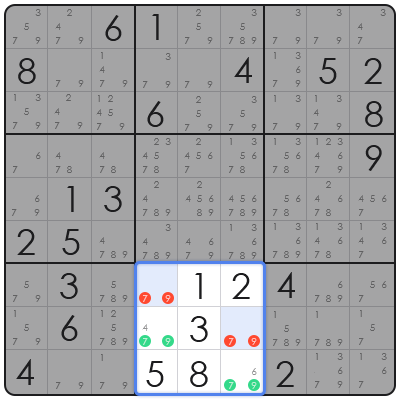
Diabolical Sudoku puzzles represent the pinnacle of this popular number placement game, demanding far more than rudimentary elimination techniques. Unlike their easier counterparts, these intricate grids require a deep dive into advanced logical deduction, pattern recognition, and multi-cell dependency analysis to uncover solutions. The significance of mastering how to solve diabolical sudoku puzzles extends beyond mere recreation; it serves as an exceptional benchmark for advanced analytical reasoning and systematic problem-solving. This level of Sudoku challenges solvers to think several steps ahead, identify subtle relationships between numbers, and apply complex strategies where straightforward deductions are exhausted. The primary problem these puzzles solve, from an intellectual perspective, is the need for sophisticated strategies when brute-force attempts or simple ‘naked single’ methods fail. This mirrors real-world challenges in complex system optimization or strategic analysis, where initial solutions are insufficient, necessitating deeper, interconnected logical frameworks. This article will provide a structural analysis of the methodologies and techniques required to conquer these intricate puzzles, offering insights grounded in systematic observation and professional problem-solving principles.
Unpacking the Core Mechanics: Advanced Logic for Diabolical Sudoku
Solving diabolical sudoku puzzles fundamentally transcends basic row, column, and block elimination, requiring an understanding and application of multi-cell logical dependencies. The core mechanics involve identifying complex patterns and relationships that reveal hidden candidate eliminations, which are not immediately obvious.
Based on structural analysis, techniques like ‘chains’ are foundational. These include X-Wing, Swordfish, and Jellyfish formations, which are complex structures that identify candidates that can be eliminated across multiple units based on specific alignments. These advanced patterns allow solvers to deduce eliminations that would be impossible with simpler methods.
Another critical component involves mastering ‘naked and hidden subsets,’ such as pairs, triples, and quads. These techniques focus on groups of candidates within a unit (row, column, or block) that restrict the placement of certain numbers, thereby narrowing down possibilities when direct elimination is not feasible.
From a framework perspective, these advanced techniques represent a hierarchical approach to constraint satisfaction problems, where initial constraints are processed, followed by more abstract, interconnected constraints. This layered thinking is essential for progress in diabolical grids.
Systematic Implementation: Identifying and Utilizing Advanced Patterns in Diabolical Sudoku
The initial step in how to solve diabolical sudoku puzzles invariably involves an exhaustive scan for basic naked and hidden singles across all rows, columns, and 3×3 blocks. This foundational sweep ensures that no obvious deductions are overlooked before moving to more complex strategies.
Subsequently, practitioners must develop a keen eye for identifying ‘naked subsets’ by carefully observing candidate numbers within a unit. This iterative process demands meticulously tracking which candidates are restricted to only a few cells, thereby allowing for the elimination of those candidates from other cells within the same unit.
Concurrently, searching for ‘hidden subsets’ requires an even sharper analytical focus, as it involves pinpointing numbers that can *only* exist in specific cells within a unit, despite the presence of other plausible candidates in those same cells. This often involves scanning for candidates that appear exactly two or three times in a unit, forming a hidden pair or triple.
This systematic approach, building from simple to complex pattern recognition, ensures that the solver maintains a robust analytical foundation, avoiding haphazard attempts and maximizing the efficiency of each deduction. It underscores the iterative nature of high-level problem-solving.
Advanced Techniques: Mastering Chains, Wings, and Forcing for Complex Sudoku
Based on structural analysis, X-Wing formations are a primary technique to consider when simple subsets are exhausted. An X-Wing involves identifying two rows (or columns) where a specific candidate number appears in exactly two cells, aligning in matching columns (or rows). This configuration allows for the elimination of that candidate from all other cells in those aligning columns or rows.
Forcing chains, often colloquially termed ‘what-if’ scenarios, involve hypothesizing a number in a particular cell and meticulously tracing the logical consequences throughout the entire puzzle. If this hypothesis leads to an undeniable contradiction or an impossible state, then the initial hypothesis must be false, revealing the true number for that cell.
Another critical method involves ‘XY-Wings’ or ‘remote pairs,’ which connect three cells in a specific L-shaped or linear pattern, allowing for the elimination of a common candidate from a fourth cell that ‘sees’ all three pivot cells. These chains rely on the principle of bivalue cells (cells with only two candidates).
In practical application, these sophisticated techniques demand meticulous tracking of candidates, a systematic approach to evaluating potential impacts, and the ability to visualize interdependencies across the entire grid. Success relies on disciplined execution and careful verification of each step.
Comparative Analysis: Diabolical Sudoku vs. Standard Puzzles
Diabolical Sudoku puzzles fundamentally differ from ‘easy’ or ‘medium’ variants in the depth and complexity of logical inference required for their solution. While simpler puzzles can often be solved with basic ‘cross-hatching’ and single-candidate eliminations, diabolical grids necessitate multi-layered, conditional logic.
From an efficiency perspective, solving easier puzzles typically involves direct candidate reduction, leading to quicker resolutions. In contrast, how to solve diabolical sudoku puzzles demands iterative application of complex chaining and subset analysis, significantly extending the solution time and requiring sustained concentration.
The inherent complexity in diabolical puzzles stems from the scarcity of immediate, obvious deductions. This forces solvers to employ multiple levels of conditional logic, such as identifying an X-Wing and then using its deductions to enable the discovery of a subsequent XY-Chain or forcing scenario, rather than a single, isolated technique.
The frequency of needing advanced techniques is a defining characteristic; simpler puzzles might occasionally present a need for a hidden pair, whereas diabolical puzzles consistently necessitate the deployment of techniques like X-Wings, Swordfish, Jellyfish, and forcing chains to make any significant progress. This sustained demand for advanced strategies sets them apart.
Navigating Common Pitfalls in Diabolical Sudoku Solving
A frequent mistake when learning how to solve diabolical sudoku puzzles is prematurely abandoning a technique, assuming it won’t yield immediate results, or failing to re-scan the entire grid after a single, small deduction. Professional advice strongly suggests maintaining thoroughness and patience, as even a minor elimination can unlock a cascade of new possibilities.
Another significant pitfall involves incorrect candidate marking or misidentifying advanced patterns, which can lead to errors that propagate throughout the puzzle, making it unsolvable. To mitigate this, meticulous double-checking of all marked candidates and identified patterns is essential, verifying each step before moving forward. Precision is paramount.
Over-reliance on ‘guessing’ when encountering a seemingly insurmountable deadlock is a critical error; diabolical Sudoku puzzles are designed to be solvable purely by logic. Instead of guessing, professional strategists advise reverting to systematic scanning for overlooked hidden chains, subsets, or meticulously initiating a forcing chain with careful backtracking if a contradiction arises.
Frequently Asked Questions About Diabolical Sudoku
**Q: What makes a Sudoku ‘diabolical’?** A: Diabolical Sudoku puzzles require advanced logic like X-Wings, XY-Chains, and forcing, as basic elimination techniques are insufficient for solving them.
**Q: How long does it typically take to solve diabolical sudoku puzzles?** A: Solving can range from 30 minutes to several hours, depending on the puzzle’s complexity and the solver’s familiarity with advanced techniques.
**Q: Are there any universal starting strategies?** A: Always begin with basic singles, then hidden/naked subsets. Progress to X-Wings, Swordfish, and then more complex chains and forcing strategies.
**Q: Can computers solve diabolical Sudoku?** A: Yes, sophisticated algorithms can solve these puzzles quickly. The true challenge for humans lies in discovering intricate logical paths.
**Q: Is ‘how to solve diabolical sudoku puzzles’ a valuable skill?** A: Yes, it hones critical thinking, pattern recognition, and systematic problem-solving skills, highly transferable to complex analytical fields.
The journey to master how to solve diabolical sudoku puzzles is a testament to the power of structured analytical thinking, perseverance, and the application of advanced logical frameworks. These challenging grids serve as an excellent training ground for enhancing cognitive abilities, fostering a mindset essential for strategic decision-making and complex system optimization in any demanding field. Mastering these intricate logical challenges prepares individuals for an increasingly data-driven and complex world where simple solutions are rarely sufficient, reinforcing the value of deep, systematic analysis.