

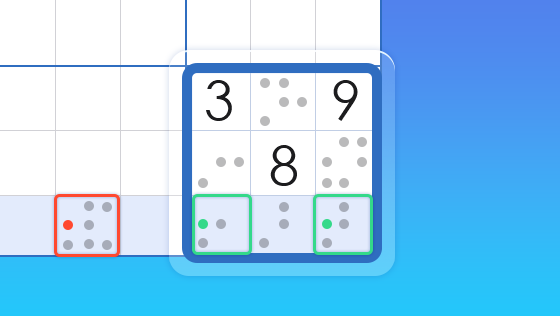
An advanced Sudoku technique, the XY-Wing is a crucial strategy for eliminating candidate numbers from cells when simpler methods are no longer sufficient. It involves a specific logical relationship between three distinct cells, unlocking pathways to solve complex puzzles that might otherwise seem intractable. From a framework perspective, the XY-Wing addresses the challenge of seemingly stalled Sudoku puzzles by introducing a powerful conditional exclusion rule. It allows solvers to progress beyond basic deductions, bridging the gap between intermediate and expert-level solving by leveraging implicit logical dependencies. In practical application, mastering the XY-Wing marks a significant leap in a solver’s ability, transforming how they approach difficult Sudoku variants. This technique lays essential groundwork for understanding and applying even more intricate logical chains, positioning it as a foundational skill for advanced puzzle strategy.
Deconstructing the XY-Wing: Fundamental Mechanics
The XY-Wing is fundamentally comprised of three cells: a “pivot” cell (Y) and two “wing” cells (X and Z). The pivot cell (Y) must contain exactly two candidate numbers, for instance, {A, B}. Each wing cell must ‘see’ the pivot (Y) and contain one of the pivot’s candidates, along with a third, common candidate (C). Thus, Wing X will have candidates {A, C} and Wing Z will have candidates {B, C}.
Based on structural analysis, the core principle operates on a mutual exclusion inference. If the pivot cell (Y) ultimately takes the value ‘A’, then Wing X (seeing Y) cannot be ‘A’, forcing Wing X to be ‘C’. Conversely, if the pivot cell (Y) ultimately takes the value ‘B’, then Wing Z (seeing Y) cannot be ‘B’, forcing Wing Z to be ‘C’. In both exhaustive scenarios, at least one of the wings (X or Z) must contain candidate ‘C’.
This critical deduction leads to the elimination rule: any cell that ‘sees’ *both* Wing X and Wing Z cannot contain candidate ‘C’. Since one of the wings *must* contain ‘C’, any cell that shares a row, column, or block with both of these wings cannot simultaneously hold ‘C’ without violating Sudoku’s fundamental rules. This precise logical deduction offers powerful candidate elimination.
Identifying and Applying the XY-Wing: A Step-by-Step Practical Guide
**Step 1: Locate Potential Pivot (Y) Cells.** Begin by systematically identifying any cell that contains precisely two candidate numbers. These dual-candidate cells are the only viable candidates for the pivot (Y) in an XY-Wing. For example, if R3C5 contains candidates {1, 7}, mark it as a potential pivot.
**Step 2: Identify Potential Wing (X and Z) Cells.** For each pivot identified, search for two other cells (Wing X and Wing Z) that satisfy specific criteria. Wing X must ‘see’ the pivot (Y) and contain two candidates: one matching a pivot candidate (e.g., ‘1’) and a third unique candidate (e.g., ‘6’). So, Wing X has {1, 6}. Wing Z must also ‘see’ the pivot (Y) and contain the other pivot candidate (e.g., ‘7’) and the same third unique candidate (‘6’). Thus, Wing Z has {7, 6}. Crucially, both wings must be within the same row, column, or 3×3 block as the pivot, ensuring they ‘see’ it.
**Step 3: Determine Common-Sight Cells.** Pinpoint any cells on the Sudoku grid that are simultaneously ‘seen’ by *both* Wing X and Wing Z. This means the target cell must share a row, column, or 3×3 block with Wing X, AND independently share a row, column, or 3×3 block with Wing Z. These intersection points are critical for the elimination phase.
**Step 4: Execute the Elimination of Candidate ‘C’.** The common candidate ‘C’ (e.g., ‘6’ in our example) can now be safely eliminated from all cells identified in Step 3. In practical application, this systematic, rigorous approach ensures accurate identification and prevents erroneous deductions, allowing for precise candidate reduction.
Comparative Analysis: XY-Wing Versus Advanced Sudoku Techniques
Based on structural analysis, the XY-Wing occupies a distinct and valuable niche when compared to other advanced Sudoku techniques. Unlike X-Wings or Swordfish, which rely on candidates forming large patterns across entire rows or columns, the XY-Wing leverages a more localized, conditional chain of three interacting cells. This makes it more about the intricate relationships between specific cells rather than distributed candidate alignment.
From a framework perspective, the XYZ-Wing is a direct extension of the XY-Wing, introducing an additional layer of complexity. In an XYZ-Wing, the pivot cell (Y) contains three candidates (A, B, C) instead of two. This modification means that candidate C from the pivot is now part of the elimination logic. This allows candidate C to be eliminated from any cell seeing all three (pivot and two wings) if C is also a candidate in the wings. While potentially more powerful, XYZ-Wings are generally harder to spot and apply due to the increased candidate count in the pivot.
Remote Pairs, another form of logical chaining, differ significantly in their scope and mechanism. While an XY-Wing is a concise, defined three-cell chain, Remote Pairs extend over multiple cells, forming longer, alternating logical sequences. Remote Pairs often require tracking alternating candidate possibilities across a greater number of cells, leading to higher complexity and sometimes less direct, though equally powerful, eliminations compared to the concise and immediate inferences of the XY-Wing.
Common Pitfalls in XY-Wing Application and Expert Solutions
**Pitfall 1: Misidentifying Wing Relationships.** A frequent error among solvers is selecting wing cells that do not properly ‘see’ the pivot, or that lack the precise candidate pattern (e.g., Wing X having {A, C} and Wing Z having {B, C}). Solution: Rigorously verify that the pivot and both wings are linked by a shared row, column, or 3×3 block. Furthermore, meticulously check that their candidate sets precisely match the required (A,B), (A,C), (B,C) structure, as any deviation invalidates the entire chain.
**Pitfall 2: Incorrect Elimination Target Selection.** Solvers sometimes mistakenly eliminate candidate ‘C’ from cells that only ‘see’ one of the wings, or from cells that do not intersect with the viewing areas of *both* wings. This leads to erroneous deductions and can break the puzzle. Solution: In practical application, candidate ‘C’ can *only* be eliminated from cells that are simultaneously ‘seen’ by *both* Wing X and Wing Z. Meticulously outline the intersection of sightlines before performing any elimination.
**Pitfall 3: Overlooking Implicit Chains.** Often, an XY-Wing exists on the grid, but one or more of its components are obscured by other, more obvious candidates, causing solvers to miss the opportunity. This oversight can prematurely halt progress. Solution: Regularly re-scan the grid for cells with exactly two candidates, as these are primary candidates for pivots. Based on structural analysis, consistent and complete candidate notation is vital for revealing these implicit logical chains and maximizing detection rates.
Strategic Integration of XY-Wing for Advanced Sudoku Solving
Based on structural analysis, the XY-Wing is not a primary, first-pass technique but rather a tactical tool to be deployed strategically within a solver’s arsenal. It becomes invaluable and highly efficient when simpler methods, such as Hidden Singles, Naked Pairs, or pointing pairs, have exhausted their immediate utility, and the puzzle appears to stall without clear direct deductions.
From a framework perspective, integrating the XY-Wing into a solving routine represents a significant shift towards more advanced conditional logic. It signifies a solver’s readiness to identify complex interdependencies between cells, moving beyond simple candidate exclusions to inferential ones. This technique often acts as a critical bridge, enabling the resolution of truly difficult Sudoku puzzles by unraveling complex candidate interactions.
In practical application, the strategic value of the XY-Wing lies in its ability to break persistent deadlocks and initiate cascades of further deductions. A single correct XY-Wing elimination can often unlock several subsequent simpler steps, such as naked singles or hidden pairs, rapidly progressing the puzzle to completion. This demonstrates its profound efficiency and strategic importance in complex Sudoku scenarios.
Frequently Asked Questions on XY-Wing Sudoku Strategy
To further clarify the application and understanding of this crucial advanced technique, here are some frequently asked questions regarding the how to solve xy wing sudoku strategy, offering concise insights for optimal problem-solving.
**Q1: What is the core principle of an XY-Wing?** An XY-Wing uses three cells (a pivot with candidates A,B and two wings with A,C and B,C) to eliminate candidate C from any cell that can see both wings.
**Q2: How does an XY-Wing differ from an X-Wing?** An XY-Wing relies on a three-cell logical chain for elimination, typically spanning within blocks or close proximity, whereas an X-Wing involves four cells in a rectangular pattern across two rows and two columns for distributed candidate elimination.
**Q3: Is the XY-Wing always necessary for solving hard Sudoku?** While not universally required for *all* hard puzzles, the XY-Wing is a frequently encountered and highly effective technique that significantly aids in solving many intermediate to expert-level Sudoku grids, often breaking critical deadlocks.
**Q4: Can an XY-Wing be formed by cells that don’t share a common block?** Yes, the pivot and wing cells must ‘see’ each other (sharing a row, column, or block), and the target cells must ‘see’ both wings (X and Z). This ‘seeing’ can span across different blocks, rows, or columns, as long as the direct line of sight exists.
The XY-Wing stands as a definitive and powerful technique within advanced Sudoku strategy, a testament to the intricate logic underpinning constraint satisfaction problems. Its mastery transcends mere puzzle-solving, offering valuable insights into conditional reasoning and strategic deduction. Based on structural analysis, understanding how to solve xy wing sudoku fundamentally enhances one’s ability to navigate complex logical landscapes, providing a robust framework for approaching challenges far beyond the grid itself.