

Understanding how to do Sudoku puzzles is a rewarding journey into the world of logical deduction, offering a unique blend of challenge and mental stimulation. This globally cherished numerical puzzle, seemingly simple with its 9×9 grid, demands keen observation and systematic reasoning rather than mathematical prowess. For millions worldwide, Sudoku provides an accessible yet profound exercise in cognitive agility, enhancing focus and problem-solving capabilities. Whether you are a casual player looking to unwind or a competitive solver aiming for speed records, the core principles of how to do Sudoku puzzles remain universal. The satisfaction derived from filling in the final digit of a complex grid is unparalleled, a testament to the power of structured thought. Our aim in this comprehensive guide is to demystify the process, breaking down complex strategies into actionable steps. This article will serve as your definitive resource, meticulously detailing the logical underpinnings, essential techniques, and advanced strategies required to confidently approach any Sudoku challenge. We will navigate through candidate identification, pattern recognition, and effective error avoidance, ensuring you gain a robust framework for consistent success. Prepare to transform your approach and elevate your Sudoku mastery to an expert level.
Understanding the Foundational Logic: How to Do Sudoku Puzzles
Understanding how to do Sudoku puzzles begins with grasping its fundamental logical constraints within a 9×9 grid. The game is built upon a simple yet elegant principle: every row, every column, and every one of the nine 3×3 sub-grids (often called ‘blocks’ or ‘boxes’) must contain all digits from 1 to 9, with no repetition. This structural necessity forms the bedrock of all Sudoku-solving techniques, ensuring that each number’s placement is uniquely determined by its context.
Based on logic-chain analysis, the absence of guesswork is paramount; every digit you place must be derived through irrefutable deduction. This means continuously evaluating the ‘grid topology,’ observing how numbers interact across the various regions. When a digit is present in a certain row, it cannot be in any other cell within that same row. The same rule applies to columns and 3×3 blocks, creating a web of exclusions that narrows down possibilities for empty cells.
For competitive solvers and enthusiasts alike, internalizing these basic rules is more than just memorization; it’s about developing an intuitive sense for ‘candidate elimination.’ Each filled cell acts as a data point, immediately eliminating that number as a possibility in its corresponding row, column, and block. This systematic reduction of potential candidates is the driving force behind solving any Sudoku puzzle, regardless of its perceived difficulty.
Initial Setup and Candidate Identification: Your First Moves in How to Do Sudoku Puzzles
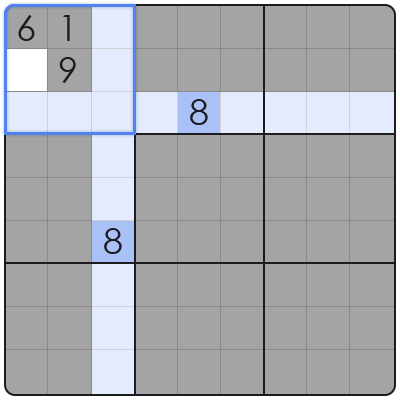
The initial steps in how to do Sudoku puzzles involve systematically scanning the grid to identify immediate placements and potential candidates. A strategic start is crucial for setting a solid foundation, beginning with a thorough visual sweep for obvious numbers. This process involves looking for instances where a digit can only logically fit into one cell within a row, column, or 3×3 block, often referred to as ‘Naked Singles’ or ‘Visible Singles’.
The crucial role of ‘pencil marks,’ or candidate notation, cannot be overstated in this stage. These small numbers, written lightly in each empty cell, represent all possible digits that could potentially occupy that cell. By meticulously noting these candidates, you create a visual database of possibilities. As you place more numbers, you will ‘eliminate’ these pencil marks from corresponding cells, constantly refining your understanding of the grid’s state.
Effective candidate elimination is a dynamic process. After placing a new number, immediately scan its row, column, and 3×3 block to remove that number’s pencil mark from all other cells in those regions. This often reveals new ‘Naked Singles’ or exposes other basic patterns, allowing you to chain deductions. This systematic approach, driven by careful observation and updating, forms the cornerstone of approaching how to do Sudoku puzzles efficiently.
Applying Core Sudoku Strategies: The Art of Logical Deduction
Applying core Sudoku strategies is central to understanding how to do Sudoku puzzles, enabling the deduction of hidden numbers through advanced candidate analysis. Beyond simply placing ‘Naked Singles,’ players must learn to identify ‘Hidden Singles.’ A Hidden Single occurs when a particular digit is a possible candidate in only one cell within a specific row, column, or 3×3 block, even if that cell has other candidates. This unique placement makes it the definitive number for that cell.
Mastering cell constraints involves meticulously examining the intersections of rows, columns, and blocks. For example, if a specific number can only exist in two cells within a block, and those two cells happen to fall on the same row, then that number can be eliminated as a possibility from all other cells in that row outside the block. This cross-referencing is a powerful technique rooted in the structural necessity of the Sudoku grid.
The structural necessity of considering multiple regions simultaneously becomes increasingly important as puzzles become harder. This methodical, logic-first approach, where every move is justified by the rules of the grid, prevents errors and builds confidence. Developing this eye for interconnected possibilities is what truly transforms a novice into a proficient solver of how to do Sudoku puzzles.
Elevating Your Game: Beyond the Basics of How to Do Sudoku Puzzles
Elevating your game in how to do Sudoku puzzles involves mastering more complex patterns and strategic thinking to resolve challenging grids. Once comfortable with singles, the next logical step is to identify ‘Naked Pairs’ or ‘Naked Triples.’ A Naked Pair consists of two cells within the same row, column, or block that contain only two identical candidates (e.g., {2,5} and {2,5}). Once identified, these two numbers can be eliminated from all other cells in that region, as they must occupy those two specific cells.
Similarly, ‘Hidden Pairs’ and ‘Hidden Triples’ involve identifying two or three candidates that can only exist within two or three specific cells within a region, effectively ‘hiding’ among other candidates. These techniques offer a significant leap in logical complexity compared to simple candidate elimination. For competitive solvers, the ability to spot these patterns quickly and accurately is a hallmark of efficiency and advanced grid topology understanding.
Beyond pairs and triples, advanced techniques like the ‘X-Wing’ and ‘Swordfish’ patterns represent sophisticated applications of candidate elimination across multiple rows or columns. While more difficult to spot and utilize, these strategies dramatically increase the solvable range of Sudoku puzzles. They exemplify how mastering how to do Sudoku puzzles is a continuous learning process, where each new technique builds upon a deeper understanding of the grid’s inherent logic and cell constraints.
Avoiding Common Missteps When Learning How to Do Sudoku Puzzles
Avoiding common missteps when learning how to do Sudoku puzzles is crucial for accurate and efficient problem-solving. One of the most frequent errors beginners make is resorting to guessing when stuck. Guessing introduces uncertainty and often leads to a cascade of incorrect placements, forcing players to backtrack and erase extensively. A true Sudoku solution is always derived from pure logic, not chance, so if you find yourself guessing, it’s a sign to re-evaluate your current deductions.
Another significant pitfall involves inaccurate or incomplete pencil marks. Rushing this critical step or making errors in candidate notation can derail an entire puzzle. It is vital to diligently update pencil marks after every number placement, removing eliminated candidates and adding new ones where appropriate. Failure to maintain accurate pencil marks deprives you of the visual information necessary for identifying more advanced patterns and logical deductions.
Finally, many players suffer from ‘tunnel vision,’ focusing too intently on one specific area of the grid. This can lead to missing crucial opportunities that arise elsewhere after a number has been placed. After each successful deduction, it is essential to re-scan the entire grid—rows, columns, and blocks—for new ‘Naked Singles,’ ‘Hidden Singles,’ or other patterns that might have become apparent. This holistic approach ensures you capitalize on all available information and effectively understand how to do Sudoku puzzles consistently.
Your Top Questions Answered: How to Do Sudoku Puzzles
What is the very first step in how to do Sudoku puzzles? The very first step is to scan rows, columns, and 3×3 blocks for numbers that can only fit in one specific cell. This identifies “Naked Singles” and builds initial certainty, starting your logical deduction process.
Should I use pencil marks when learning how to do Sudoku puzzles? Yes, using pencil marks is highly recommended for all but the simplest puzzles. They help visualize all possible candidates for each cell, aiding in advanced logical deductions and effectively managing cell constraints.
What if I get stuck while doing a Sudoku puzzle? If you get stuck, review your pencil marks for errors or missed deductions. Look for “Hidden Singles” or “Naked Pairs” in rows, columns, or blocks. Sometimes, stepping away briefly can help identify new patterns and avoid tunnel vision.
Are there advanced techniques for how to do Sudoku puzzles faster? Yes, advanced techniques like X-Wing, Swordfish, and chaining patterns significantly improve solving speed and tackle harder puzzles. These build upon a solid understanding of candidate elimination and grid topology, crucial for competitive solvers.
How does logical deduction differ from guessing in Sudoku? Logical deduction is based on irrefutable grid rules and candidate elimination, ensuring correctness. Guessing involves arbitrary placement without logical proof, often leading to errors and making it impossible to truly understand how to do Sudoku puzzles correctly.
The Logic-First Approach to Sudoku Mastery
Mastering how to do Sudoku puzzles is an accessible yet profoundly engaging intellectual pursuit, demanding a “logic-first” approach that shuns guesswork in favor of systematic deduction. From the initial pencil marks to the final number placement, every step is a testament to the power of structured thinking and careful observation of grid topology and cell constraints. By diligently applying candidate elimination, identifying patterns like Naked and Hidden Singles, and progressively tackling more complex techniques, any player can enhance their problem-solving skills and derive immense satisfaction from conquering even the most challenging grids. Embrace the journey of continuous learning, and let the elegance of logical deduction guide your path to becoming a true Sudoku master.
The structural integrity of Sudoku relies entirely on the logical relationships between numbers across rows, columns, and blocks. Developing an intuitive understanding of these interconnections is what separates a casual player from a proficient one. Regular practice, coupled with a deep dive into the various deductive strategies, solidifies one’s ability to approach any Sudoku puzzle with confidence and precision. Remember, every unsolved cell is simply an invitation for further logical inquiry.
Ultimately, how to do Sudoku puzzles is less about raw mathematical ability and more about cultivating patience, precision, and a robust analytical mindset. The skills honed through Sudoku—attentiveness to detail, systematic problem-solving, and the ability to track multiple variables—are invaluable in many aspects of life. Continue to refine your techniques, trust in logical deduction, and enjoy the enduring intellectual pleasure that Sudoku consistently offers.
Mastering how to do Sudoku puzzles is an accessible yet profoundly engaging intellectual pursuit, demanding a “logic-first” approach that shuns guesswork in favor of systematic deduction. From the initial pencil marks to the final number placement, every step is a testament to the power of structured thinking and careful observation of grid topology and cell constraints. By diligently applying candidate elimination, identifying patterns like Naked and Hidden Singles, and progressively tackling more complex techniques, any player can enhance their problem-solving skills and derive immense satisfaction from conquering even the most challenging grids. Embrace the journey of continuous learning, and let the elegance of logical deduction guide your path to becoming a true Sudoku master.