

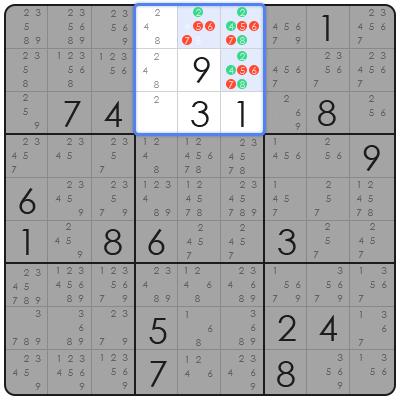
The world of Sudoku extends far beyond the classic 9×9 grid, encompassing a fascinating array of variations that challenge players with unique rules and grid topologies. Understanding these different kinds of Sudoku is essential for both speed-solvers aiming to hone their skills and casual players looking to expand their logical deduction toolkit. Each variant introduces novel constraints, demanding adaptability and a deeper appreciation for the underlying mathematical principles that govern these captivating logic puzzles. For competitive solvers, recognizing and efficiently applying strategies across various Sudoku types is paramount for shaving precious seconds off their solving times. For casual players, exploring these different kinds of Sudoku offers a refreshing mental workout, preventing stagnation and fostering a more profound understanding of logical reasoning. This article will delve into the intricacies of several popular Sudoku variations, explaining their core mechanics, strategic approaches, and how they build upon the foundational principles of the classic game. The beauty of Sudoku, in all its forms, lies in its elegant simplicity and the depth of logical deduction it requires. Whether you’re a seasoned grandmaster or just beginning your puzzle journey, understanding the nuances of different kinds of Sudoku can unlock new levels of enjoyment and mental acuity. This guide aims to provide a comprehensive overview, ensuring you’re well-equipped to tackle any grid that comes your way, from the familiar to the esoteric.
The Mathematical Foundation of Sudoku Variants
The logic behind different kinds of Sudoku hinges on the principle of Latin squares, extended and constrained by additional rules that govern specific regions or cell relationships. At its core, a standard Sudoku requires each row, column, and 3×3 box to contain the digits 1 through 9 exactly once. Variants introduce new ‘neighborhoods’ or relationships that must also adhere to this unique number constraint.
For instance, Killer Sudoku adds ‘cages’ – groups of cells with a specified sum – that must contain unique digits. This introduces a layer of arithmetic alongside the spatial logic. Jigsaw Sudoku (also known as Irregular Sudoku or Geometry Sudoku) replaces the standard 3×3 boxes with irregularly shaped regions of nine cells each, demanding a flexible approach to identifying the unique number constraints. Other variants, like Diagonal Sudoku, add constraints to the main diagonals, requiring consistent digit placement along these lines. The mathematical underpinning remains the same: ensuring uniqueness within defined sets, but the definition of these sets is what differentiates the variants.
Understanding the structural necessity of these additional constraints is key to mastering any Sudoku variant. Each new rule, whether it’s a sum in a cage, a shape of a region, or a diagonal requirement, creates new pathways for logical deduction. These pathways allow for more sophisticated candidate elimination and the identification of more complex patterns, often making previously unsolvable classic Sudoku puzzles tractable within the context of the variant’s rules.
How to Approach Different Kinds of Sudoku: A Step-by-Step Guide
To effectively tackle different kinds of Sudoku, the first step is to thoroughly understand the specific rules of the variant you are playing. Always begin by noting all the new constraints introduced beyond the standard row, column, and box rules. For Killer Sudoku, this means identifying the sums of all cages. For Jigsaw Sudoku, it involves familiarizing yourself with the shape and boundaries of each irregular region. For Diagonal Sudoku, mark the two main diagonals.
Next, apply the basic Sudoku techniques of candidate elimination (often using pencil marks) to the standard row, column, and box constraints. As you place numbers, constantly cross-reference them with the variant-specific rules. For example, in Killer Sudoku, if you’ve determined the possible combinations for a cage’s sum, any number placed in a cell within that cage will eliminate that digit as a possibility for other cells in the same cage, and vice-versa. This dual application of logic is crucial.
Finally, look for interactions between the standard Sudoku constraints and the variant-specific ones. A number placed in a cell due to a cage sum might, in turn, reveal a unique candidate for a row or column that was previously ambiguous. Conversely, a number forced into a specific cell by standard logic might significantly narrow down the possibilities for a cage’s sum. Continuously cycling through all rules and possibilities is the most effective way to progress through any Sudoku variant.
Comparative Analysis of Sudoku Strategies
To provide a clearer picture of how different kinds of Sudoku and their associated strategies interact, consider this comparative analysis:
| Strategy/Variant | Difficulty Level | Frequency of Use | Logical Complexity | Focus Areas |
|—|—|—|—|—|
| Standard Sudoku | Easy to Medium | Very High | Basic (Candidate Elimination, Hidden Singles) | Rows, Columns, 3×3 Boxes |
| Killer Sudoku | Medium to Hard | Medium | Moderate (Arithmetic, Cage Combinations, Basic Sudoku Logic) | Cages, Sums, Rows, Columns, Boxes |
| Jigsaw Sudoku | Medium to Hard | Medium | Moderate (Region Identification, Basic Sudoku Logic) | Irregular Regions, Rows, Columns |
| Diagonal Sudoku | Medium | Medium | Moderate (Diagonal Constraint, Basic Sudoku Logic) | Diagonals, Rows, Columns, Boxes |
| Advanced Techniques (e.g., X-Wing, Swordfish) | Hard | Varies | High (Pattern Recognition, Multi-Row/Column Analysis) | Across Standard Grid Structures |
Common Pitfalls When Solving Sudoku Variants
One common pitfall is neglecting the variant-specific rules until later in the solving process. Many players focus solely on standard Sudoku logic initially, only to find themselves stuck when the unique constraints become crucial. To avoid this, always review and integrate the variant’s rules from the very first step, using them to inform your initial pencil marks and candidate eliminations.
Another frequent mistake is misinterpreting or miscalculating cage sums in Killer Sudoku. A simple arithmetic error can lead to an incorrect deduction that propagates through the grid. Always double-check your calculations and be methodical when listing possible digit combinations for each cage, ensuring uniqueness within the cage.
Finally, for Jigsaw Sudoku, players sometimes struggle to mentally ‘see’ the irregular regions, reverting to thinking in terms of 3×3 boxes. It is vital to consistently focus on the actual boundaries of the defined regions. Visualizing these shapes and understanding which cells belong to which region is key to applying the uniqueness constraint correctly. Practice tracing these regions with your finger or a stylus can help build this spatial awareness.
Frequently Asked Questions about Different Kinds of Sudoku
Q: What is the easiest Sudoku variant for beginners?
A: Diagonal Sudoku is often considered an accessible variant, as it adds only two simple constraints to the standard rules, making it easier to grasp than Killer or Jigsaw Sudoku.
Q: Do advanced Sudoku techniques like X-Wing apply to variants?
A: Yes, advanced techniques can often be applied to Sudoku variants, but their effectiveness and how they interact with the variant’s unique rules must be carefully considered.
Q: How does Killer Sudoku’s cage system work?
A: Killer Sudoku cages are groups of cells that must sum to a specific number, with the additional rule that all digits within a cage must be unique.
Q: Is Jigsaw Sudoku just a harder version of classic Sudoku?
A: Jigsaw Sudoku is different rather than strictly harder; it replaces the 3×3 boxes with irregular shapes, changing the spatial logic required while still relying on fundamental Sudoku deduction.
Q: What is the primary skill developed by playing different kinds of Sudoku?
A: Playing various Sudoku types primarily enhances logical deduction, pattern recognition, and the ability to adapt strategies based on new constraints and rules.
Mastering different kinds of Sudoku is a journey built on a ‘Logic-First’ approach. While each variant presents unique challenges and rule sets, the fundamental principles of logical deduction, candidate elimination, and systematic analysis remain constant. By understanding the core mechanics and carefully integrating variant-specific constraints with established Sudoku techniques, players can elevate their problem-solving skills and deepen their appreciation for the elegance of these puzzles. Embrace the variety, hone your logical reasoning, and enjoy the rewarding experience of conquering any grid.