

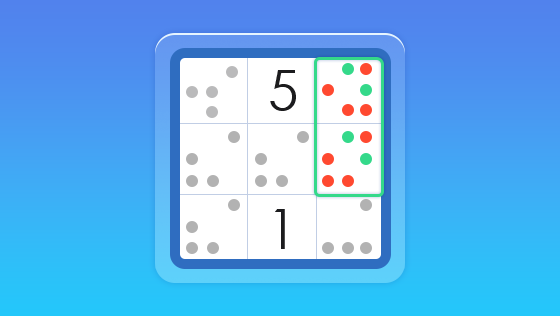
The Sudoku Unique Rectangle is a sophisticated advanced Sudoku solving technique that leverages specific configurations within the grid to eliminate candidate possibilities and uncover hidden digits, thereby simplifying the puzzle. Understanding the Sudoku Unique Rectangle is crucial for players aiming to improve their solving speed and accuracy, moving beyond basic candidate elimination to more complex logical deduction. While it might seem intimidating at first, mastering the Sudoku Unique Rectangle allows solvers to tackle more challenging puzzles efficiently and provides a significant advantage in competitive Sudoku environments.
The Logic Behind the Sudoku Unique Rectangle
The Sudoku Unique Rectangle is a powerful pattern-solving technique that relies on the fundamental rule of Sudoku: each row, column, and 3×3 box must contain the digits 1 through 9 exactly once.
This technique specifically targets scenarios where four cells form a rectangle across two rows and two columns, and these four cells contain only two candidates. The structural necessity of unique solutions in Sudoku is what makes this pattern so potent.
When these four cells, say at (R1, C1), (R1, C2), (R2, C1), and (R2, C2), all share the same two candidates (e.g., {3, 7}), and these are the only candidates in these cells, the Sudoku Unique Rectangle logic allows us to deduce that one specific candidate *cannot* be placed in certain locations, thereby breaking the deadlock. Based on logic-chain analysis, if placing a ‘3’ in (R1, C1) leads to a contradiction elsewhere, then ‘7’ must be in (R1, C1), and vice-versa for the other cells in the rectangle. However, the true power lies in the ‘uniqueness’ principle: if there were two possible solutions arising from this rectangle, the puzzle would not have a single, unique solution, which is a prerequisite for standard Sudoku puzzles.
How to Identify and Apply the Sudoku Unique Rectangle
To effectively use the Sudoku Unique Rectangle, begin by diligently filling in all possible candidates for each empty cell using basic techniques like Naked Singles, Hidden Singles, and Pair Elimination. This process, often referred to as using pencil marks, is foundational.
Once candidates are noted, scan the grid for rectangles formed by four cells that share exactly two candidates, say {A, B}. Ensure these two candidates appear in both cells of a given row and both cells of a given column within this rectangle, and importantly, that these are the *only* candidates in these four cells.
With the rectangle identified and candidates {A, B} confirmed in all four cells, consider the implications for cells that have either candidate A or B as their sole remaining options. For instance, if a cell in the same row as the rectangle has candidate B as its only possibility, and another cell in the same column as the rectangle has candidate A as its only possibility, this configuration is what the Sudoku Unique Rectangle addresses. The core logic dictates that *if* one of the cells in the rectangle is A, then a certain elimination becomes possible elsewhere. If that cell is B, a different elimination is possible. Since a Sudoku must have a unique solution, one of these scenarios must be impossible, allowing for a definitive placement or elimination.
Sudoku Unique Rectangle vs. Other Advanced Techniques
The Sudoku Unique Rectangle is a high-level pattern that requires a significant amount of candidate information and grid analysis to spot.
It is less frequently encountered than fundamental techniques like Naked Pairs but is more deterministic when it appears. Its logical complexity stems from the reliance on the puzzle’s overall uniqueness constraint.
While X-Wings and Swordfish also focus on candidate elimination across rows and columns, they typically involve more than two candidates and a larger number of rows/columns. The Sudoku Unique Rectangle is precisely targeted at a specific four-cell, two-candidate structure.
Common Pitfalls When Applying the Sudoku Unique Rectangle
A primary mistake is misidentifying the pattern: ensuring that all four cells in the rectangle contain *only* the two specific candidates is crucial; if other candidates are present, the logic breaks down.
Another common error is incorrectly applying the elimination rule after identifying the rectangle. The technique’s power comes from realizing that if placing one candidate in a corner cell leads to a contradiction, the *other* candidate must be in that corner. This often means eliminating the ‘other’ candidate from cells that *only* contain one of the two shared candidates.
Players may also overlook the uniqueness constraint. The Sudoku Unique Rectangle is only valid if its presence (or absence) is essential for ensuring a single solution. If the puzzle can be solved without considering it, or if its application leads to multiple solutions, it’s being misapplied.
Frequently Asked Questions about the Sudoku Unique Rectangle
What exactly is a Sudoku Unique Rectangle?
A Sudoku Unique Rectangle involves four cells forming a rectangle, each containing only two specific candidates (e.g., {A, B}). It exploits the rule that a Sudoku must have only one solution to make deductions.
When should I look for a Sudoku Unique Rectangle?
Look for this technique when you have thoroughly marked all candidates and are facing a difficult step where standard eliminations are insufficient, especially when you spot potential two-candidate rectangles.
Is the Sudoku Unique Rectangle always present in hard puzzles?
Not necessarily. While advanced, it’s a specific pattern. Many hard puzzles are solved using other complex techniques or combinations, but recognizing it can unlock particularly stubborn grids.
How does it differ from a Naked Pair?
A Naked Pair involves two cells in the same unit (row, column, or box) with only two identical candidates, allowing elimination from *other* cells in that unit. A Unique Rectangle uses four cells to form a rectangle and relies on the global puzzle uniqueness for elimination.
Can this technique be used in variations other than 9×9 Sudoku?
The principle can be adapted to other grid sizes and variations, but the specific 9×9 structure and the common ‘rectangle’ shape are most often associated with standard Sudoku. The core logic of candidate interaction and uniqueness remains applicable.
The Sudoku Unique Rectangle is a testament to the intricate logical architecture underlying Sudoku puzzles. By understanding and applying this advanced strategy, solvers can enhance their deductive capabilities significantly, moving towards a more profound mastery of the game through a logic-first approach.