

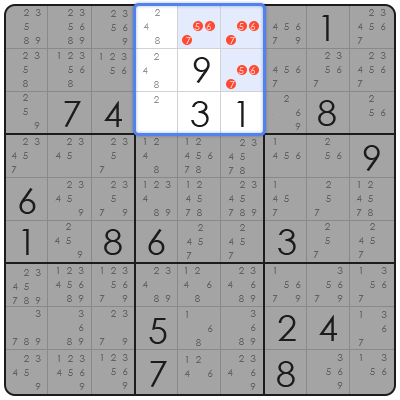
In the intricate world of Sudoku, a ‘candidate’ refers to a potential digit (1-9) that can logically occupy an empty cell without violating the fundamental rules governing rows, columns, and 3×3 blocks. This seemingly simple concept forms the bedrock of systematic puzzle solving, distinguishing efficient logical deduction from mere guesswork. The significance of managing candidates cannot be overstated. It transforms a seemingly overwhelming 81-cell grid into a tractable problem, providing a clear, verifiable pathway to the solution. By meticulously identifying and tracking these potential numbers, solvers gain profound insights into the structural constraints of the puzzle. The primary problem candidate management solves is the inherent ambiguity of empty cells. Instead of blindly attempting numbers, a candidate-based approach allows for a structured elimination process, drastically reducing errors, preventing dead ends, and making even the most complex Sudoku puzzles accessible through pure logic. Effective candidate management is, therefore, the cornerstone of all advanced Sudoku strategies, essential for moving beyond basic techniques.
The Foundational Mechanics of Sudoku Candidates
Sudoku candidates are the set of all possible digits (1-9) that could logically fit into an empty cell, given the constraints of its row, column, and 3×3 block. These candidates are not static; they are dynamic entities, constantly refined as numbers are placed, and serve as the primary data points for all subsequent logical deductions.
From a framework perspective, the precise identification of candidates for each empty cell is the initial data-gathering phase of any serious Sudoku endeavor. It shifts the solver’s focus from attempting to guess the correct number to systematically narrowing down possibilities based on established rules.
Based on structural analysis, the process of listing candidates transforms a seemingly complex and intractable grid into a solvable logical matrix. This systematic approach eradicates the need for brute-force attempts, replacing them with a calculated and verifiable placement methodology.
Initial Candidate Identification: A Structured Approach
Initial candidate identification involves scrutinizing each empty cell individually and, for each, eliminating any digit that is already present in its corresponding row, column, or 3×3 block. This meticulous process lays the groundwork for all subsequent solving techniques.
This foundational step, often performed mentally for simpler puzzles or with pencil marks for more challenging ones, creates the essential data set upon which all advanced Sudoku strategies are built. Accuracy and thoroughness in this phase are critically important.
In practical application, any error during this initial candidate listing phase will propagate through the entire puzzle, leading to incorrect deductions and ultimately rendering the puzzle unsolvable or requiring extensive backtracking. Therefore, a careful, methodical approach is indispensable.
Advanced Candidate Strategies: Beyond Singles
Advanced candidate strategies extend beyond simply finding a single candidate for a cell, delving into identifying intricate patterns and relationships among multiple candidates within cells, rows, columns, and blocks. These techniques are crucial for tackling higher-difficulty puzzles.
These sophisticated methods, which include strategies such as Naked Pairs, Hidden Pairs, X-Wing, and Swordfish, leverage the collective information of candidates to deduce definitive placements or eliminate possibilities that are not immediately obvious through simple scanning.
From a framework perspective, mastering these advanced techniques is what distinguishes truly efficient and proficient Sudoku solvers. They enable navigation through complex logical landscapes, systematically reducing the candidate pool until a unique solution emerges for otherwise stubborn cells.
Based on structural analysis, these strategies fundamentally rely on the principle of uniqueness and exclusion, allowing solvers to make powerful deductions by observing how candidates interact across different units of the grid.
Step-by-Step Implementation of Candidate Elimination
Applying candidate elimination in Sudoku is a methodical, iterative process that begins with a comprehensive initial scan and progresses through continuous refinement. This structured approach ensures no logical opportunities are missed.
Based on structural analysis, here is a clear, numbered guide on how to effectively implement candidate management to solve Sudoku puzzles efficiently:
1. **Initial Grid Scan:** For every empty cell, begin by listing all digits (1-9) as potential candidates. This creates a raw, unfiltered set of possibilities for each void space.
2. **Basic Elimination:** For each cell, systematically remove any candidate digit that already exists in its designated row, column, or 3×3 block. Update these lists continuously as numbers are placed or eliminated.
3. **Identify Naked Singles:** If, after basic elimination, a cell has only one candidate remaining, that digit is the definitive solution for that cell. Place the digit and immediately repeat step 2 across the grid, as this new placement will trigger further eliminations.
4. **Identify Hidden Singles:** Actively search for a candidate digit that appears only once within the candidate lists of empty cells in a specific row, column, or 3×3 block. If found, that digit is the solution for that cell, even if it has other candidates. Place it and reiterate step 2.
5. **Pattern Recognition (Pairs/Triples):** Look for Naked Pairs/Triples (two or three cells in a unit with the exact same two/three candidates, and no other candidates) or Hidden Pairs/Triples (two or three candidates that only appear in two/three specific cells within a unit). Use these patterns to eliminate those candidates from other cells in that unit.
6. **Advanced Techniques:** For more challenging puzzles, employ advanced strategies like X-Wing, Swordfish, or Forcing Chains. All these rely heavily on intricate candidate interactions and relationships across multiple units.
7. **Iterate and Re-evaluate:** Continuously cycle through these steps. Placing a new number or eliminating a candidate always creates new opportunities for further deductions, making the process highly iterative.
Comparative Analysis: Candidate-Based vs. Guessing
A comparative analysis starkly reveals the superior efficacy of a candidate-based approach over traditional guessing in Sudoku solving. These two methods represent fundamentally different paradigms for problem-solving.
Candidate management offers a systematic, verifiable, and logic-driven path to a solution, contrasting sharply with random guessing, which relies on trial-and-error and frequently leads to convoluted dead ends, requiring extensive backtracking.
Based on structural analysis, the efficiency gains realized through the systematic use of candidates are profound, particularly evident in higher-difficulty puzzles where the sheer volume of potential solutions makes guessing impractical and frustrating.
From a framework perspective, guessing introduces uncertainty and potential errors, whereas candidate elimination systematically reduces uncertainty, providing a clear audit trail of logical steps.
Common Pitfalls in Candidate Management and Their Solutions
Even experienced solvers can inadvertently fall into common traps when meticulously managing candidates; recognizing these pitfalls is paramount for consistent improvement and efficient solving.
One frequent mistake is **incomplete initial candidate listing**, where certain potential digits are overlooked for an empty cell. This omission leads to missed opportunities for early deductions and can halt progress.
**Solution:** Systematically scan each empty cell for row, column, and block exclusions, taking care to double-check before proceeding. Use a consistent, methodical approach to ensure no digit is inadvertently missed.
Another critical pitfall is **failing to update candidates immediately** after a new number has been placed into a cell. This results in outdated information, which can lead to incorrect deductions and wasted effort.
**Solution:** From a framework perspective, treat candidate lists as dynamic entities. Every time a digit is placed, make it a habit to immediately re-evaluate and eliminate that digit from the candidate pools of all cells within its row, column, and 3×3 block.
A third common error is **over-reliance on finding ‘Naked Singles’ while neglecting ‘Hidden Singles’ or pairs**, particularly prevalent in harder puzzles where explicit singles are rare. This prevents breakthroughs.
**Solution:** Actively search for less obvious patterns. Based on structural analysis, the key to unlocking a difficult puzzle often lies in identifying these more subtle, hidden candidate relationships rather than waiting for obvious single placements to appear.
FAQ: Essential Insights into Sudoku Candidate Management
**Q: What is a candidate in Sudoku?** A: A candidate is a potential digit (1-9) that could logically occupy an empty cell without violating Sudoku rules for its row, column, or 3×3 block.
**Q: Why are candidates important for solving Sudoku?** A: Candidates provide a systematic, logical framework, eliminating guesswork and enabling advanced deduction techniques for efficient, error-free puzzle solving.
**Q: How do I identify initial candidates?** A: For each empty cell, list all digits 1-9, then cross out any digit already present in that cell’s row, column, or 3×3 block.
**Q: What is the difference between a Naked Single and a Hidden Single?** A: A Naked Single is the *only* candidate left in a cell. A Hidden Single is a candidate that is the *only* place a particular digit can go within a specific row, column, or block.
**Q: Can candidate tracking help with any Sudoku puzzle?** A: Yes, fundamental candidate tracking is essential for all difficulty levels, forming the basis for both basic and advanced strategies, making every puzzle solvable through logic.
In conclusion, understanding how to use candidate in Sudoku – or more precisely, mastering candidate management – is not merely a technique but the foundational bedrock of systematic Sudoku solving. It transforms the puzzle from a game of chance into a rigorous logical challenge, offering a clear, verifiable, and highly efficient pathway to every solution. From a framework perspective, the strategic value of meticulous candidate tracking extends beyond the puzzle itself, honing analytical thinking and systematic problem-solving skills invaluable in diverse fields. As puzzles continue to grow in complexity, the ability to expertly manage and interpret candidate data will remain the definitive differentiator for solvers aiming for consistent success and deeper logical insight.