

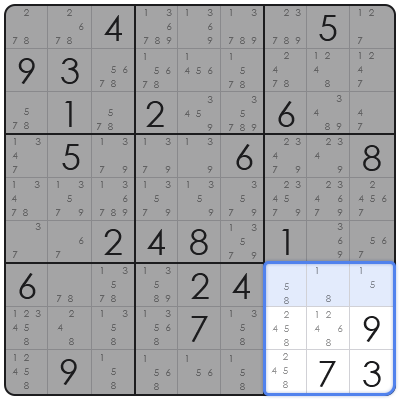
Solving Sudoku faster is not merely a matter of quick number placement; it is a sophisticated exercise in logical deduction, pattern recognition, and systematic elimination. From a cognitive strategy perspective, accelerating Sudoku completion involves optimizing mental processes to identify constraints and deduce solutions with heightened efficiency. This article delves into the core mechanisms that enable rapid Sudoku resolution, offering insights for enthusiasts aiming to reduce their solve times significantly. The primary problem that expedited Sudoku solving addresses is the human tendency towards trial-and-error or brute-force methods, which are inherently inefficient and prone to errors. Instead, a structured, analytical approach, grounded in specific techniques and systematic application, transforms the puzzle from a test of endurance into a challenge of strategic thinking. This paradigm shift is central to understanding how to solve Sudoku faster within the current landscape of intellectual challenges. Based on structural analysis, optimizing your Sudoku strategy involves a blend of foundational rules mastery and advanced pattern identification. This comprehensive guide will break down the essential components, step-by-step implementations, and common pitfalls, providing a definitive framework for achieving faster, more accurate Sudoku solutions. It is about sharpening your observational skills and applying logical inferences with precision and speed.
The Underlying Logic and Cognitive Framework of Rapid Sudoku Resolution
Solving Sudoku faster fundamentally involves a shift from brute-force number placement to sophisticated pattern recognition and systematic elimination. The 9×9 grid, divided into nine 3×3 sub-grids (blocks), operates on a simple principle: each row, column, and block must contain all digits from 1 to 9 exactly once. The cognitive framework for speed optimization centers on anticipating implications of each number placement, rather than just reacting to immediate vacancies. This proactive mental model is paramount for accelerating solve times.
From a framework perspective, achieving speed in Sudoku hinges on developing robust mental heuristics. These are cognitive shortcuts that allow the brain to quickly assess the grid for immediate deductions. This includes rapid scanning for ‘single’ possibilities—where only one number can fit into a specific cell, row, column, or block. Effective training in this area establishes a baseline for how to solve Sudoku faster, building a foundation of quick, reliable deductions.
In practical application, the underlying logic demands a continuous cycle of observation, deduction, and verification. It’s about maintaining a dynamic mental map of the grid, updating possibilities with each successful placement. This continuous feedback loop ensures that the solver is always working with the most current and accurate information, minimizing backtracking and maximizing forward progress. Mastery of this cycle is a hallmark of an expedited Sudoku solver.
Essential Techniques for Accelerated Initial Placement
Accelerating initial Sudoku number placement relies on mastering ‘singles’ identification across rows, columns, and 3×3 blocks. Naked Singles are the most basic and powerful technique: if a cell can only contain one possible digit based on its row, column, and block constraints, that digit can be placed immediately. This technique is the bedrock for how to solve Sudoku faster, as it quickly prunes the decision tree.
Hidden Singles, while slightly more complex, are equally vital. A Hidden Single occurs when a specific digit can only be placed in one cell within a particular row, column, or block, even if that cell initially has multiple candidate digits. Identifying these requires a focused scan for each number (1-9) across the un-filled cells within a constraint unit. Efficiently locating Hidden Singles marks a significant step towards improved speed and accuracy.
Effective candidate marking, often done mentally or with small notations, underpins the rapid identification of both Naked and Hidden Singles. By keeping track of possible numbers for each empty cell, solvers can quickly cross-reference conflicting digits and pinpoint the inevitable placements. This systematic approach to initial deductions reduces cognitive load and streamlines the early stages of solving, setting the pace for a faster overall solve.
Advanced Pattern Recognition Strategies for Speed
Advanced pattern recognition strategies are crucial for how to solve Sudoku faster, enabling the elimination of candidates based on logical interdependencies across the grid. Naked Pairs/Triples/Quadruples involve identifying 2, 3, or 4 cells within a unit (row, column, or block) that share the exact same 2, 3, or 4 candidate digits, and no other cells in that unit can contain those digits. These patterns allow for the removal of those shared candidates from other cells in the unit.
Similarly, Hidden Pairs/Triples/Quadruples are powerful, occurring when a set of 2, 3, or 4 candidate digits appear only in a corresponding set of 2, 3, or 4 cells within a unit. This allows for the elimination of all other candidates from those specific cells, and potentially the elimination of those digits from other cells within the same unit. Mastering these hidden patterns is a clear differentiator for advanced solvers.
More intricate techniques, such as X-Wing and Swordfish, leverage row-column interactions to eliminate candidates across multiple units. An X-Wing, for instance, involves two rows where a specific candidate digit appears in only two identical columns, allowing that candidate to be removed from those columns in other rows. Understanding and applying these complex inter-unit logic patterns are essential for navigating tougher puzzles and achieving elite solving speeds, embodying the pinnacle of how to solve Sudoku faster through strategic insight.
A Systematic Implementation Guide for Boosting Solve Speed
A systematic approach to Sudoku involves a hierarchical application of techniques, beginning with direct deductions and progressing to more complex pattern recognition to significantly boost solve speed. Firstly, begin by performing a comprehensive scan for all Naked Singles across the entire grid. This initial pass often reveals a significant number of immediate placements, simplifying the puzzle considerably. Prioritize these obvious deductions.
Secondly, after exhausting Naked Singles, proceed to identify Hidden Singles. Systematically check each row, column, and 3×3 block for digits that can only reside in one specific cell within that unit. This requires a more focused examination of candidate possibilities. Continuously cycle through Naked and Hidden Singles after each new number placement, as new placements frequently create new single opportunities. Consistency in this iterative process is key for how to solve Sudoku faster.
Thirdly, when basic singles diminish, advance to pattern-based eliminations like Naked/Hidden Pairs and Triples. At this stage, candidate marking becomes invaluable, allowing you to quickly spot these groupings. For particularly stubborn puzzles, employ advanced techniques such as X-Wings or Swordfish. The methodical progression from simpler to more complex strategies ensures efficient problem-solving and minimizes wasted effort, solidifying a professional approach to rapid Sudoku resolution.
Comparative Efficacy of Sudoku Solving Methodologies
The efficacy of various Sudoku solving methodologies can be comparatively analyzed across dimensions such as complexity, efficiency, and frequency of application in typical puzzles. Basic scanning for Naked Singles, while low in complexity, offers high efficiency during the initial stages and is frequently applicable. This method provides the foundational speed, making it the starting point for anyone learning how to solve Sudoku faster.
Candidate notation combined with Hidden Singles and Pairs represents a medium complexity strategy, significantly boosting efficiency when basic singles are exhausted. Its frequency of application is high across a broad range of Sudoku difficulties. This approach provides a balance between mental effort and deductive power, allowing for consistent progress even in moderately challenging grids. It enhances the solver’s ability to see deeper into the puzzle’s structure.
Advanced techniques like X-Wing and Swordfish are of high complexity and require considerable mental processing, but offer very high efficiency in breaking deadlocks in expert-level puzzles. Their frequency of application is lower, as they are typically only needed in harder Sudokus. While not always necessary, mastering these complex patterns is crucial for consistent speed across all difficulty levels, showcasing a complete mastery of how to solve Sudoku faster from a strategic perspective.
Navigating Common Obstacles in Expedited Sudoku Solving
Navigating common obstacles in expedited Sudoku solving requires a disciplined approach to candidate tracking and a strategic mindset to avoid logical fallacies. A frequent mistake is inconsistent candidate marking or failing to systematically update possibilities after each placement. This leads to missed deductions and unnecessary backtracking, severely hindering speed. The solution involves developing a consistent notation system, whether mental or physical, and meticulously updating it.
Another pitfall is rushing and making ‘jump-ahead’ assumptions without rigorous logical verification. This often results in placing incorrect numbers, necessitating a complete reset or extensive error correction, which drastically impacts overall solve time. Expert advice emphasizes pausing after a deduction to mentally (or physically) verify its validity against all constraints before committing. This measured approach, paradoxically, leads to faster and more accurate solves, demonstrating a disciplined application of how to solve Sudoku faster.
Finally, getting stuck in a local optimum by repeatedly scanning the same areas without identifying new patterns is a common obstacle. When progress stalls, professionals recommend stepping back, re-evaluating the entire grid for higher-level patterns (like X-Wings), or systematically checking for a specific digit across all units. Shifting focus or employing a different strategy can unlock new deductions and maintain momentum, embodying an adaptive problem-solving framework.
Frequently Asked Questions About Enhancing Sudoku Performance
Frequently asked questions regarding enhancing Sudoku performance often revolve around technique efficiency, practice routines, and mental conditioning for speed. What is the quickest technique to learn? Naked Singles are the most accessible and effective starting point for immediate speed gains.
How much practice is needed to solve Sudoku faster? Consistent daily practice, even just one puzzle, helps to internalize patterns and improve recognition speed over time. Focus on understanding *why* a number fits, not just *that* it fits.
Should I use pencil marks? Yes, particularly for harder puzzles. Pencil marks (candidate notations) are invaluable for tracking possibilities and identifying complex patterns like Naked/Hidden Pairs. They are a tool for efficiency.
Is there a specific order to apply strategies? Based on structural analysis, start with simple deductions (Naked/Hidden Singles), then progressively apply more complex pattern-based eliminations as needed to maintain solving momentum.
How can I avoid errors when trying to solve faster? Verify each placement against its row, column, and block. A brief double-check prevents cascading errors that can significantly prolong the solve time. Accuracy underpins speed.
In conclusion, the journey to how to solve Sudoku faster is a definitive exercise in refining cognitive strategies and mastering a suite of logical deduction techniques. From the foundational identification of singles to the intricate application of advanced patterns, each method contributes to a holistic framework for rapid problem-solving. This strategic approach minimizes errors, maximizes efficiency, and transforms the Sudoku experience from a tedious task into an engaging intellectual pursuit. The long-term strategic value lies in the transferable skills of analytical thinking and systematic problem-solving, insights that extend far beyond the grid into various cognitive domains. Looking forward, continuous practice and an adaptive mindset remain crucial for anyone aiming to consistently achieve peak Sudoku performance.