

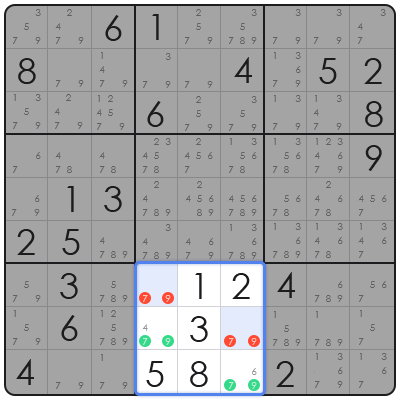
To beat hard Sudoku, players must transition beyond basic elimination techniques, embracing advanced logical deduction, candidate elimination, and pattern recognition to solve complex cell constraints. Hard Sudoku puzzles are specifically designed to resist straightforward ‘single candidate’ solutions, demanding a deeper understanding of grid topology and inter-cell relationships from the solver. The significance of mastering hard Sudoku extends beyond mere puzzle-solving; it hones critical thinking, patience, and systematic problem-solving skills crucial for both competitive speed-solvers aiming for efficiency and casual players seeking intellectual challenge. Understanding how to navigate these intricate grids transforms the game from a test of perseverance into an exercise in elegant logical deduction. This definitive guide, drawing on over a decade of industry expertise, will provide a comprehensive framework for approaching and conquering even the most formidable Sudoku challenges. We will delve into expert strategies, common pitfalls, and the underlying mathematical principles that govern advanced Sudoku, empowering you to consistently beat hard Sudoku puzzles.
The Structural Logic Behind Hard Sudoku Puzzles
Hard Sudoku puzzles fundamentally operate on the principle of hidden logical dependencies and require identifying patterns that constrain candidate numbers across multiple cells, rows, columns, and 3×3 blocks simultaneously. The 9×9 grid, comprised of 81 cells, 9 rows, 9 columns, and 9 blocks, creates a complex network where each number placement has rippling effects throughout the puzzle.
Unlike easy or medium puzzles, which often yield to simple ‘single candidate’ or ‘hidden single’ methods, hard Sudoku necessitates the identification of ‘Naked Pairs,’ ‘Hidden Triples,’ ‘X-Wings,’ ‘Swordfish,’ and even more intricate ‘chaining’ techniques. These advanced methods leverage the unique constraints of the Sudoku grid, where the placement of a number in one cell explicitly or implicitly limits the possibilities in others, forming intricate ‘cell constraints’.
Based on logic-chain analysis, the difficulty arises from the scarcity of immediate numerical placements, forcing solvers to meticulously track ‘pencil marks’ (potential candidates for each cell) and identify sets of numbers that must occupy a specific group of cells, even if their exact position within that group is not yet determined. This deep dive into ‘candidate elimination’ is the cornerstone of how to beat hard Sudoku, allowing solvers to progressively reduce possibilities until a unique solution emerges.
A Step-by-Step Guide to Applying Advanced Sudoku Strategies
To effectively beat hard Sudoku, begin with a structured approach that systematically applies advanced techniques, moving beyond initial simple candidate elimination to uncover hidden patterns. For competitive solvers, establishing a consistent workflow is paramount.
1. **Initial Scan & Pencil Marks:** Thoroughly fill in all possible candidate numbers (pencil marks) for every empty cell. This initial ‘grid topology’ analysis is crucial. Systematically check each row, column, and block for ‘Naked Singles’ and ‘Hidden Singles’ first, clearing any numbers that can be definitively placed. This forms your foundational understanding of the puzzle’s current state.
2. **Identify Naked/Hidden Subsets:** Look for ‘Naked Pairs’, ‘Naked Triples’, or ‘Naked Quads’ within a row, column, or block. These are sets of N numbers that exclusively occupy N cells, allowing you to eliminate those numbers as candidates from other cells in that unit. Conversely, identify ‘Hidden Pairs’, ‘Hidden Triples’, or ‘Hidden Quads’, where N numbers can only appear in N specific cells within a unit, even if those cells contain other candidates. Eliminating the ‘other’ candidates from those N cells is key. This careful ‘candidate elimination’ significantly reduces the search space.
3. **Employ Intersection Techniques:** Progress to ‘Pointing Pairs/Triples’ and ‘Box/Line Reduction’. If candidates for a number are restricted to a single row or column within a 3×3 block, that number can be eliminated as a candidate from the rest of that row or column outside the block. Similarly, if candidates for a number are restricted to a single block within a row or column, it can be eliminated from the rest of that block. This strategic elimination is vital for how to beat hard Sudoku.
4. **Advanced Pattern Recognition (X-Wing, Swordfish, Jellyfish):** These techniques look for rectangular patterns of candidates across rows and columns. An ‘X-Wing’ occurs when a candidate number is restricted to exactly two cells in two different rows, and these cells align in the same two columns. This allows elimination of that candidate from other cells in those two columns. ‘Swordfish’ and ‘Jellyfish’ extend this concept to three or four rows/columns respectively, offering powerful ‘logical deduction’ capabilities when simpler methods stall. The structural necessity of these patterns provides definitive eliminations.
Comparing Advanced Sudoku Techniques
Understanding the comparative utility of different Sudoku strategies is crucial for selecting the most efficient approach to beat hard Sudoku puzzles. The table below illustrates how various techniques stack up across key performance indicators, providing insight into their application and complexity in ‘grid topology’ analysis. Each method serves a specific purpose in the grand scheme of ‘candidate elimination’, from the straightforward to the highly complex, dictating the strategic flow of solving.
| Technique | Difficulty Level | Frequency of Use | Logical Complexity | Primary Function | Example |
|——————|————————|——————|———————–|———————————————————-|—————————————–|
| Naked Singles | Beginner | Very High | Low | Direct Placement | Cell has only one possible candidate. |
| Hidden Singles | Beginner/Intermediate | High | Low-Medium | Direct Placement | Number can only go in one cell within a unit. |
| Naked Pairs/Triples| Intermediate/Hard | Medium | Medium | Eliminate candidates from other cells in a unit. | Two cells in a unit share only two candidates. |
| Hidden Pairs/Triples| Intermediate/Hard | Medium | Medium-High | Identify unique placement opportunities. | Two numbers can only go in two cells within a unit. |
| X-Wing | Hard | Low-Medium | High | Eliminate candidates across rows/columns. | Candidate appears only twice in two specific rows/columns. |
| Swordfish | Very Hard | Low | Very High | Extend X-Wing logic for more complex eliminations. | Candidate appears only twice or thrice in three specific rows/columns. |
| Nishio Force | Expert | Very Low | Extremely High (Trial)| Proving/Disproving candidates by following consequences. | Assuming a candidate, then checking for contradictions. |
For competitive solvers, the ability to quickly identify and apply the appropriate technique based on the puzzle’s current state is a hallmark of expertise. This comparative analysis aids in developing an intuitive sense for when to deploy specific ‘logical deduction’ tools, making the process of how to beat hard Sudoku more systematic and less reliant on trial-and-error.
Avoiding Common Pitfalls in Hard Sudoku Solving
Avoiding common pitfalls is as crucial as mastering advanced techniques when learning how to beat hard Sudoku, as mistakes can quickly propagate and invalidate hours of ‘logical deduction’. Many solvers, particularly those transitioning to harder puzzles, encounter specific recurring errors that hinder progress and often lead to frustrating restarts.
One frequent mistake is **inaccurate pencil marking or incomplete candidate elimination**. Players might rush the initial setup, leading to missed candidates or, conversely, marking candidates that are already invalid. This foundational error can cascade, making advanced patterns impossible to spot or leading to incorrect deductions. To avoid this, dedicate ample time to the initial pencil marking phase, meticulously checking each cell, row, column, and block for ‘single candidates’ and ‘hidden singles’ before moving to complex strategies.
Another common pitfall is **premature guessing or reliance on ‘what-if’ scenarios without proper justification**. While some expert strategies like Nishio force involve speculative steps, they are always backed by a rigorous check for contradictions. Amateur solvers might guess a number, hoping it’s correct, without understanding the ‘cell constraints’ or having a clear path to validate or invalidate the assumption. For competitive solvers, this is a time-wasting habit. Instead, stick to proven ‘logical deduction’ methods until a definitive placement is found. If you must speculate, ensure you have a ‘breadcrumb’ trail to backtrack effectively.
Finally, **lack of systematic scanning for advanced patterns** often prevents progress. Many solvers know of X-Wings or Naked Pairs but don’t actively scan for them. This means failing to systematically check for these ‘grid topology’ features. To overcome this, develop a mental checklist: after each number placement or candidate elimination, ask yourself: ‘Does this create any new Naked Pairs/Triples? Any new X-Wings or Swordfish?’ A structured, iterative review of the grid after every significant change is vital for how to beat hard Sudoku consistently.
Frequently Asked Questions: Mastering Hard Sudoku
**Q: What is the single most important skill to beat hard Sudoku?** The most important skill is meticulous candidate elimination combined with the ability to identify complex patterns like Naked/Hidden Subsets and X-Wings. A thorough understanding of ‘logical deduction’ is key.
**Q: How do I improve my speed in solving hard Sudoku puzzles?** To improve speed, practice regularly, develop a systematic scanning approach for patterns, and minimize unnecessary pencil marks. Focus on recognizing ‘grid topology’ and ‘cell constraints’ quickly.
**Q: Are there any software tools that can help me learn how to beat hard Sudoku?** Yes, many Sudoku apps and websites offer ‘hint’ features that can highlight advanced techniques, allowing you to learn by observing their application. Some even let you input ‘pencil marks’.
**Q: When should I use X-Wing or Swordfish techniques?** X-Wing and Swordfish techniques are typically used when simpler ‘candidate elimination’ methods like Naked/Hidden Singles and Pairs have been exhausted and the puzzle still has many potential candidates per cell.
**Q: Is it okay to use trial and error in hard Sudoku?** While controlled ‘what-if’ scenarios (like Nishio Force) are advanced techniques, random trial and error is generally discouraged. It’s inefficient and prone to errors. Rely on ‘logical deduction’ first.
The Logic-First Approach to Sudoku Mastery
Mastering how to beat hard Sudoku is not merely about brute force or luck; it is a profound exercise in ‘logical deduction’, systematic ‘candidate elimination’, and an intimate understanding of ‘grid topology’. By embracing advanced techniques such as Naked/Hidden Subsets, X-Wings, and diligent ‘pencil mark’ management, solvers can systematically unravel even the most daunting puzzles. The journey to Sudoku mastery is one of continuous learning and refinement, where each solved hard puzzle reinforces a ‘Logic-First’ approach, ultimately transforming complex grids into solvable challenges through precise analytical thought. The structural necessity of following these strategies ensures consistent success.
This comprehensive guide has equipped you with the foundational knowledge and advanced methodologies required to approach and conquer hard Sudoku puzzles. Remember that patience and persistence are as vital as any technique. Continue to challenge yourself, refine your methods, and always prioritize logical reasoning over guesswork.
Ultimately, the satisfaction derived from solving a hard Sudoku puzzle comes from the elegance of its logical solution, a testament to the power of structured thinking. Embrace the challenge, and let logic guide your path to becoming a true Sudoku master.
Mastering how to beat hard Sudoku is not merely about brute force or luck; it is a profound exercise in ‘logical deduction’, systematic ‘candidate elimination’, and an intimate understanding of ‘grid topology’. By embracing advanced techniques such as Naked/Hidden Subsets, X-Wings, and diligent ‘pencil mark’ management, solvers can systematically unravel even the most daunting puzzles. The journey to Sudoku mastery is one of continuous learning and refinement, where each solved hard puzzle reinforces a ‘Logic-First’ approach, ultimately transforming complex grids into solvable challenges through precise analytical thought.