

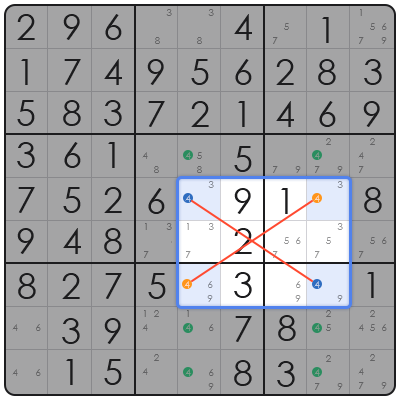
Winning hard Sudoku puzzles fundamentally involves a systematic application of advanced logical deduction, moving beyond simple candidate elimination to uncover hidden relationships and patterns across the grid. This approach transforms seemingly intractable grids into solvable sequences of steps, emphasizing analytical rigor over guesswork. The significance of mastering hard Sudoku extends beyond recreational enjoyment; it serves as a robust training ground for enhancing critical thinking, pattern recognition, and sustained problem-solving capabilities. These cognitive skills are highly transferable to complex challenges in various professional and academic fields, underscoring the value of disciplined logical reasoning. The primary problem that a structured approach to hard Sudoku solves is the pervasive frustration associated with encountering grids that appear to offer no obvious moves. By providing a clear framework of advanced techniques, players can confidently navigate intricate scenarios, transforming ‘stuck’ moments into opportunities for deeper analytical engagement. From a framework perspective, success in hard Sudoku is not about innate genius but about acquiring and meticulously applying a comprehensive toolkit of strategies. This article will deconstruct these methods, offering a structural analysis of how to win hard Sudoku puzzles through methodical, entity-based reasoning.
Deconstructing Advanced Sudoku Logic
Advanced Sudoku logic revolves around identifying sophisticated patterns and exclusionary rules that extend far beyond the basic ‘single candidate’ eliminations. It demands a holistic view of the grid, where cells, rows, columns, and 3×3 blocks interact in complex ways to reveal solutions.
Based on structural analysis, core techniques include the detection of Naked and Hidden Subsets (Pairs, Triples, Quads). These methods involve identifying groups of candidates that are restricted to a specific set of cells within a unit, allowing for the elimination of those candidates from other cells in that unit, or other candidates from those specific cells.
Further elevating the analytical challenge are ‘fish’ patterns like X-Wing, Swordfish, and Jellyfish. These strategies operate across multiple rows and columns, leveraging the restricted placement of a particular candidate to eliminate it from cells outside the ‘fish’ structure, thereby simplifying the grid.
From a framework perspective, understanding how to construct and utilize candidate arrays for every empty cell is fundamental. This meticulous notation serves as the raw data upon which all advanced logical deductions are built, ensuring no potential solution or elimination is overlooked.
The power of these advanced techniques lies in their ability to resolve situations where no obvious direct deductions are available. By systematically applying these methods, players can unlock seemingly impossible grids, transforming the puzzle from a series of isolated choices into an interconnected logical system.
Systematic Application of Advanced Sudoku Strategies
Applying advanced Sudoku strategies begins with a rigorous and meticulous process of candidate notation. Every empty cell must have all its possible numbers (candidates) written down. This initial phase, while time-consuming, is non-negotiable for hard puzzles, as it forms the bedrock for all subsequent deductions.
Step 1: The process should always start with a thorough scan for basic Naked and Hidden Singles. These are the simplest deductions and will significantly reduce the number of candidates, often revealing further opportunities for advanced techniques. This foundational pass ensures maximum simplification before engaging complex patterns.
Step 2: Progress to identifying Naked and Hidden Subsets (Pairs, Triples, Quads). Systematically examine each row, column, and 3×3 block for these patterns. A Naked Pair, for instance, involves two cells in a unit that share only two identical candidates, meaning those two candidates *must* reside in those two cells, allowing their elimination from other cells in that unit.
Step 3: Introduce more complex chain-based logic and fish patterns. Once simpler subsets are exhausted, look for X-Wings, Swordfish, or even more intricate Forcing Chains. An X-Wing, for example, requires a specific candidate to appear in exactly two cells in two different rows (or columns) that align, enabling eliminations in the corresponding columns (or rows).
In practical application, the key is cyclical iteration. After each significant deduction, whether it’s a single, a subset, or a fish pattern, it’s crucial to re-evaluate the entire grid. The elimination of one candidate can trigger a cascade of new singles or reveal previously hidden subsets, necessitating a fresh scan of the board. This iterative process is what ultimately leads to the resolution of hard Sudoku puzzles.
Comparative Analysis of Advanced Sudoku Techniques
From a framework perspective, comparing various advanced Sudoku techniques illuminates their distinct utility, complexity, and optimal application scenarios. Understanding these differences allows for a more strategic deployment of methods during a puzzle.
| Technique | Complexity | Efficiency | Frequency of Use | Application Stage | Impact on Grid |
|———————-|————|———————–|——————|————————-|—————————-|
| Hidden/Naked Pairs | Moderate | High (early-mid game) | High | All stages | Significant candidate reduction |
| X-Wing | High | Medium (mid-late game)| Medium | Mid-game onward | Targeted candidate elimination |
| Forcing Chains | Very High | Very High (late game) | Low | Late game, critical points | Resolves complex dead ends |
| Single-Cell Forcing | Medium | Variable | Medium | Mid-late game | Confirms cell values |
Based on structural analysis, Hidden/Naked Pairs offer a robust and frequently occurring method for candidate reduction. They are fundamental building blocks for more complex logic. X-Wings, while more complex to identify, provide powerful eliminations across units, often breaking open stagnant parts of the grid.
Forcing Chains, including techniques like Simple Colorings or XYZ-Wings, represent the pinnacle of Sudoku logic. They are highly complex, requiring meticulous tracking of implications but offer extremely high efficiency in resolving puzzles when all other methods fail. Their infrequent appearance is offset by their decisive impact.
This comparative view helps players strategize which tools to deploy based on the current state of the puzzle. An efficient Sudoku solver doesn’t just know techniques; they understand their hierarchy and interdependencies, deploying them in a logical and systematic order.
Avoiding Common Obstacles in Hard Sudoku
One frequent mistake in attempting how to win hard Sudoku puzzles is succumbing to the temptation of guessing. This fundamentally undermines the logical foundation of Sudoku and almost invariably leads to errors, frustration, and the need to backtrack extensively, if not restart entirely.
Pitfall 1: Premature Guessing. Solution: If stuck, the correct approach is never to guess, but to re-examine all candidates and re-scan for advanced patterns. Often, a subtle Hidden Triple or a potential X-Wing was overlooked. Patience and methodical re-evaluation are key.
Pitfall 2: Errors in Candidate Notation. Solution: Meticulously double-check all initial candidate markings. A single missed candidate or an incorrectly marked candidate can lead to invalid deductions down the line. Utilize pencil marks for clarity and cross-referencing.
Pitfall 3: Tunnel Vision on a Single Technique. Solution: Develop a varied toolkit and know when to switch strategies. If one technique isn’t yielding results, it’s essential to pivot and look for opportunities using another method, as different puzzles emphasize different advanced patterns.
From a framework perspective, maintaining discipline in logical deduction and resisting impulsive decisions is paramount to preventing errors. Consistently reviewing the grid, verifying eliminations, and being open to applying a diverse set of strategies will lead to consistent success in solving hard Sudoku puzzles.
Quick Answers: Your Hard Sudoku Questions
Q: What is the very first step to solve a hard Sudoku puzzle? A: The absolute first step is to accurately fill in all possible candidates (pencil marks) for every empty cell on the grid. This creates the essential data set for all subsequent advanced deductions.
Q: How do you identify an X-Wing pattern in Sudoku? A: An X-Wing involves a specific candidate appearing in exactly two cells across two different rows (or columns), with these cells forming the corners of a rectangle. This allows for eliminations in the corresponding columns (or rows).
Q: Is it ever acceptable to guess when solving a hard Sudoku? A: No, true Sudoku puzzles are designed to be solvable purely through logical deduction. Guessing introduces uncertainty and usually leads to dead ends, making the puzzle harder to resolve.
Q: What defines a ‘hard’ Sudoku puzzle? A: A hard Sudoku puzzle typically requires the consistent application of advanced techniques like Hidden/Naked Subsets, X-Wings, Forcing Chains, or other complex logic, as basic single-cell deductions quickly become exhausted.
Q: How can I effectively improve my skills for hard Sudoku? A: Consistent practice with increasingly challenging puzzles, coupled with a deliberate study and application of advanced techniques, including reviewing solved puzzles for missed patterns, is the most effective way to improve.
Mastering how to win hard Sudoku puzzles is a profound exercise in disciplined analytical problem-solving, showcasing a player’s ability to navigate complex logical landscapes. It’s a journey from initial confusion to methodical clarity, built upon a foundation of meticulous candidate tracking and the strategic deployment of advanced techniques. This capability extends beyond the grid, fostering sharper decision-making and a more structured approach to challenges. The long-term strategic value lies not just in solving puzzles, but in cultivating a mind that thrives on logical discovery and systematic resolution, a highly valued trait in any analytical field.