

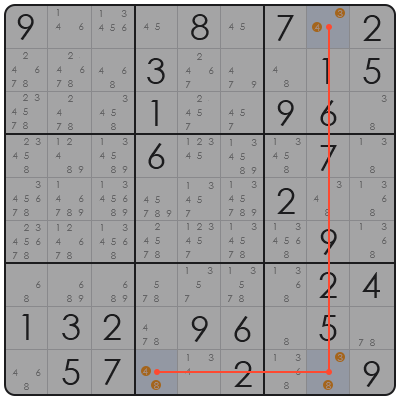
To solve tough Sudoku effectively, one must move beyond basic techniques and embrace advanced logical deduction, focusing on patterns and interdependencies across the grid. Tough Sudoku puzzles present a formidable challenge, often appearing intractable at first glance, demanding a deeper understanding of grid topology and candidate elimination strategies. For both competitive speed-solvers aiming to shave seconds off their times and casual enthusiasts seeking to conquer the most perplexing grids, mastering these advanced methods is paramount. Standard approaches like single candidate identification quickly become insufficient, pushing solvers into the realm of intricate logical chains and pattern recognition. The satisfaction derived from cracking a seemingly impossible Sudoku lies in the successful application of structured thinking and an unwavering commitment to systematic analysis. This article will equip you with the essential tools and insights needed to confidently approach and ultimately how to solve tough sudoku with expert precision.
The Logical Framework for Solving Tough Sudoku
The logical framework for solving tough Sudoku fundamentally relies on identifying complex interdependencies and constraints that are not immediately obvious from simple cell-by-cell analysis. Understanding how to solve tough sudoku means appreciating the underlying mathematical structure of the 9×9 grid, where each cell’s possibilities are inherently linked to its row, column, and 3×3 block. This interwoven network creates a web of potential candidates that, when meticulously examined, reveals opportunities for elimination through advanced pattern recognition.
At its core, advanced Sudoku solving employs a systematic approach to candidate elimination, where pencil marks become indispensable tools for tracking possibilities within each cell. This process extends beyond basic singles to identify patterns like Naked Pairs, Hidden Triples, and Locked Candidates, which represent specific sets of numbers confined to particular cells or lines within a block. These patterns provide the necessary breakthroughs when direct numerical placement is no longer possible, showcasing the power of grid topology.
For competitive solvers, the structural necessity of identifying these advanced patterns is not merely about finding a solution, but about optimizing the path to it. Techniques like X-Wing and Swordfish, for instance, leverage the symmetrical properties of the grid to eliminate candidates across multiple rows or columns, often requiring a deep grasp of how these elements interact. Based on logic-chain analysis, these techniques demonstrate that tough Sudoku is less about luck and more about the rigorous application of defined, repeatable strategies.
A Step-by-Step Guide to Cracking Hard Sudoku Puzzles
To crack hard Sudoku puzzles effectively, begin by meticulously filling in all possible pencil marks for every empty cell, as this comprehensive candidate elimination foundation is crucial for advanced techniques. This initial setup provides a visual representation of all potential numbers, allowing for easier identification of patterns that are otherwise obscured. Once all basic singles (Hidden and Naked) have been resolved, the real work of how to solve tough sudoku begins, moving into more intricate logical deduction.
Next, systematically scan for Naked Pairs, Triples, and Quads within rows, columns, and 3×3 blocks, which occur when a set of N candidates is confined to exactly N cells within a defined region. For example, if two cells in a row only contain candidates {2,5}, then 2 and 5 can be eliminated as candidates from all other cells in that same row, column, or block. Identifying these directly eliminates possibilities for other cells, narrowing down the search space considerably.
Subsequently, search for Hidden Pairs, Triples, and Quads, where N candidates are the only possible numbers for a set of N cells within a region, despite those cells having other candidates. This requires careful observation and often benefits from temporarily filtering out other candidates to highlight the hidden patterns. Finally, progress to advanced techniques like X-Wing and Swordfish, looking for numbers that form a rectangle or complex fish pattern across rows or columns, allowing for widespread candidate elimination based on intricate cell constraints and logical implications. The structural necessity of these larger patterns reveals hidden paths to a solution.
Comparing Advanced Sudoku Solving Strategies
Comparing advanced Sudoku solving strategies reveals that while all aim for candidate elimination, they differ significantly in their logical complexity, frequency of occurrence, and the difficulty level of puzzles they resolve. Understanding how to solve tough sudoku involves recognizing which technique is appropriate for a given situation, moving beyond simple candidate spotting to more intricate logical deduction. This matrix provides a clear overview of how different methods stack up.
The following table illustrates the distinctions between fundamental and advanced techniques, crucial for truly understanding how to solve tough sudoku. | Strategy | Difficulty Level | Frequency of Use | Logical Complexity | |———————-|——————|——————|————————| | Hidden Singles | Beginner-Medium | High | Low-Medium | | Naked Pairs | Medium | Medium-High | Medium | | X-Wing | Hard | Medium | Medium-High | | Swordfish | Very Hard | Low-Medium | High | | Coloring/Chains | Expert | Low | Very High |
As the table demonstrates, mastering how to solve tough sudoku requires a willingness to engage with strategies that have higher logical complexity and appear less frequently, yet are indispensable for breaking impasses. For competitive solvers, the ability to quickly identify and apply X-Wings or even advanced Coloring techniques is a hallmark of true expertise, demonstrating a comprehensive grasp of candidate elimination and grid topology. The judicious application of these varied strategies forms the backbone of advanced Sudoku play.
Navigating Common Pitfalls in Tough Sudoku Solving
Navigating common pitfalls in tough Sudoku solving requires vigilance against premature candidate elimination and inconsistent pencil marking, which can quickly lead to incorrect deductions and dead ends. A frequent mistake made when learning how to solve tough sudoku is removing a candidate without absolute certainty, often based on a hunch rather than a definitive logical chain. Such errors propagate rapidly through the grid, making the puzzle unsolvable or extremely difficult to recover from without restarting.
Another prevalent issue is the failure to maintain a complete and accurate set of pencil marks for all remaining empty cells, especially after a significant breakthrough. Incomplete pencil marking can cause solvers to overlook crucial patterns like Hidden Pairs or Locked Candidates, which are only visible when all possibilities are meticulously recorded. Based on logic-chain analysis, consistently updating and reviewing pencil marks after each number placement is essential for how to solve tough sudoku.
Finally, tunnel vision – focusing too intensely on one small area of the grid while neglecting broader patterns – is a significant pitfall. While deep dives into specific blocks or lines are sometimes necessary, an overarching perspective is vital for spotting X-Wings, Swordfish, or other global candidate elimination opportunities. Regularly stepping back to review the entire grid and all candidate constraints can prevent this, ensuring a holistic approach to how to solve tough sudoku.
Frequently Asked Questions About Tough Sudoku
Frequently asked questions about tough Sudoku often center on distinguishing advanced techniques from basic ones and understanding when to apply them. How to solve tough sudoku fundamentally involves moving past simple singles and pairs to complex patterns like X-Wing and Swordfish that require intricate logical deduction.
Q: What is the single most important skill for solving tough Sudoku? A: The most critical skill is systematic candidate elimination through meticulous pencil marking, coupled with the ability to identify advanced patterns such as Naked/Hidden Subsets and X-Wings.
Q: How do I know if a Sudoku is “tough”? A: A tough Sudoku typically cannot be solved using only basic techniques like Hidden and Naked Singles. It requires advanced strategies, often involving chained deductions and complex candidate constraints.
Q: Are guessing and backtracking ever necessary for tough Sudoku? A: For truly solvable Sudoku puzzles, guessing is never necessary. Every step can be derived through logical deduction. If you find yourself guessing, you’ve likely missed an advanced pattern or made an error.
Q: How quickly should I expect to solve a tough Sudoku? A: For competitive solvers, tough Sudokus can take anywhere from 10-30 minutes, depending on difficulty and technique proficiency. Casual solvers might take significantly longer, focusing on the process rather than speed.
Mastering how to solve tough sudoku ultimately boils down to adopting a “Logic-First” approach, where every candidate elimination and number placement is rigorously justified by sound deduction, rather than intuition. The journey from basic techniques to advanced strategies like X-Wing and Swordfish transforms a casual player into an expert, equipped to tackle any grid complexity. By embracing meticulous pencil marking, understanding grid topology, and continuously seeking intricate candidate constraints, solvers can consistently conquer even the most daunting puzzles, embodying the true spirit of Sudoku mastery.