

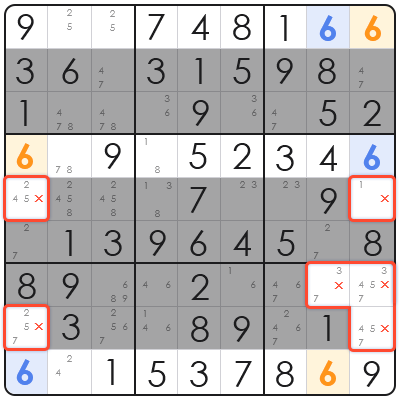
Learning how to solve difficult Sudoku puzzles is a journey into advanced logical deduction and pattern recognition, transcending basic number placement to reveal intricate grid relationships. For both competitive speed-solvers aiming to shave seconds off their times and casual enthusiasts seeking to conquer the most challenging grids, understanding advanced techniques is paramount. This guide provides a deep-dive into the methodologies and mindsets required to systematically dismantle even the most formidable Sudoku configurations. The true essence of conquering difficult Sudoku lies not in guesswork, but in a meticulous, logic-first approach that leverages every available clue. It demands a thorough command of candidate elimination, careful application of pencil marks, and an understanding of complex cell constraints and grid topology. This article will equip you with the knowledge to identify and apply sophisticated strategies, transforming seemingly impossible puzzles into satisfying victories rooted in pure logical reasoning.
The Core Logic: Deconstructing Difficult Sudoku Puzzles
Deconstructing how to solve difficult Sudoku puzzles fundamentally relies on understanding advanced logical deduction and the intricate structural necessity within the 9×9 grid.
Unlike simpler puzzles where single candidate cells are abundant, difficult Sudoku often requires identifying patterns that eliminate candidates across multiple cells, rows, columns, or 3×3 blocks simultaneously. This involves moving beyond ‘naked singles’ and ‘hidden singles’ to spotting more complex formations, where the very absence of a number in certain places reveals its required position elsewhere.
Based on logic-chain analysis, difficult puzzles are characterized by a sparsity of initial numbers, forcing solvers to rely heavily on pencil marks for all possible candidates within each empty cell. The game transitions from finding obvious placements to proving, through a sequence of eliminations, where a number *must* logically reside. The grid topology, specifically the interconnectedness of rows, columns, and blocks, becomes a critical tool in this process, allowing for broad candidate pruning.
Systematic Approach: A Step-by-Step Guide to Tackling Challenging Grids
A systematic approach to how to solve difficult Sudoku puzzles involves a structured process of candidate identification, elimination, and pattern recognition.
1. **Initial Candidate Generation:** Begin by meticulously filling in all possible candidates (pencil marks) for every empty cell. This foundational step is non-negotiable for difficult puzzles, as it creates the visual data necessary for advanced deductions. Ensure accuracy, as a single error can invalidate subsequent logic. 2. **Basic Candidate Elimination Cycles:** Perform rounds of ‘naked singles’ (a cell with only one candidate) and ‘hidden singles’ (a number that can only go in one cell within its row, column, or block). Repeat until no more basic singles can be found. This often clears a significant portion of the grid.
3. **Identify Naked Pairs/Triples/Quadruples:** Look for two or more cells within the same row, column, or block that share an identical set of 2, 3, or 4 candidates, and *only* those candidates. For instance, if two cells in a row both have ‘{1,5}’ as their only candidates, then ‘1’ and ‘5’ *must* go in those two cells, eliminating ‘1’ and ‘5’ as candidates from all other cells in that row. 4. **Uncover Hidden Pairs/Triples/Quadruples:** This is the inverse: find two or more candidates that only appear in a specific set of 2, 3, or 4 cells within a row, column, or block. Those cells *must* contain those candidates, allowing other candidates within those cells to be eliminated. This requires careful scrutiny of your pencil marks.
5. **Advanced Techniques (X-Wing, Swordfish, Jellyfish, XY-Wing):** For competitive solvers, these techniques are crucial. An X-Wing, for example, involves identifying a number that forms a rectangle across two rows and two columns, allowing for eliminations in other cells. These techniques exploit specific grid topologies to eliminate candidates that are not immediately obvious. 6. **Chaining and Forcing Chains:** When simple eliminations halt, advanced solvers resort to ‘chaining’ – hypothesizing a number in one cell and tracing its logical consequences throughout the grid. If a contradiction arises, the initial hypothesis was false. While powerful, this requires significant practice and is a hallmark of expert-level play in how to solve difficult Sudoku puzzles.
Advanced Strategies: Comparing Techniques for Difficult Sudoku
Understanding how to solve difficult Sudoku puzzles often involves a comparative analysis of various logical deduction techniques based on their difficulty level, frequency of use, and overall logical complexity.
Basic techniques like ‘Naked Singles’ and ‘Hidden Singles’ are foundational; they are simple, frequently used in all difficulty levels, and have low logical complexity, requiring direct observation. They form the initial pass on any Sudoku puzzle. Moving to ‘Naked Pairs/Triples’ and ‘Hidden Pairs/Triples’, the difficulty and logical complexity increase moderately. These are common in intermediate to difficult puzzles, demanding a broader view of candidate sets within a specific house (row, column, or block). Their frequency of use is high in difficult puzzles, making them essential tools.
Further up the ladder are ‘X-Wing’ and ‘Swordfish’ patterns. These techniques represent a significant leap in logical complexity and are characteristic of truly difficult to expert-level puzzles. Their frequency of use is lower than simpler techniques but when found, they often unlock critical breakthroughs. These multi-cell, multi-house patterns require a keen eye for grid topology and the ability to visualize how candidates interact across different houses, making them indispensable when learning how to solve difficult Sudoku puzzles.
Ultimately, advanced chaining and ‘forcing chains’ represent the pinnacle of Sudoku solving. These methods have the highest logical complexity and are used less frequently than direct pattern recognition, often only when other techniques fail. They demand abstract reasoning and the ability to hold multiple hypothetical scenarios in mind, showcasing the depth of a logic-first approach.
Avoiding Obstacles: Common Mistakes in Solving Difficult Sudoku
Successfully learning how to solve difficult Sudoku puzzles also means recognizing and avoiding common pitfalls that can lead to frustration and incorrect solutions.
One frequent mistake is **incomplete pencil marking**. Many players, especially transitioning from easier puzzles, fail to meticulously mark *all* possible candidates for *every* empty cell. Without this comprehensive visual representation, identifying complex `Naked Pairs`, `Hidden Triples`, or `X-Wings` becomes virtually impossible. The solution is simple: adopt a rigorous practice of writing down every potential number for each cell before attempting advanced deductions. This exhaustive `candidate elimination` groundwork is non-negotiable.
Another pitfall is **over-reliance on guessing**. When faced with a seemingly intractable section, some solvers resort to ‘trial and error’ without sufficient logical justification. While sometimes a last resort in extreme cases, blind guessing often leads to dead ends and requires extensive back-tracking. A better strategy involves revisiting the entire grid, checking for overlooked `cell constraints` or patterns, and systematically applying advanced techniques. The structural necessity of Sudoku ensures a logical path always exists, even if it’s hidden.
Finally, **tunnel vision**—focusing too narrowly on one small area of the grid—can obscure crucial global patterns. An X-Wing, for instance, requires observing relationships across two rows and two columns. Constantly scan the entire grid, shifting your perspective between rows, columns, and 3×3 blocks. This holistic view of the grid topology is key to spotting the subtle interdependencies that difficult Sudoku puzzles demand.
Frequently Asked Questions: Mastering Difficult Sudoku
**Q: What defines a difficult Sudoku puzzle?** A: A difficult Sudoku puzzle is characterized by a sparsity of initial clues and the necessity for advanced logical deduction techniques beyond simple singles, such as X-Wings and Naked Pairs, to find a unique solution.
**Q: Are pencil marks essential for difficult puzzles?** A: Yes, pencil marks are absolutely essential for solving difficult Sudoku puzzles. They provide a visual representation of all possible candidates, enabling the identification of complex patterns and facilitating `candidate elimination`.
**Q: What is the most crucial skill for difficult Sudoku?** A: The most crucial skill is advanced `logical deduction`, specifically the ability to identify and apply complex patterns and `cell constraints` across the grid to eliminate candidates systematically.
**Q: How can I improve my speed in solving hard Sudoku?** A: Improve speed by consistent practice, mastering pattern recognition for techniques like X-Wing, developing quick `candidate elimination` skills, and training your eye to scan the grid efficiently for `grid topology` interactions.
**Q: When should I use advanced techniques like X-Wing?** A: Advanced techniques like X-Wing should be applied after exhausting all simpler methods (singles, naked/hidden pairs/triples). They are critical when basic `candidate elimination` no longer yields progress and require identifying specific multi-cell patterns.
Mastering how to solve difficult Sudoku puzzles is a testament to the power of a ‘Logic-First’ approach, emphasizing systematic deduction over guesswork. By diligently applying `pencil marks`, understanding `grid topology`, and expertly leveraging `candidate elimination` through advanced techniques, any challenging Sudoku can be conquered. The journey from novice to expert is paved with practice, analytical thought, and an unwavering commitment to the structural necessity of numbers within the 9×9 grid. Embrace the complexity, refine your methods, and the most formidable Sudoku puzzles will yield to your logical prowess.