

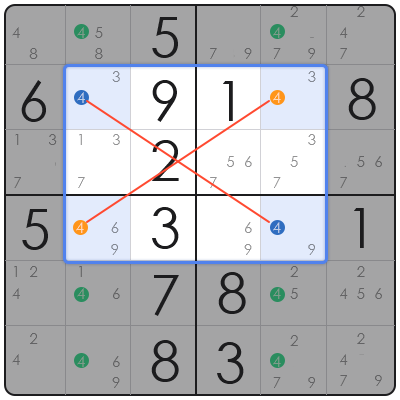
Sudoku tips Swordfish refers to a sophisticated pattern-recognition technique used in solving complex Sudoku puzzles, allowing solvers to eliminate candidates across multiple rows and columns simultaneously. This advanced strategy, while less common than simpler techniques like Naked Pairs or Hidden Singles, is crucial for tackling harder Sudoku grids. Mastering the Swordfish not only enhances a solver’s ability to break through challenging stages but also sharpens their overall logical deduction skills, proving valuable for both speed-solvers aiming for efficiency and casual players seeking a deeper understanding of the puzzle’s mechanics. The Swordfish pattern, named for its resemblance to the Japanese fishing tool when visualized on the Sudoku grid, represents a powerful application of candidate elimination, extending the logic of the X-Wing pattern to three (or more) rows and columns.
The Logic Behind the Swordfish Pattern in Sudoku
The logic behind Sudoku tips Swordfish hinges on a fundamental Sudoku principle: each row, column, and 3×3 box must contain the digits 1 through 9 exactly once.
A Swordfish pattern emerges when a specific candidate digit appears in exactly two or three cells within each of three different rows, and crucially, these cells are aligned in such a way that they are confined to only three columns. This structural necessity means that if the candidate exists in these rows, it *must* also exist in these specific columns. Consequently, this candidate can be eliminated from all other cells within those three identified columns, as its placement is already logically constrained to the intersection points of the rows and columns involved in the pattern. The candidate elimination process here is indirect, relying on the deduction that the candidate must be placed within the Swordfish structure, thereby freeing up other possibilities in the affected columns.
Mathematically, the Swordfish exploits the interdependence of row and column constraints. If a number `N` can only be placed in two or three specific cells within each of three selected rows, and these specific cells fall within only three specific columns, then `N` *must* occupy one of the cells at the intersection of these rows and columns. This forces `N` out of contention for any other cell in those three columns. This is a direct extension of the X-Wing logic, which applies the same principle to two rows and two columns.
Step-by-Step Implementation of the Swordfish Technique
To apply Sudoku tips Swordfish, begin by identifying a candidate digit that appears in only two or three cells across multiple rows. Start by scanning the grid for digits that are significantly restricted in their placement.
Select three rows where the candidate digit has a limited number of potential placements, ideally two or three cells per row. Pay close attention to the columns these potential placements fall into. The core of the Swordfish is identifying when these potential placements across the three selected rows are confined to a total of *only* three distinct columns. For instance, if you are examining the candidate ‘7’, and you find it can only go in R1C2, R1C5; R3C2, R3C8; and R7C5, R7C8, you have a potential Swordfish.
Verify that the candidate digit’s possible locations within these three rows exclusively occupy cells within precisely three columns. In the example above, the candidate ‘7’ is restricted to columns 2, 5, and 8 across rows 1, 3, and 7. This forms the Swordfish pattern. Once confirmed, eliminate this candidate digit from all other cells within those three identified columns (C2, C5, and C8) that are not part of the Swordfish structure. This candidate elimination is key to progressing in difficult puzzles.
Look for opportunities to apply this technique repeatedly. After an elimination using the Swordfish, new singles or pairs might emerge, potentially setting up further advanced strategies or simplifying the grid enough for basic logic to take over. Always use pencil marks to keep track of candidates accurately.
Comparing Swordfish to Other Sudoku Strategies
While Swordfish is a powerful tool, understanding its place relative to other Sudoku strategies provides a clearer picture of its utility and complexity.
Here’s a comparative analysis:
| Strategy | Difficulty Level | Frequency of Use | Logical Complexity |
|—|—|—|—|
| Naked Pairs | Easy | High | Low: Identifies two candidates in two cells within the same unit. |
| X-Wing | Medium | Medium | Medium: Extends Naked Pairs logic to two rows/columns. |
| Swordfish | Hard | Low-Medium | High: Extends X-Wing logic to three rows/columns. |
| Hidden Triples | Medium-Hard | Low-Medium | High: Identifies three candidates confined to three cells in a unit. |
| Jellyfish | Very Hard | Very Low | Very High: Extends Swordfish to four rows/columns. |
Based on logic-chain analysis, the Swordfish requires a higher degree of foresight and pattern recognition than simpler techniques. Its lower frequency of use in easier puzzles doesn’t diminish its importance for high-difficulty grids, where candidate elimination becomes sparse and advanced patterns are essential for breaking through logical stalemates. For competitive solvers, recognizing and applying the Swordfish quickly can be a significant time-saver.
Common Pitfalls When Applying Sudoku Swordfish
One of the most common mistakes players make when attempting Sudoku tips Swordfish is misidentifying the pattern, particularly concerning the number of rows and columns involved. It is crucial that the candidate is confined to *exactly* three rows and *exactly* three columns. Mistaking a pattern with four rows/columns for a Swordfish (when it might be a Jellyfish) or incorrectly assuming a candidate fits the pattern when it appears in more than three columns will lead to incorrect eliminations.
Another frequent error is overlooking the ‘other’ cells within the identified columns. The Swordfish technique allows elimination of the candidate from *all* cells in the target columns *except* those forming the Swordfish pattern itself. Players sometimes fail to eliminate the candidate from all applicable cells, or worse, they eliminate it from the Swordfish cells themselves, fundamentally misunderstanding the deduction. Always ensure eliminations are made only from cells *outside* the direct pattern intersections but *within* the affected columns.
Finally, insufficient use of pencil marks can hinder Swordfish application. This technique requires careful tracking of candidate digits across the grid. Without clear and accurate pencil marks, it becomes incredibly difficult to spot the precise alignment of candidates that define a Swordfish pattern. Ensure your notation is consistent and up-to-date; ambiguity in pencil marks is the enemy of advanced Sudoku strategies.
Frequently Asked Questions about Sudoku Swordfish
What is the core principle behind the Sudoku Swordfish technique?
The Swordfish technique leverages the constraint that a specific candidate digit, appearing in only two or three cells across three rows, must be confined to those same three columns. This allows elimination of the candidate from other cells in those columns.
When should I look for a Swordfish pattern?
Look for Swordfish patterns when you are stuck on a medium to hard difficulty Sudoku puzzle, and simpler techniques like singles, pairs, and X-Wings have been exhausted. It’s a strategy for situations with limited candidate eliminations.
How is the Swordfish different from the X-Wing pattern?
The X-Wing involves two rows and two columns, whereas the Swordfish extends this logic to three rows and three columns, making it a more complex pattern to identify and apply.
Can a Swordfish pattern involve more than three rows or columns?
Yes, the underlying logic can extend to four rows and columns (known as a Jellyfish) or even more, but the ‘Swordfish’ specifically refers to the three-by-three variant. The principle of candidate elimination remains consistent.
What is the benefit of learning Sudoku tips Swordfish?
Mastering the Swordfish significantly enhances your ability to solve difficult Sudoku puzzles, improves your logical deduction skills, and allows for more efficient candidate elimination, ultimately making you a more proficient solver.
The Swordfish technique represents a significant step forward in a Sudoku solver’s journey, moving beyond basic arithmetic constraints into sophisticated pattern recognition. While its application might seem daunting initially, its power lies in its logical certainty. Embracing advanced strategies like the Swordfish, supported by meticulous pencil marking and a deep understanding of grid topology, is fundamental to achieving mastery in Sudoku. The ‘Logic-First’ approach, where every deduction is built on an unassailable foundation of rules, is the hallmark of a truly skilled solver, transforming complex grids from insurmountable challenges into elegant logical sequences.