

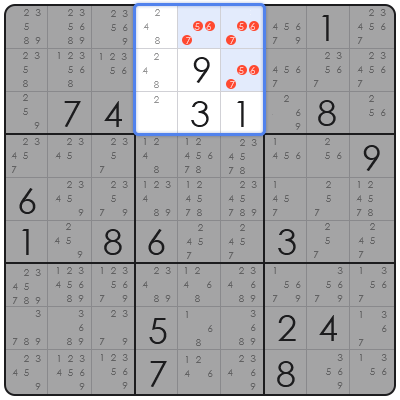
Hard Sudoku, a formidable variant of the classic number placement puzzle, presents a significant cognitive challenge, demanding more than basic cell-filling. From a cognitive strategy perspective, completing these intricate grids involves a methodical application of advanced logical deduction techniques that go far beyond simple scanning and single-candidate elimination. The primary problem it solves is pushing the boundaries of logical reasoning and pattern recognition, serving as an excellent mental workout. Based on structural analysis, the complexity of hard Sudoku stems from the scarcity of immediate numerical clues and the prevalence of interdependent candidate relationships. Unlike easier puzzles that often yield to direct placement, hard Sudokus necessitate inferential steps, where the absence of a number in one cell informs the presence of a number in another, often across multiple blocks, rows, or columns. This intricate web of possibilities is where the true challenge and intellectual reward lie. In practical application, mastering hard Sudoku is less about speed and more about precision and a robust understanding of advanced combinatorial logic. This article will delve into the underlying mechanics, strategic frameworks, and common pitfalls associated with tackling these advanced puzzles, providing a definitive guide for enthusiasts aiming to elevate their solving prowess within the realm of cognitive strategy.
The Foundation: Understanding Advanced Sudoku Logic
To effectively complete hard Sudoku, one must first transcend the basic “naked single” and “hidden single” techniques, which typically suffice for easier puzzles. Hard grids are characterized by situations where multiple candidates exist for almost every empty cell, requiring a deeper analytical approach. This initial phase of structural analysis involves carefully identifying all possible candidates for each empty cell, creating a comprehensive “candidate matrix” that serves as the bedrock for further deductions.
From a framework perspective, the next step involves recognizing “naked pairs,” “naked triplets,” and “naked quads.” A naked pair, for instance, occurs when two cells in a row, column, or 3×3 block are the only two cells containing precisely the same two candidate numbers. Once identified, these two numbers can be eliminated as candidates from all other cells within that same row, column, or block, significantly reducing the complexity. This principle extends to triplets and quads, requiring an accurate visual scan for these specific numerical relationships.
Equally crucial are “hidden pairs,” “hidden triplets,” and “hidden quads.” Unlike their “naked” counterparts, these patterns are defined by candidates that appear only in a specific set of cells within a row, column, or block, even if those cells contain other candidates. For example, if two numbers appear as candidates only in two specific cells within a block, those two numbers must reside in those two cells, allowing all other candidates to be removed from those cells, and those two numbers to be removed as candidates from all other cells in the block. Identifying these “hidden” structures is a hallmark of advanced Sudoku solving.
Advanced Techniques: X-Wing and Swordfish Patterns
Based on structural analysis, one of the most powerful advanced techniques for hard Sudoku is the “X-Wing.” An X-Wing occurs when a particular candidate number appears in exactly two cells in two different rows, and these cells align in the same two columns. If these conditions are met, that candidate number can be eliminated from all other cells in those two columns, outside of the rows forming the X-Wing. This technique leverages a rectangular pattern of candidate occurrences to make substantial deductions, often unlocking further progress in a stalled grid.
A more complex, yet equally impactful, pattern is the “Swordfish.” Extending the logic of the X-Wing, a Swordfish involves three rows (or columns) where a specific candidate number appears in exactly two or three cells, and these cells align in the same three columns (or rows). Once identified, this candidate number can be eliminated from all other cells in those three columns (or rows) that are not part of the Swordfish rows (or columns). This three-dimensional logic often requires a meticulous scan of the entire grid for symmetrical distributions of a single candidate.
In practical application, identifying X-Wings and Swordfish demands a systematic approach, often involving highlighting or circling specific candidates across the entire grid. These techniques are often pivotal for breaking through impasses in hard Sudoku puzzles where simpler methods have been exhausted. Mastery of these patterns significantly enhances a solver’s ability to navigate the most challenging scenarios, pushing towards a definitive solution by revealing hidden constraints.
Strategic Application: A Step-by-Step Resolution Guide
The methodical approach to completing hard Sudoku begins with a comprehensive candidate marking phase for every empty cell. This initial step is non-negotiable, as all subsequent advanced techniques rely on an accurate and complete visualization of possibilities. Based on structural analysis, start by systematically checking each row, column, and 3×3 block to list all potential numbers for each empty cell, ensuring no possibility is overlooked. This creates the foundational data set for your deductions.
Following candidate marking, implement a tiered strategy, starting with basic deductions and progressing to advanced patterns. First, sweep for hidden/naked singles, pairs, triplets, and quads within rows, columns, and blocks. Once these simpler patterns are exhausted, move on to more complex patterns like X-Wings, Swordfish, and eventually Jellyfish. Each successful elimination or placement should trigger a recalculation of candidates in affected cells, rows, columns, and blocks, maintaining an updated candidate matrix.
In practical application, when faced with an impasse where no obvious pattern emerges, professional advice often suggests using a “what-if” or “forcing chain” strategy. This involves selecting a cell with only two candidates and hypothetically assigning one of them. Then, meticulously follow the logical consequences of that choice. If this hypothetical path leads to a contradiction (e.g., two identical numbers in a row), then the initial hypothetical assignment was incorrect, proving the other candidate must be the solution. This powerful, albeit time-consuming, technique can break the most stubborn grids.
Comparative Analysis of Puzzle Complexities
From a framework perspective, comparing hard Sudoku to other logic puzzles reveals its unique blend of constraint satisfaction and inferential deduction. While puzzles like KenKen introduce arithmetic constraints, and Kakuro involves sums, Sudoku’s purity lies in its singular rule: each number must appear once. This minimalist rule set forces deeper combinatorial thinking rather than arithmetic problem-solving, making pattern recognition and candidate tracking paramount for hard variants.
In practical application, understanding the relative complexities helps solvers choose appropriate strategies. Easy Sudoku relies on direct observation; Medium Sudoku introduces basic hidden pairs/triplets; and Hard Sudoku mandates advanced patterns like X-Wings and forcing chains. Compared to other similar grid-based logic puzzles, hard Sudoku’s difficulty scales due to the sheer number of interdependencies between cells, making brute-force guessing highly inefficient and prone to error.
The following table provides a comparative analysis of hard Sudoku against related logic puzzles, focusing on key operational dimensions:
| Puzzle Type | Complexity (Deductive Layers) | Efficiency (Time/Effort) | Common Techniques |
|—|—|—|—|
| Easy Sudoku | Low (Direct Observation) | High (Rapid Progress) | Singles, basic pairs |
| Hard Sudoku | High (Multi-layered Inference) | Moderate (Systematic) | X-Wing, Swordfish, Forcing Chains |
| KenKen | Medium (Arithmetic + Logic) | Moderate (Equation Solving) | Candidate elimination, sum combinations |
| Kakuro | Medium (Sum-based Logic) | Moderate (Intersection Analysis) | Sum decomposition, candidate filtering |
Avoiding Common Traps and Enhancing Accuracy
One frequent mistake when attempting to complete hard Sudoku is insufficient candidate marking, leading to missed opportunities for advanced deductions. From a framework perspective, a partially completed candidate list is inherently flawed, as it prevents the visual identification of patterns like naked pairs or X-Wings. Professional advice strongly recommends a meticulous, double-checked pass for all candidates before engaging in complex strategies. A single omitted candidate can render an entire section of the grid unsolvable or lead to incorrect conclusions.
Another common pitfall is premature guessing without sufficient logical backing. In practical application, while “what-if” scenarios are valid strategies, they must be rigorously followed through to a logical contradiction or resolution. Randomly filling cells or making unsubstantiated assumptions invariably leads to errors that propagate throughout the grid, making it exponentially harder to backtrack and correct. Based on structural analysis, every placement or elimination must be justified by an observable logical constraint.
Finally, many solvers fall into the trap of tunnel vision, focusing too intensely on one small section of the grid and neglecting the wider context. Hard Sudoku often requires a holistic view, where a deduction in one block can unlock possibilities several rows or columns away. Regularly stepping back and rescanning the entire grid for new singles or emerging patterns is crucial. This macro-level perspective helps identify the intricate interdependencies that characterize genuinely hard puzzles and are essential for their resolution.
Optimizing Your Sudoku Solving Workflow
From a framework perspective, an optimized workflow for hard Sudoku involves a systematic progression of techniques, rather than a haphazard application. Begin with a full candidate pass, then cycle through increasingly complex strategies: first singles, then naked/hidden pairs/triplets, then pointing/claiming, and finally X-Wings, Swordfish, and forcing chains. This iterative process ensures that easier deductions are made first, simplifying the grid for the more challenging patterns.
In practical application, maintaining a clear and organized workspace, whether physical or digital, significantly enhances accuracy. Using different colored pens for candidates versus confirmed numbers, or leveraging digital tools with candidate tracking features, minimizes visual clutter and reduces the chance of oversight. This organized approach is critical when dealing with the high density of candidates typical of hard Sudoku puzzles.
Based on structural analysis, regular practice with a variety of hard Sudoku puzzles is indispensable for developing intuition and speed in pattern recognition. Each puzzle, while unique, reinforces the underlying logical principles. Over time, identifying complex patterns like an X-Wing becomes more instinctive, shortening the time required for structural analysis and allowing for a more fluid and efficient solving experience.
Frequently Asked Questions: Hard Sudoku Demystified
Q: What defines a “hard” Sudoku puzzle? A: Hard Sudoku puzzles are characterized by a scarcity of initial numbers and the requirement for advanced logical deduction techniques beyond simple singles, such as X-Wings or forcing chains, to solve them.
Q: Are there specific tools that help complete hard Sudoku? A: While many prefer pen and paper, digital Sudoku apps with candidate marking features, or even specialized solvers, can assist in visualizing possibilities and testing hypothetical moves, especially for learning advanced strategies.
Q: How do I improve my speed in solving hard Sudoku? A: Improvement in speed comes with consistent practice. Focus on mastering advanced patterns like X-Wing and Swordfish, and systematically applying a tiered solving workflow to reduce guesswork and identify opportunities faster.
Q: Is guessing ever a valid strategy in hard Sudoku? A: Pure guessing is highly discouraged. Instead, employ “what-if” or “forcing chain” techniques, which involve making a provisional placement to logically test consequences, ensuring any decision is evidence-based.
Q: What is the most challenging aspect of hard Sudoku? A: The most challenging aspect is often breaking through impasses where no direct deductions are apparent, requiring multi-layered inferential logic and the identification of complex, often subtle, candidate patterns.
In conclusion, completing hard Sudoku is not merely a test of patience but a sophisticated exercise in structured logical deduction and pattern recognition. Based on structural analysis, the transition from beginner to advanced solver hinges on a deep understanding of techniques like X-Wings, Swordfish, and forcing chains, coupled with a systematic approach to candidate management. From a cognitive strategy perspective, mastering these intricate puzzles cultivates analytical precision and problem-solving resilience, skills invaluable beyond the grid. The continued evolution of complex Sudoku variants ensures that the pursuit of elegant solutions remains a compelling challenge within the realm of logical reasoning, offering endless opportunities for intellectual engagement and strategic development.