

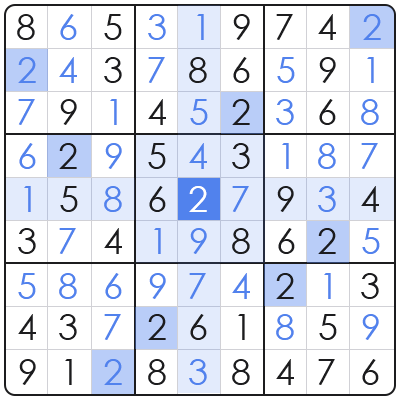
Solving hard Sudoku puzzles transcends mere number placement; it is a sophisticated exercise in deductive reasoning and strategic pattern recognition. Based on structural analysis, a truly hard Sudoku presents a grid where basic elimination techniques alone are insufficient, demanding a deeper understanding of advanced logical constructs. This challenge serves as a potent metaphor for complex problem-solving in strategic thinking fields, where initial obvious moves quickly dissipate, necessitating a more nuanced approach. The primary problem hard Sudoku solves is the mental stagnation that arises when conventional methods fail, pushing practitioners to develop a robust toolkit of advanced strategies. These puzzles force the solver to move beyond superficial observations, encouraging a meticulous examination of all potential interactions within the grid to uncover hidden relationships. This iterative process of refinement and deduction is fundamental to achieving mastery. This article will deconstruct these methods, providing a framework for systematically tackling even the most formidable Sudoku grids. We will explore the underlying mechanics of advanced techniques, offer a step-by-step implementation guide, and analyze their comparative efficacy, ensuring a comprehensive understanding for any solver seeking to elevate their game in the realm of strategic problem-solving.
Advanced Sudoku Techniques Unveiled: Decoding the Grid’s Hidden Logic
Advanced Sudoku techniques are systematic methods employed to solve puzzles that cannot be completed using basic single-candidate elimination, often requiring an iterative process of identifying intricate relationships between cells. These methods move beyond simple row, column, and block scanning, focusing instead on the interplay of potential candidates across multiple units. From a framework perspective, understanding these techniques involves recognizing specific configurations of numbers that allow for broader candidate eliminations, ultimately simplifying the puzzle to a solvable state. This deeper dive into the grid’s hidden logic is what differentiates a novice solver from a seasoned expert, allowing them to navigate seemingly intractable scenarios with precision.
Key among these techniques are Naked and Hidden Subsets, which involve identifying groups of candidates that are uniquely confined to a specific set of cells within a row, column, or block. For instance, a ‘Naked Pair’ consists of two cells in a unit that share only two common candidates, meaning those candidates must reside in those two cells, allowing their elimination from all other cells in that unit. Conversely, a ‘Hidden Pair’ exists when two candidates appear in only two cells within a unit, making those cells the exclusive domain for those two numbers, regardless of other candidates present in those cells. Recognizing these subsets is crucial for thinning out the candidate list, which is an essential step when confronted with sparse information.
Beyond subsets, ‘Fish’ techniques like X-Wing and Swordfish represent a more complex form of candidate elimination based on rectangular patterns. An X-Wing, for example, occurs when a candidate appears in only two cells in two different rows (or columns) and these cells also align in two common columns (or rows). This configuration logically dictates that the candidate must exist in those four specific cells, enabling its removal from other cells in the two involved columns (or rows). Further extending this concept, ‘Chaining’ methods such as XY-Wing or Simple Coloring explore conditional logic, tracing the implications of a candidate being true or false, thereby uncovering more extensive eliminations across the entire grid. These methods are particularly vital when direct deductions have been exhausted and the puzzle appears to reach a deadlock, offering a pathway through conditional reasoning.
Applying Advanced Strategies: A Systematic Path to Solving Hard Sudoku
Applying advanced strategies involves a structured approach of identifying patterns and candidate eliminations that are not immediately obvious, demanding patience and meticulous tracking. In practical application, the process begins by thoroughly exhausting all basic techniques, ensuring all obvious single candidates are placed and initial candidate lists for empty cells are accurately pencil-marked. This foundational step is non-negotiable, as it lays the groundwork for identifying the more complex patterns that characterize hard Sudoku. A common mistake is to rush past this stage, which can obscure critical advanced setups.
Once basic deductions are complete, the next phase involves systematically searching for Naked and Hidden Subsets. Begin by scanning each row, column, and 3×3 block for pairs, triples, and even quadruples. This requires careful observation of the pencil marks and an understanding of the logical implications these subsets create for candidate eliminations. For example, if cells (R1,C1) and (R1,C3) in a row both contain only candidates {2,5}, then 2 and 5 can be removed from all other cells in R1. This systematic sweep ensures that no obvious subset goes unnoticed, progressively narrowing down the possibilities across the grid.
Following subset identification, the solver must transition to more intricate patterns such as X-Wings, Swordfish, and chaining techniques like XY-Wing. These require a broader perspective, often spanning multiple rows and columns simultaneously. For an X-Wing, identify a candidate that appears exactly twice in two different rows, residing in the same two columns. This visual recognition of geometric patterns across the grid is a hallmark of advanced Sudoku solving. If these patterns fail to yield sufficient progress, then conditional logic, exemplified by XY-Wings or Simple Coloring, should be deployed, tracking how the placement of one candidate influences others across the puzzle. This iterative application, coupled with vigilant candidate management, forms the core methodology for cracking hard Sudoku puzzles.
Comparative Analysis: Deconstructing Sudoku Strategy Efficacy
Comparing Sudoku strategies reveals their varying levels of complexity, efficiency, and application frequency based on puzzle difficulty, highlighting why a multi-faceted approach is essential for hard grids. From a framework perspective, different techniques offer distinct advantages at various stages of solving, and their optimal deployment is a key indicator of a solver’s expertise. Understanding these distinctions allows for a more adaptive and resilient problem-solving methodology, preventing stagnation when simpler methods are no longer productive.
The table below provides a structural analysis of common Sudoku strategies, outlining their inherent complexity, the efficiency with which they typically resolve candidates, and their frequency of utility when tackling genuinely hard puzzles. Based on this structural analysis, it becomes clear that while basic elimination is foundational, its limitations necessitate the integration of more sophisticated methods. The progression from simple eliminations to complex chaining represents an increasing demand on cognitive resources and pattern recognition abilities, yet offers significantly higher leverage in breaking deadlocks in difficult puzzles. This comprehensive view ensures that solvers are equipped with the right tool for the right challenge.
| Strategy | Complexity | Efficiency | Frequency in Hard Sudoku |
|—|—|—|—|
| Basic Candidate Elimination | Low | High (initial setup) | Always (foundational) |
| Naked/Hidden Subsets | Medium | High (mid-game impact) | Very High (crucial) |
| X-Wing/Swordfish | High | Medium-High (significant breakthroughs) | Medium-High |
| XY-Wing/Chaining | Very High | High (critical for complex deadlocks) | Medium (often the final push) |
As demonstrated, the journey through a hard Sudoku puzzle is a strategic ascent, starting with simple steps and progressively requiring more intricate logical leaps. The efficiency of a strategy often correlates with its complexity in hard puzzles; simpler methods quickly exhaust their utility, whereas more complex techniques, though harder to spot, provide more substantial eliminations. The judicious application of these varied strategies, guided by their comparative efficacy, is the cornerstone of mastering hard Sudoku. In practical application, a solver must develop an intuitive sense for when to transition between different levels of strategic engagement.
Common Pitfalls & Solutions: Navigating the Obstacles in Hard Sudoku
Common pitfalls in hard Sudoku often stem from incorrect candidate management, overlooking advanced patterns, or prematurely resorting to trial and error, all of which can lead to frustration and incorrect solutions. From a framework perspective, these errors represent a breakdown in systematic thinking or a lack of refined observation skills. Recognizing these traps is the first step toward developing a more robust and reliable solving methodology. Many solvers, when faced with a seemingly impossible grid, abandon logical deduction for speculative placement, which almost invariably leads to errors and necessitates time-consuming backtracking.
A frequent mistake is the over-reliance on basic techniques, expecting them to eventually yield a solution for a hard puzzle. Solution: Develop a disciplined approach to learning and applying advanced patterns. Actively train your eye to spot Naked/Hidden Subsets (pairs, triples, quads), then progress to X-Wings, Swordfish, and XY-Wings. Practice by seeking specific patterns in puzzles you’ve already solved or by using online trainers that highlight these structures. This proactive learning ensures that you have the right tools when basic methods run dry, avoiding the common pitfall of hitting a logical wall and not knowing how to proceed.
Another significant pitfall is sloppy or incomplete candidate marking, which can obscure crucial advanced patterns and lead to missed deductions. Solution: Implement a rigorous and consistent pencil-marking system. This might involve writing all possible candidates in small numbers within each cell. Regularly update these lists after every deduction, removing eliminated candidates immediately. Consider using digital tools that automate candidate marking for practice, allowing you to focus purely on pattern recognition. Based on structural analysis, an accurate and up-to-date candidate list is the single most important foundation for all advanced techniques, making its meticulous maintenance non-negotiable for success in hard Sudoku.
Finally, premature guessing or attempting trial and error before exhausting all logical deductions is a common trap, especially when time pressure or frustration builds. Solution: Resist the urge to guess. Instead, view a seemingly stuck puzzle as an indicator that an advanced technique has been overlooked. Re-scan the entire grid systematically for hidden subsets, fish patterns, or potential chaining opportunities. If absolutely necessary, employ a ‘forcing chain’ strategy, which involves making a hypothetical placement and carefully tracking its consequences, but always with a clear rollback point. From a framework perspective, true mastery lies in the ability to solve through pure logic, reserving guesswork for only the most obscure and complex scenarios, and even then, applying it systematically.
FAQ Section: Critical Insights for Mastering Hard Sudoku
Q: What truly defines a ‘hard’ Sudoku puzzle? A: A ‘hard’ Sudoku puzzle is one where basic single-candidate elimination and simple intersection techniques are insufficient to solve it, requiring the application of advanced logical patterns like Naked/Hidden Subsets, X-Wings, or chaining for resolution.
Q: Is it ever acceptable to guess in hard Sudoku? A: Ideally, hard Sudoku is solved through pure logic. However, in extremely complex cases, an educated guess (forcing chain) can be a last resort. Always note your assumption to backtrack if it leads to a contradiction and is not a part of systematic deduction.
Q: How can I effectively improve my speed in solving difficult Sudoku grids? A: Consistent practice with diverse hard puzzles, mastering a thorough and consistent candidate-marking system, and actively learning to recognize advanced patterns swiftly are key to boosting solving speed and accuracy. Regular exposure helps train your eye.
Q: What’s the recommended initial approach for tackling a hard Sudoku? A: Always start by completing all obvious single placements, then meticulously pencil-mark every possible candidate in each empty cell. This comprehensive initial candidate list is vital for spotting hidden advanced patterns and is the bedrock of all subsequent deductions.
Q: Are there specific tools or apps helpful for learning advanced Sudoku techniques? A: Yes, many online Sudoku solvers and mobile applications offer ‘hint’ features that can identify and explain advanced techniques as you play, serving as excellent learning aids for complex strategies. These tools can illuminate the logic behind difficult moves.
Mastering how to answer hard Sudoku is more than just conquering a numerical puzzle; it’s a rigorous training ground for developing superior analytical thinking, patience, and a highly structured approach to complex problems. The strategic value extends beyond the grid, cultivating a mindset capable of deconstructing multifaceted challenges into manageable logical steps. Based on structural analysis, the iterative application of advanced techniques, combined with meticulous attention to detail, mirrors the critical problem-solving paradigms prevalent in strategic industries. Looking forward, the principles honed in solving hard Sudoku—systematic analysis, pattern recognition, and resilient deduction—remain invaluable assets in any field demanding sophisticated cognitive engagement, reinforcing the enduring relevance of logical mastery in an increasingly complex world.