

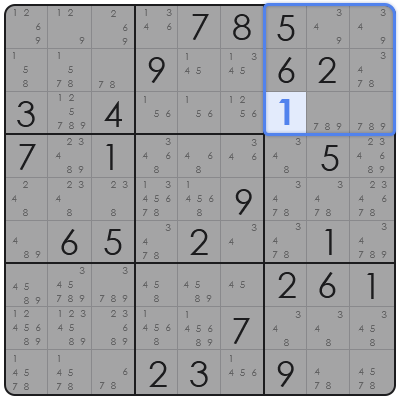
Mastering expert Sudoku represents the pinnacle of logical deduction and pattern recognition within the realm of numerical puzzles. At its core, mastering expert Sudoku involves the systematic application of advanced logical strategies to fill a 9×9 grid, where each column, row, and 3×3 subgrid must contain all digits from 1 to 9 without repetition. This advanced level distinguishes itself from simpler variations by requiring solvers to move beyond basic scanning and single-candidate eliminations, demanding a deeper understanding of interdependent relationships within the grid. From a strategic perspective, the significance of mastering expert Sudoku extends beyond mere entertainment; it cultivates critical thinking, enhances problem-solving capabilities, and refines attention to detail. This pursuit is particularly relevant in an era where cognitive flexibility and analytical rigor are highly valued skills across various professional disciplines. The challenge presented by expert Sudoku compels individuals to develop a methodical approach to complex problems, iteratively testing hypotheses and identifying nuanced logical pathways. The primary problem that mastering expert Sudoku solves within the cognitive landscape is the static application of rudimentary logic. Beginners often rely on simple eliminations, which prove insufficient for expert-level grids deliberately constructed to hide straightforward solutions. Expert Sudoku forces a paradigm shift towards sophisticated inference, requiring the solver to synthesize multiple data points and anticipate future implications of current moves. This advanced intellectual exercise bridges the gap between basic puzzle-solving and sophisticated strategic analysis, making it a compelling endeavor for those seeking to sharpen their mental acuity.
Dissecting the Core Mechanics of Expert Sudoku
Dissecting the core mechanics of expert Sudoku reveals a reliance on interlocking logical structures that necessitate advanced pattern recognition and multi-step deduction. Unlike simpler puzzles, expert grids are designed with fewer given numbers, often placed strategically to obscure immediate solutions and force the identification of complex relationships. This requires a shift from direct candidate elimination to inferential techniques that identify hidden singles, pairs, triplets, and more intricate patterns across rows, columns, and blocks. Based on structural analysis, every digit placement at this level is a consequence of several converging logical constraints, making each move a critical step in a larger logical chain.
From a framework perspective, the foundational mechanics include a thorough understanding of ‘candidates’—the possible numbers that can fit into an empty cell. Expert solvers meticulously track these candidates, not just for individual cells, but also for how they interact within their respective rows, columns, and 3×3 blocks. This involves identifying ‘naked subsets,’ where a set of candidates (e.g., 2 and 5) are the only possibilities for an equivalent number of cells within a unit, thus allowing those candidates to be eliminated from other cells in that unit. Conversely, ‘hidden subsets’ are identified when a set of candidates appears only in a specific number of cells within a unit, despite other candidates being present, revealing their true location.
In practical application, the mechanical mastery also encompasses techniques like X-Wing, Swordfish, and Jellyfish, which are advanced multi-row and multi-column strategies. An X-Wing, for instance, involves two rows (or columns) where a specific candidate appears in only two cells, aligning in the same two columns (or rows). This alignment creates a ‘rectangle’ of possibilities, enabling the elimination of that candidate from other cells in those columns (or rows) outside the X-Wing configuration. These sophisticated logical constructs are not intuitive; they require deliberate study, recognition, and systematic application to unlock solutions in truly expert-level puzzles.
Systematic Strategy Application for Expert Puzzles
Systematic strategy application for expert puzzles involves a disciplined, multi-layered approach to candidate analysis and pattern identification that moves beyond simple trial and error. This structured methodology is paramount for navigating the intricate dependencies characteristic of highly complex Sudoku grids. Effective application begins with a comprehensive initial scan and progresses through increasingly complex elimination techniques, ensuring no logical opportunity is missed. This methodical progression is what truly differentiates a master solver from an intermediate one.
In expert Sudoku, the most effective strategies are not about guessing, but about reducing uncertainty through irrefutable logic. This often involves iterating through various techniques, confirming the validity of each step, and updating the grid’s candidate list with precision. From a framework perspective, this systematic approach transforms the seemingly overwhelming complexity of an expert puzzle into a series of manageable, interconnected logical problems. The solver continually refines the available options, gradually revealing the definitive solution through a series of deterministic steps.
The power of systematic application lies in its ability to uncover ‘forcing chains’ or ‘alternating inference chains’ where the placement or elimination of a candidate in one cell has a ripple effect across the entire grid. These chains require careful tracking of hypothetical scenarios and their consequences, demanding a high degree of focus and meticulous record-keeping. The successful execution of these complex strategies is a hallmark of mastering expert Sudoku, demonstrating a deep understanding of the puzzle’s underlying mathematical and logical structure.
Initial Scan and Candidate Generation
Initial scan and candidate generation is the foundational step in how to master expert Sudoku, involving the meticulous identification of all potential numbers for every empty cell. This process, often called ‘penciling in’ candidates, provides the raw data upon which all subsequent advanced strategies are built. A thorough initial scan involves systematically checking each row, column, and 3×3 block to list all numbers (1-9) that are not yet present in that particular unit, thereby establishing the initial set of possibilities for each empty cell.
Based on structural analysis, this phase is critical because any error or omission in candidate generation can lead to dead ends or incorrect deductions later in the solving process. From a framework perspective, the efficiency of this step can be significantly improved by using a systematic approach, such as scanning rows first, then columns, then blocks, or focusing on cells with fewer initial candidates. The goal is to create a complete and accurate candidate matrix for the entire grid, providing a clear visual representation of all logical possibilities.
In practical application, expert solvers often employ visual aids or software to manage candidate lists, especially for larger or more complex grids where manual tracking can be error-prone. This initial data compilation serves as the primary reference throughout the solve, allowing for quick cross-referencing and identification of single candidates or preliminary subsets. The integrity of this initial candidate generation directly correlates with the success rate in applying more advanced logical techniques to break through the puzzle’s inherent complexities.
Implementing Advanced Elimination Techniques
Implementing advanced elimination techniques is how to master expert Sudoku by systematically reducing the pool of candidates using intricate logical relationships across the grid. These techniques extend beyond simple single-cell deductions, requiring the solver to identify patterns where candidates are confined to specific sets of cells within rows, columns, or blocks. One such technique is identifying ‘naked pairs, triplets, or quads,’ where a certain number of cells within a unit contain only the same two, three, or four candidates, respectively. Once identified, these candidates can be eliminated from other cells in that unit.
From a framework perspective, ‘hidden pairs, triplets, or quads’ are equally powerful; these occur when a set of two, three, or four candidates appear only in a specific set of cells within a row, column, or block, despite other candidates also being present in those cells. Recognizing these hidden subsets immediately confirms their location and allows for the elimination of all other candidates from those specific cells, as well as the elimination of the identified candidates from other cells within the same unit. This strategy is more subtle and requires a keener eye for detail.
In practical application, even more complex eliminations involve ‘X-Wing,’ ‘Swordfish,’ and ‘Jellyfish’ patterns. An X-Wing, for example, is found when a candidate appears in exactly two cells in two different rows, and those cells share the same two columns. This implies the candidate must reside in one of the two cells in each row, effectively ‘locking’ it to those two columns, allowing its elimination from other cells in those columns. These powerful techniques, when applied correctly, can unlock significant progress in seemingly intractable expert Sudoku puzzles, illustrating the depth of logical interconnectedness.
Advanced Pattern Recognition and Logic Chains
Advanced pattern recognition and logic chains are integral to how to master expert Sudoku, allowing solvers to deduce cell values through cascading implications rather than direct elimination. This involves identifying ‘forcing chains,’ where a hypothetical value in one cell triggers a series of necessary deductions across multiple cells, eventually leading to a contradiction or a definitive placement. Such chains are often complex, requiring the solver to meticulously track branching logical paths and their outcomes.
Based on structural analysis, ‘alternating inference chains’ represent an even more sophisticated form of pattern recognition. These chains follow a sequence of strong and weak links between candidates, forming a continuous path where the truth or falsity of one link implies the truth or falsity of the next. For instance, if ‘A is true’ means ‘B is false,’ and ‘B is false’ means ‘C is true,’ this chain can lead to powerful eliminations or cell placements that are not obvious through simpler techniques. From a framework perspective, these chains highlight the deep, interwoven logical structure of expert Sudoku.
In practical application, ‘Nishio’ or ‘Sudoku Chains’ are methods of exhaustive trial and error that can be systematized into logic chains. This involves picking a cell with two candidates, assuming one is true, and following all logical implications. If a contradiction arises, the initial assumption must be false, thus confirming the other candidate. If no contradiction is found, the chain might lead to new deductions. Mastering these techniques requires not only an understanding of the patterns themselves but also the ability to apply them systematically and track complex hypothetical scenarios without losing logical coherence.
Comparative Analysis: Expert Sudoku vs. Intermediate Strategies
A comparative analysis reveals significant distinctions between the strategies required for expert Sudoku and those sufficient for intermediate-level puzzles, primarily across dimensions of complexity, efficiency, and problem-solving scope. Intermediate strategies largely rely on direct candidate elimination, such as identifying single candidates within a cell, row, column, or block. These methods are efficient for puzzles designed with numerous easy deductions and a linear path to solution.
From a framework perspective, expert Sudoku elevates the complexity by minimizing overt deductions, forcing solvers to employ multi-cell, multi-unit inference patterns. While intermediate solvers might use naked/hidden pairs, expert play demands recognition of X-Wings, Swordfish, Jellyfish, and even more abstract ‘forcing chains’ or ‘cycles.’ The efficiency of an expert solver lies not in speed of basic eliminations, but in the rapid and accurate identification of these intricate patterns that unlock grid progress when simpler methods fail. This requires a deeper analytical approach.
In practical application, the problem-solving scope of intermediate strategies is limited to local deductions, whereas expert strategies demand a global perspective. Intermediate players might spend significant time ‘scanning’ for obvious numbers, a low-efficiency approach for expert grids. Expert players, conversely, understand that key deductions often emerge from the interplay of distant cells and patterns, requiring a more expansive and iterative approach to grid analysis. This broader scope in problem-solving is a hallmark of true mastery.
Navigating Common Obstacles in Expert Sudoku
Navigating common obstacles in how to master expert Sudoku requires recognizing prevalent pitfalls and applying professional advice to overcome them, ensuring sustained progress. One frequent mistake is over-reliance on basic techniques, attempting to force simple eliminations on a grid designed to resist them. This leads to frustration and a sense of being ‘stuck.’ Professional advice dictates a systematic shift in strategy: upon encountering resistance with basic methods, immediately transition to advanced candidate tracking and pattern recognition. The puzzle is signaling a need for deeper analysis.
Another significant pitfall is a lack of systematic candidate management, where solvers fail to meticulously update candidate lists after each deduction. This often results in missed opportunities for advanced eliminations and leads to repetitive checking of cells. From a framework perspective, a disciplined approach involves maintaining an up-to-date candidate list, whether mentally, on paper, or with digital tools. Regularly reviewing the entire grid’s candidate matrix after a key placement is crucial for revealing new ‘hidden’ or ‘naked’ subsets that were previously obscured.
A third common obstacle is ‘tunnel vision,’ focusing too intently on a single area of the grid or a single strategy, thereby missing broader implications. Expert Sudoku often requires a holistic view, understanding how different sections of the grid interrelate. In practical application, professional advice suggests periodically stepping back from the grid to re-evaluate it with fresh eyes, perhaps even rotating the puzzle or switching focus from rows to columns to blocks. This helps break free from cognitive biases and allows for the identification of patterns that might span multiple units, such as X-Wings or forcing chains, which are critical for advancing through expert puzzles.
Frequently Asked Questions About Expert Sudoku
What defines an expert Sudoku? An expert Sudoku is characterized by a minimal number of given digits and requires advanced logical deduction techniques beyond simple candidate elimination to solve. It often involves patterns like X-Wings, forcing chains, and hidden subsets.
What is the most crucial skill for expert Sudoku? The most crucial skill is advanced pattern recognition, allowing solvers to identify intricate relationships between candidates across multiple cells, rows, columns, and blocks.
How long does it take to master expert Sudoku? Mastery varies greatly, but consistent practice (30-60 minutes daily) over several months to a year, coupled with dedicated study of advanced techniques, can lead to significant proficiency.
Are there specific patterns to look for? Yes, beyond basic singles, focus on Naked/Hidden Pairs, Triplets, and Quads, along with X-Wings, Swordfish, Jellyfish, and various forms of forcing chains or cycles.
Can expert Sudoku improve cognitive skills? Absolutely. Engaging with expert Sudoku significantly enhances logical reasoning, critical thinking, problem-solving, patience, and concentration, which are valuable cognitive benefits.
In conclusion, mastering expert Sudoku is a definitive journey into advanced logical reasoning and analytical precision, moving far beyond the scope of rudimentary puzzle-solving. The strategic value lies in its profound capacity to sharpen cognitive faculties, fostering a methodical approach to complex problems and refining the ability to discern intricate patterns amidst apparent chaos. This pursuit of mastery is not merely about completing a grid; it is about cultivating a powerful toolkit of systematic deduction, critical analysis, and unwavering patience that transcends the puzzle itself. From a forward-looking industry insight, the mental agility and structured problem-solving skills honed through expert Sudoku are increasingly vital in data-driven and analytical professions, highlighting its enduring relevance as a potent cognitive training ground.