

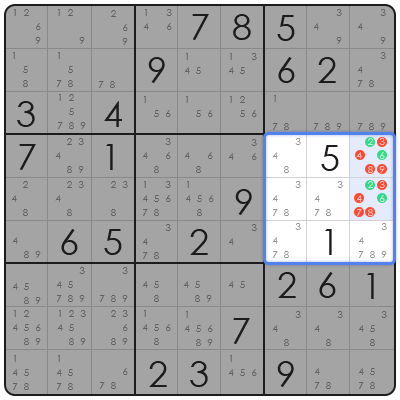
Using mathematical principles to solve Sudoku involves applying foundational concepts of set theory, combinatorics, and constraint satisfaction to systematically deduce the correct placement of numbers within the 9×9 grid. This rigorous approach transcends mere trial-and-error, transforming the puzzle into a solvable system of equations and inequalities, thereby providing a deterministic path to a solution. Based on structural analysis, understanding the mathematical underpinnings of Sudoku elevates problem-solving from intuitive guesswork to an analytical discipline. The significance of this mathematical approach lies in its ability to demystify complex Sudoku puzzles, offering a robust framework for tackling scenarios that seem intractable to the casual solver. From a framework perspective, it not only enhances the solver’s efficiency but also deepens their understanding of logical deduction, a skill transferable to various analytical challenges beyond the puzzle itself. This methodology is particularly vital for those seeking consistency and a higher success rate with difficult grids. The primary problem this structured mathematical application solves in the current landscape of Sudoku is the common reliance on brute-force guessing or intuitive leaps, which often lead to errors and frustration. By formalizing the deduction process, mathematical methods eliminate ambiguity, ensuring each step taken is logically sound and verifiable. In practical application, this systematic reasoning mitigates the risk of dead-ends, making even the most challenging Sudoku puzzles approachable and solvable with methodical precision.
Foundations of Sudoku Mathematics: Deconstructing the Grid
The underlying logic of how to use math to solve Sudoku hinges on its interpretation as a problem of set theory and permutation, where each row, column, and 3×3 block must contain the numbers 1 through 9 exactly once. This translates to a system of highly interdependent constraints where the presence of a number in one cell dictates its exclusion from other cells within its associated row, column, and block. Understanding these fundamental constraints is the first step in applying a mathematical lens.
Mechanically, Sudoku can be viewed as a Latin Square problem with additional regional constraints. Each cell (i, j) in the 9×9 grid must be assigned a value `v` from the set {1, 2, …, 9} such that no two cells in the same row, column, or 3×3 block share the same value. This setup allows for the systematic elimination of possibilities for each cell, forming the basis for ‘candidate tracking’ – a crucial mathematical step. Entities like ‘Naked Singles’ (a cell with only one possible value) and ‘Hidden Singles’ (a value that can only go in one cell within a row, column, or block) are direct consequences of these set-based rules.
Advanced mathematical techniques extend to identifying patterns such as ‘Naked Pairs’ or ‘Hidden Triples,’ where two or three numbers are restricted to two or three specific cells within a unit, allowing the elimination of those numbers as candidates from other cells in that same unit. Moreover, the concept of ‘forcing chains’ or ‘X-Wings’ utilizes combinatorial reasoning to identify number placements across multiple units. Based on structural analysis, these techniques demonstrate how local constraints ripple across the entire grid, providing global deductions essential for complex puzzles.
Applying Mathematical Principles to Sudoku Grids: A Step-by-Step Guide
1. **Initial Grid Scan and Naked Singles Identification:** Begin by systematically scanning the entire 9×9 grid, looking for cells where only one number can logically fit. This is achieved by examining the intersecting row, column, and 3×3 block for each empty cell and noting which numbers from 1-9 are already present. The number that is absent from all three intersecting units is the ‘Naked Single’ for that cell. This foundational step is a direct application of set subtraction.
2. **Row, Column, and Block Analysis for Hidden Singles:** After identifying all Naked Singles, pivot to a unit-centric approach. For each row, column, and 3×3 block, determine if any number (1-9) can only be placed in a single empty cell within that unit, even if that cell has other potential candidates. This ‘Hidden Single’ deduction requires analyzing the candidates for each empty cell within a unit and cross-referencing them with the required numbers for that unit, effectively pinpointing unique placements. This is a crucial application of uniqueness within a defined set.
3. **Candidate Listing and Elimination:** For cells that still lack a definite number, meticulously list all possible candidate numbers for each remaining empty cell. As new numbers are placed through ‘Naked’ or ‘Hidden’ singles, immediately update these candidate lists by eliminating the newly placed numbers from adjacent cells’ possibilities. This iterative process of listing and eliminating is a core aspect of mathematical constraint propagation.
4. **Identifying Paired and Tripled Candidates:** Progress to identifying ‘Naked Pairs,’ ‘Naked Triples,’ ‘Hidden Pairs,’ or ‘Hidden Triples’ within rows, columns, or 3×3 blocks. For example, if two cells within a unit exclusively share the exact same two candidate numbers (e.g., {2,5}), then these two numbers *must* occupy those two cells, eliminating ‘2’ and ‘5’ as candidates from all other cells in that unit. This is a more advanced application of set partitioning and exclusivity.
5. **Advanced Deduction Techniques (e.g., X-Wing, Swordfish):** For highly challenging puzzles, employ more sophisticated logical constructions such as X-Wing or Swordfish. An ‘X-Wing’ in rows, for instance, involves two rows where a particular number (e.g., ‘7’) can only exist in two identical columns within those rows. This mathematical pattern allows for the elimination of ‘7’ from other cells in those two columns, outside of the two specified rows. These techniques are rooted in combinatorial logic and conditional probabilities.
6. **Systematic Backtracking (as a last resort):** When pure deduction stalls, a controlled form of ‘backtracking’ can be employed, which, while often perceived as guessing, can be mathematically structured. This involves making a tentative placement of a number in a cell with two candidates, then logically following all consequences. If a contradiction arises (e.g., two identical numbers in a unit), the tentative placement is invalidated, and the other candidate is confirmed. This is an algorithmic approach often used in computational solutions.
Comparative Analysis: Sudoku Solving Methodologies and Their Mathematical Efficiency
Understanding how to use math to solve Sudoku becomes clearer when contrasted with other popular methodologies. From a framework perspective, comparing these approaches highlights the distinct advantages of a mathematically grounded strategy in terms of reliability and efficiency, especially in complex scenarios. The following table provides a structural analysis of key dimensions:
| Methodology | Complexity (Solver’s Effort) | Efficiency (Time/Steps) | Success Rate (Hard Puzzles) | Human Cognitive Load |
|:—————————|:—————————-|:———————–|:—————————|:———————|
| **Mathematical/Algorithmic** | High (Initial Learning Curve) | High (Systematic) | Very High (Deterministic) | Moderate (Structured) |
| Intuitive/Trial-and-Error | Low (Initial) | Moderate (Heuristic) | Low to Moderate (Prone to Errors) | High (Unstructured) |
| Brute Force (Computational)| Low (Human Input) | Very High (Automated) | 100% (Given Correct Algorithm) | Very Low (Delegated) |
In practical application, the mathematical approach, while demanding a higher initial cognitive investment to learn the techniques, ultimately delivers superior efficiency and a near-perfect success rate on even the most challenging puzzles. It systematizes the problem, reducing the need for arbitrary guesses and the subsequent errors. The intuitive method, conversely, relies on pattern recognition and often leads to dead ends, requiring frequent backtracking without a clear logical path. Computational brute force, while efficient for machines, does not contribute to human problem-solving skill development. Based on structural analysis, the mathematical method strikes an optimal balance between human engagement and logical rigor.
Common Pitfalls & Solutions: Navigating Complex Sudoku Scenarios with Math
A frequent mistake in applying mathematical methods to Sudoku is **over-reliance on simple techniques** like Naked Singles without progressing to more advanced deductions. Many solvers get stuck because they expect every puzzle to yield to the most basic eliminations, failing to see the need for identifying pairs, triples, or more complex patterns. The professional advice here is to systematically exhaust all simple eliminations and then transition to candidate listing for every empty cell. This provides the comprehensive data necessary for spotting higher-order mathematical relationships like X-Wings or forcing chains, which are essential for breaking through plateaus in harder puzzles.
Another significant pitfall is **premature guessing or making assumptions** when the grid appears to offer no more ‘obvious’ mathematical moves. This often leads to errors that propagate throughout the puzzle, making it impossible to solve without restarting. The solution involves adhering strictly to logical deduction. If no direct deduction is apparent, it’s crucial to ensure that all candidate lists are accurate and complete, and then to review for implicit relationships. In practical application, this means revisiting advanced techniques or, if absolutely necessary, using a structured ‘what if’ scenario (backtracking) that is carefully tracked, rather than a random guess. A mathematical approach demands patience and thoroughness.
Finally, **inconsistent or sloppy candidate tracking** is a major impediment. Many solvers try to hold all candidate possibilities in their head or make messy, unorganized notes, leading to oversight and incorrect eliminations. The professional advice is to maintain a clear, systematic method for tracking candidates for each cell, whether through small pencil marks, digital tools, or a dedicated candidate matrix. This meticulous record-keeping is a direct application of data management and ensures that all mathematical possibilities are accurately represented, allowing for reliable deductions and avoiding errors stemming from incomplete or incorrect information. Based on structural analysis, consistency in data representation is paramount for complex logical puzzles.
FAQ Section: Essential Insights into Sudoku Mathematics
**Q: Is Sudoku purely mathematical in its essence?** A: Yes, Sudoku is fundamentally a mathematical puzzle rooted in combinatorial mathematics and set theory, relying on principles of unique placement within defined sets and subsets. Its solution involves logical deduction rather than arithmetic.
**Q: Can artificial intelligence (AI) solve Sudoku using mathematical algorithms?** A: Absolutely. AI systems commonly use algorithms like backtracking, constraint propagation, and SAT solvers, which are mathematical methods, to efficiently solve Sudoku puzzles, often in milliseconds.
**Q: What defines the ‘hardest’ Sudoku puzzle from a mathematical perspective?** A: The hardest Sudoku puzzles mathematically are those requiring the most complex and advanced logical deduction techniques, often with the fewest starting clues that yield direct deductions, forcing deep analysis.
**Q: How does Sudoku relate to graph theory in mathematics?** A: Sudoku can be modeled as a graph coloring problem, where each cell is a vertex, and an edge exists between two vertices if they share a row, column, or block. The ‘colors’ are the numbers 1-9.
**Q: Are there limits to using math to solve Sudoku?** A: Not strictly. While some puzzles require more advanced techniques, the mathematical principles are always applicable. The ‘limits’ typically relate to the solver’s understanding and application of these principles.
In conclusion, approaching Sudoku through a mathematical lens transforms it from a simple pastime into a sophisticated exercise in logical deduction and constraint satisfaction. By systematically applying principles from set theory, combinatorics, and algorithmic thinking, solvers can navigate even the most intricate grids with confidence and precision. This structured methodology not only guarantees a higher success rate but also cultivates enhanced analytical capabilities, which are invaluable. The strategic value of mastering how to use math to solve Sudoku extends beyond the puzzle, offering profound insights into optimization, pattern recognition, and systematic problem-solving across various complex domains. The forward-looking industry insight suggests that the principles honed through this mathematical approach to Sudoku are directly transferable to challenges in data science, artificial intelligence, and operations research, underscoring its enduring relevance.