

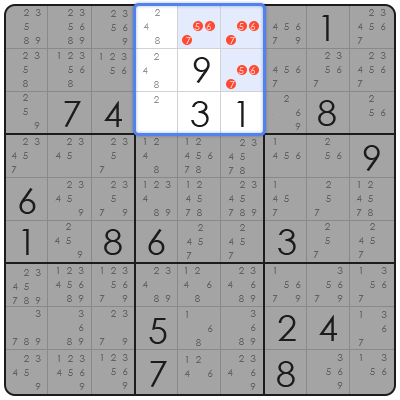
How does Sudoku work? At its core, Sudoku operates as a pure logic puzzle, challenging solvers to fill a 9×9 grid with digits so that each column, each row, and each of the nine 3×3 subgrids contains all of the digits from 1 to 9 without repetition. This deceptively simple premise underpins a complex array of problem-solving techniques, making it a universal test of analytical reasoning. For the casual player, understanding how Sudoku works offers an engaging mental exercise, a daily challenge that sharpens focus and pattern recognition without requiring advanced mathematical knowledge. It’s a therapeutic dive into a world governed by clear rules, providing a satisfying sense of accomplishment with each completed puzzle. The accessibility of its basic rules belies the depth of strategy required for more difficult iterations. For competitive solvers and enthusiasts, comprehending the intricate mechanics of how Sudoku works is paramount to mastering advanced techniques and achieving speed. Beyond simple number placement, Sudoku demands a systematic approach to `candidate elimination` and the application of sophisticated `logical deduction` strategies. Mastery involves a deep understanding of `grid topology` and `cell constraints`, transforming the puzzle from a simple pastime into a rigorous intellectual sport.
The Core Mechanics: How Does Sudoku Work Structurally?
How does Sudoku work structurally? Sudoku functions on a 9×9 grid, subdivided into nine 3×3 ‘blocks’ or ‘regions,’ where the fundamental principle is that every digit from 1 to 9 must appear exactly once in each row, each column, and each 3×3 block. This triple-constraint system is the mathematical and structural bedrock upon which all Sudoku puzzles are built, ensuring a unique solution for well-formed puzzles.
Based on logic-chain analysis, the initial placement of numbers within this `grid topology` creates `cell constraints` that ripple across the entire puzzle. When a number is placed in a cell, it immediately eliminates that number as a possibility from all other cells in its row, column, and 3×3 block. This cascading effect of eliminations is the primary mechanism through which new, singular possibilities emerge.
The interaction between rows, columns, and blocks is crucial for `logical deduction`. For instance, if a specific digit can only be placed in one particular cell within a given row due to constraints from its column and block, that cell becomes a ‘Naked Single.’ Understanding these interconnected relationships is key to progressing through any Sudoku puzzle, from beginner to expert levels.
The Pillars of Play: Logical Deduction and Candidate Elimination
Logical deduction is how Sudoku works as a problem-solving exercise, allowing players to systematically narrow down possibilities until a single correct digit can be placed in each empty cell. This process relies on the immutable rules of the grid to infer information rather than relying on guesswork.
A crucial technique in `logical deduction` is `candidate elimination`, often performed using `pencil marks`. Players mark all possible digits (candidates) for each empty cell. As numbers are placed, corresponding candidates are eliminated from relevant rows, columns, and blocks. This meticulous tracking helps reveal cells where only one candidate remains (Naked Singles) or where a candidate only appears once in a row, column, or block among its peers (Hidden Singles).
For competitive solvers, sophisticated `candidate elimination` leads to the discovery of more complex patterns. Entity-based writing highlights techniques like Naked Pairs, where two cells in a unit share the same two candidates, removing those candidates from other cells in that unit. Similarly, X-Wing formations use intersecting sets of candidates across rows or columns to eliminate possibilities in other parts of the grid, showcasing the depth of `grid topology` analysis.
A Step-by-Step Approach to Solving Sudoku
To effectively understand how Sudoku works in practice, one should follow a structured, iterative solving methodology starting with an initial scan for immediate placements. Begin by scanning rows, columns, and 3×3 blocks for ‘Naked Singles’ – cells where the missing number is immediately obvious because all other numbers in that unit are already present.
The next critical step involves systematic `pencil marks`. For every empty cell, lightly note down all possible candidate digits (1-9) that do not violate the row, column, or block rules. This comprehensive list of `cell constraints` for each square transforms the puzzle from a guessing game into an analytical challenge, allowing you to visualize all potential states of the grid.
Once `pencil marks` are established, transition to `candidate elimination` patterns. Search for ‘Hidden Singles’ (where a candidate exists only once in a row, column, or block’s `pencil marks`). Then, look for more advanced patterns like ‘Naked Pairs’ (two cells in a unit with identical two candidates) or ‘Hidden Pairs’ (two candidates appearing only in two cells within a unit). This iterative process of placing numbers, updating pencil marks, and identifying new patterns is fundamental to mastering Sudoku.
The structural necessity of regular re-evaluation cannot be overstated. Each time a number is placed, it invalidates numerous `pencil marks` across its row, column, and block. Consistently updating these marks and re-scanning the grid for new singles or pairs is vital. This cycle of observation, deduction, placement, and update forms the core loop of how Sudoku works as a solvable puzzle.
“How Does Sudoku Work” Versus Advanced Strategies
Understanding how Sudoku works fundamentally provides the basis for all advanced strategies, which essentially refine the process of `logical deduction` and `candidate elimination`. While the core mechanism is constant, advanced techniques offer more efficient or complex pathways to uncover solutions that aren’t immediately apparent.
The foundational logic of Sudoku involves direct inferences and simple singles. However, strategies like ‘Naked Pairs’ or ‘X-Wing’ represent higher-order deductions that leverage the grid’s interdependencies more intricately. For example, an X-Wing uses the intersection of candidates across two rows and two columns to eliminate possibilities outside of those intersections, a concept built directly on the triple-constraint rule but requiring a more sophisticated visual and logical scan.
A comparison of how Sudoku works at its basic level versus advanced strategies can be summarized:
| Strategy | Difficulty Level | Frequency of Use | Logical Complexity | Skill Focus |
|—————————|——————-|——————-|———————–|———————————————|
| Core Sudoku Logic | Low to Medium | Constant | Foundational | Direct `Candidate Elimination`, Singles |
| Naked/Hidden Pairs/Triples| Medium | High | Pattern Recognition | Interdependent `Cell Constraints` |
| X-Wing/Swordfish | High | Moderate | Set Theory, Intersects| Cross-Unit Candidate `Logical Deduction` |
| Forcing Chains | Very High | Low (Expert only) | Hypothetical Analysis | Consequential `Candidate Elimination` |
Common Pitfalls in Sudoku Solving and How to Avoid Them
One of the most common pitfalls when learning how Sudoku works is an over-reliance on guessing, which fundamentally undermines the `logical deduction` principle. Guessing often leads to dead ends and forces players to backtrack, wasting significant time. To avoid this, always ensure every number placement is based on irrefutable logic derived from `cell constraints` and `candidate elimination`.
Another frequent mistake involves inconsistent or incomplete `pencil marks`. Many players either skip pencil marking altogether or fail to update their marks consistently as new numbers are placed. This oversight obscures potential singles and patterns. The remedy is meticulousness: always mark all possible candidates and rigorously update them after every successful digit placement, maintaining an accurate representation of the grid’s state.
Lastly, failing to systematically scan the entire grid can lead to overlooked opportunities. Players might focus too heavily on one region, missing obvious placements or patterns elsewhere. To counter this, adopt a methodical scanning pattern (e.g., row-by-row, then column-by-column, then block-by-block) for `Naked Singles` and `Hidden Singles`, and then repeat this for more complex patterns after each new number is added. This ensures a comprehensive approach to `grid topology` analysis.
Frequently Asked Questions About Sudoku Mechanics
Q: What is the primary rule of Sudoku?
A: The primary rule is to fill a 9×9 grid so each row, column, and 3×3 block contains digits 1-9 exactly once. This forms the basis of all `logical deduction`.
Q: Are there different types of Sudoku puzzles?
A: Yes, many variations exist, including Killer Sudoku, Sumoku, and Samurai Sudoku. Each introduces unique `cell constraints` beyond the standard rules, altering `how does Sudoku work`.
Q: How do I improve my Sudoku speed?
A: Improving speed involves mastering `pencil marks`, quickly identifying `Naked Singles` and `Hidden Singles`, and recognizing advanced `candidate elimination` patterns like pairs and triples. Consistent practice is key.
Q: What are ‘pencil marks’ used for?
A: `Pencil marks` are used to track all possible candidate digits for an empty cell, facilitating `candidate elimination` and revealing patterns through `logical deduction`. They are essential for complex puzzles.
Q: Is Sudoku a math puzzle?
A: Sudoku is a logic puzzle, not a math puzzle. While it uses numbers, no arithmetic is involved; the numbers serve as symbols constrained by position. `How does Sudoku work` relies purely on `logical deduction`.
In conclusion, understanding how Sudoku works is fundamentally about embracing a ‘Logic-First’ approach. It’s not a game of arithmetic or guessing, but a meticulous exercise in `logical deduction`, `candidate elimination`, and pattern recognition within a defined `grid topology`. Mastery comes from rigorously applying `pencil marks`, systematically scanning for `cell constraints`, and progressively recognizing more intricate relationships between numbers. By adhering to these principles, any solver can unlock the grid’s secrets and find immense satisfaction in conquering even the most formidable puzzles, reinforcing the power of pure logic.