

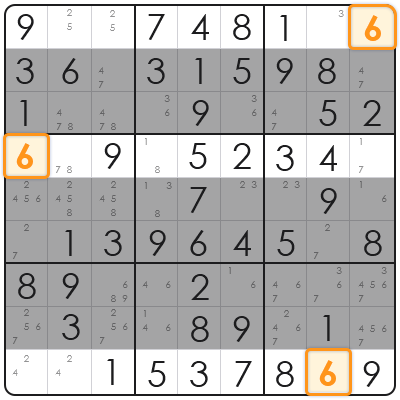
Swordfish Sudoku explained is an advanced logical deduction technique used to solve challenging Sudoku puzzles by identifying specific patterns of candidate elimination across rows and columns. This strategy is crucial for intermediate to advanced solvers aiming to break through difficult puzzles where simpler methods like Naked Pairs or Hidden Singles fall short. Understanding the Swordfish pattern allows players to significantly reduce the number of possible candidates in various cells, thereby unlocking further logical chains. The significance of the Swordfish technique lies in its ability to handle complex grid topologies that often stump solvers relying solely on basic candidate elimination. For speed-solvers, mastering the Swordfish can shave valuable seconds off completion times by providing a definitive way to eliminate candidates that would otherwise require much longer logic chains. Casual players, on the other hand, find that learning this technique offers a satisfying step up in puzzle-solving prowess, opening the door to more engaging and challenging Sudoku experiences. This article provides a comprehensive deep-dive into the Swordfish technique, covering its logical underpinnings, practical application, and comparison with other advanced Sudoku strategies. We will explore how its unique structure allows for powerful candidate elimination and guide you through the process of identifying and applying it effectively.
The Logic Behind Swordfish Sudoku Explained
The Swordfish Sudoku technique operates on the principle of candidate elimination across multiple rows and columns, leveraging a specific structural constraint within the 9×9 grid.
Mathematically and structurally, the Swordfish relies on a number (let’s call it ‘N’) appearing as a candidate in exactly two or three cells within a specific row, and crucially, these cells must align in a way that covers only two or three columns across the entire grid. Specifically, if candidate ‘N’ appears in only two or three cells in three different rows, and these appearances are confined to only three specific columns, then ‘N’ can be eliminated as a candidate from all other cells within those three columns that are *not* part of the Swordfish pattern. The structural necessity of this pattern guarantees that ‘N’ must reside in one of the identified cells within the three rows, thereby making it impossible for ‘N’ to exist in any other cell in the affected columns.
Consider a candidate number, say ‘7’. If ‘7’ appears as a candidate in, for example, row 2, row 5, and row 8, and all instances of ‘7’ in these rows are confined to columns 1, 4, and 7, then this forms a Swordfish pattern for the number ‘7’. The logic dictates that the ‘7’s in rows 2, 5, and 8 *must* occupy cells within columns 1, 4, and 7. Therefore, ‘7’ cannot be a candidate in any other cell within columns 1, 4, or 7 (i.e., in rows 1, 3, 4, 6, 7, and 9).
Step-by-Step Implementation of Swordfish Sudoku
To effectively implement the Swordfish technique in a Sudoku puzzle, begin by ensuring you have thoroughly marked all possible candidates (pencil marks) for each empty cell.
1. **Scan for Candidate Concentration:** Look for a specific candidate number (e.g., ‘3’) that appears in only two or three cells within a given row. Repeat this for at least three different rows where this candidate number appears.
2. **Identify Column Alignment:** Once you have identified three rows (let’s call them R1, R2, R3) where your chosen candidate (let’s say ‘3’) is restricted to a limited number of cells, check if these cells fall within a limited set of columns (say, C1, C2, C3). Ideally, each of these three rows should have its ‘3’ candidates restricted to *only* these same three columns.
3. **Verify the Swordfish Pattern:** Confirm that candidate ‘3’ appears in R1 across C1, C2, or C3; in R2 across C1, C2, or C3; and in R3 across C1, C2, or C3. It’s permissible for a row to have only two cells with candidate ‘3’, as long as they fall within the chosen three columns. The critical condition is that across these three rows, the candidate ‘3’ is *exclusively* confined to these three columns.
4. **Perform Elimination:** If the Swordfish pattern is confirmed for candidate ‘3’ across R1, R2, R3 and C1, C2, C3, then you can eliminate candidate ‘3’ from all other cells in columns C1, C2, and C3 that are *not* in rows R1, R2, or R3. This is the core benefit of the Swordfish technique, as it clears multiple cells of a specific candidate.
Comparative Analysis of Sudoku Strategies
The Swordfish technique is a powerful tool in a Sudoku solver’s arsenal, but its application and complexity place it within a specific tier of strategies.
Here’s a comparative analysis with other common and related Sudoku strategies:
| Strategy | Difficulty Level | Frequency of Use | Logical Complexity |
|—|—|—|—|
| Naked Pairs | Easy | High | Low |
| X-Wing | Medium-Hard | Medium | Medium |
| Swordfish | Hard | Medium-Low | High |
| Jellyfish | Very Hard | Low | Very High |
The difficulty level for Swordfish arises from the need to simultaneously track candidate placements across multiple rows and columns. Its frequency of use is moderate; while not as common as Naked Pairs, it appears often enough in difficult puzzles to warrant mastery. The logical complexity is significant, as it requires a broader view of the grid’s topology compared to simpler techniques. Based on logic-chain analysis, the Swordfish offers a more potent elimination capability than an X-Wing due to its extension across three rows/columns, but it also requires more meticulous scanning.
Common Pitfalls When Applying Swordfish Sudoku
Players often make mistakes when attempting to identify or apply the Swordfish technique, leading to incorrect eliminations or missed opportunities.
1. **Incomplete Candidate Marking:** The most common pitfall is applying the Swordfish logic without having meticulously marked all possible candidates (pencil marks) for every empty cell. Without a complete set of candidates, you cannot accurately identify the pattern or verify the cell constraints, leading to false positives or missed Swordfish formations.
2. **Incorrect Pattern Recognition:** Solvers may misinterpret the pattern, mistaking it for an X-Wing or failing to ensure that the candidate is *exclusively* confined to the selected rows and columns. For example, if the candidate appears in a fourth row or a fourth column outside the intended Swordfish structure, the elimination based on that pattern would be invalid. Always double-check that the candidate is restricted to the chosen rows and only the chosen columns.
3. **Overlooking Simpler Solutions:** Another mistake is forcing the Swordfish technique when simpler logical deductions are available. The Swordfish is an advanced tool; it should be applied when basic and intermediate techniques have been exhausted. Relying on it too early can lead to confusion and errors, whereas recognizing and applying simpler logic first often leads to a more straightforward solution path.
Frequently Asked Questions about Swordfish Sudoku
What is the primary goal of the Swordfish technique in Sudoku?
The Swordfish technique aims to eliminate a specific candidate number from cells in certain columns by identifying a pattern where that candidate appears in only two or three cells in three different rows, restricted to only three columns.
How is a Swordfish different from an X-Wing?
An X-Wing involves a candidate restricted to two cells in two rows, which must align to two columns. A Swordfish extends this to three rows and three columns.
When should I use the Swordfish technique?
Use the Swordfish technique when simpler methods like Naked/Hidden Pairs/Triples and X-Wings have failed to yield progress, and you have thoroughly marked all candidates.
Can the Swordfish pattern involve more than three rows or columns?
Yes, the pattern can be extended to four rows and four columns (known as a Jellyfish) or even more, but the core principle remains the same: restricting a candidate’s location across multiple rows to a limited set of columns allows elimination in those columns.
Does the Swordfish technique guarantee a solution step?
Not always directly, but it significantly reduces the number of possible candidates, making subsequent logical deductions easier and often leading to a solved cell or unlocking further advanced patterns.
Mastering the Swordfish Sudoku technique is a significant milestone for any serious Sudoku enthusiast, moving beyond basic candidate elimination to complex grid topology analysis. The logic-first approach, deeply embedded in this strategy, emphasizes understanding the structural necessities within the 9×9 grid to achieve decisive eliminations. For competitive solvers, its efficient application can be the difference between a personal best and a missed opportunity. By diligently practicing pattern recognition and understanding the common pitfalls, you can confidently integrate Swordfish into your problem-solving repertoire, opening up a new level of engagement with challenging Sudoku puzzles.