

In the intricate world of logic puzzles, Sudoku stands as a paragon of structured thinking and pattern recognition. The process of validating a completed Sudoku grid, often overlooked in the pursuit of a solution, is fundamentally an exercise in robust data integrity and rule-based system verification. This crucial step ensures that the intellectual effort invested culminates in a genuinely correct and permissible configuration, adhering strictly to the puzzle’s foundational axioms. The primary challenge that a systematic Sudoku check addresses is the elimination of logical inconsistencies and errors that can arise during manual or even automated puzzle-solving. Without a definitive checking mechanism, a solved grid’s correctness remains speculative, undermining the very essence of a precise logical endeavor. It establishes a verifiable standard, transforming a subjective claim of completion into an objectively confirmed solution. Based on structural analysis, the methodology for checking a Sudoku is not merely a rote inspection but a multi-faceted validation process that assesses numerical uniqueness across three distinct dimensions. From a framework perspective, understanding this verification mechanism offers profound insights not only into puzzle mechanics but also into broader principles of algorithmic validation and data consistency, essential across various analytical disciplines.
The Core Principles of Sudoku Validity: An Intrinsic Breakdown
Sudoku validity hinges unequivocally on three fundamental, interconnected rules: the absolute uniqueness of digits within each row, each column, and each of the nine 3×3 subgrids. Adherence to these principles is non-negotiable for any grid to be deemed correctly solved. This forms the bedrock of its structural integrity, dictating that every digit from 1 to 9 must appear exactly once within these specified constraints.
Delving into row validation mechanics, the first principle dictates that every single horizontal line, from row 1 to row 9, must contain all digits from 1 through 9, each appearing precisely once. Any duplication of a digit within the same row immediately signifies an invalid state, irrespective of the rest of the grid’s configuration. This linearity check is a foundational layer of the verification process, ensuring horizontal consistency.
Complementing row validation is the necessity of strict column validation. Analogously, each vertical line, spanning from column 1 to column 9, must also be a complete set of the digits 1 through 9, with no repetitions. A single instance of a repeated digit within any column renders the entire grid invalid. This vertical integrity check is equally critical, confirming perpendicular numerical harmony.
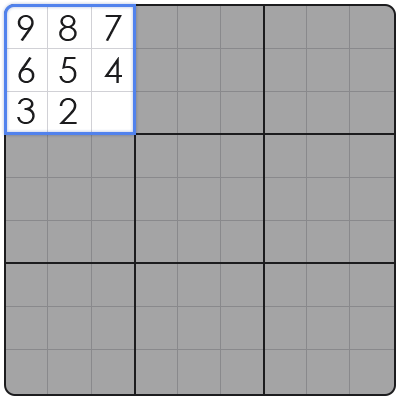
The third, and often most overlooked, component of validity involves the nine 3×3 subgrids, sometimes referred to as ‘blocks’ or ‘regions’. Each of these distinct 3×3 squares, when isolated, must independently contain all digits from 1 through 9 exactly once. Errors in this particular check are common, as the visual boundary of these blocks can be less intuitive than rows or columns, making a systematic approach vital for thorough verification.
Methodical Approaches to Sudoku Grid Verification: A Step-by-Step Guide
Verifying a Sudoku grid involves a systematic, cell-by-cell and block-by-block inspection against the core rules, demanding a structured approach to guarantee accuracy. In practical application, this systematic review minimizes oversight and ensures every constraint is properly assessed.
Step 1: Row-by-row Inspection. Begin by examining the first row. Collect all the digits present in that row (ignoring empty cells if the grid is partially filled, but for a solved grid, all cells are filled). Check if this collection contains all digits from 1 to 9 exactly once. If any digit is missing or duplicated, mark the grid as incorrect. Repeat this process for all nine rows sequentially, ensuring each row satisfies the uniqueness criterion.
Step 2: Column-by-column Inspection. After completing all rows, proceed to inspect each column. For the first column, gather all its digits and verify that it contains 1 through 9 without repetition. Move through columns 2 to 9, applying the same verification logic. This stage confirms vertical integrity across the entire grid, identifying any conflicts that might have been missed in the horizontal sweep.
Step 3: 3×3 Subgrid Inspection. This is a critical stage that often reveals errors. Identify the nine distinct 3×3 subgrids. Starting from the top-left block (cells A1-C3), collect all nine digits within it. Confirm that these digits are 1 through 9, each appearing once. Systematically progress through the remaining eight 3×3 blocks (e.g., A4-C6, A7-C9, D1-F3, etc.), applying the identical uniqueness check to each. This ensures local integrity within the defined regions.
Step 4: Consolidation and Error Identification. If any of the checks in Steps 1, 2, or 3 reveal a violation (a missing digit, a duplicate digit), the Sudoku grid is deemed invalid. If all three sets of checks pass without exception, then the Sudoku grid is confirmed as correctly solved. A complete solution implies a flawless execution across all three axes of validation.
Automated vs. Manual Sudoku Checking Methodologies: A Comparative Analysis
Sudoku checking can be performed manually or through automated algorithms, each offering distinct advantages and limitations in terms of complexity, efficiency, and typical application scenarios. From an efficiency perspective, the method chosen often depends on the scale and frequency of verification required.
Manual checking, while deeply engaging and intellectually stimulating for individual users, is inherently complex and time-consuming. It involves human visual scanning and mental comparison, making it prone to oversight, especially in larger or highly complex grids. This method excels in personal learning and reinforcing the logical process but falls short in scenarios demanding high-speed or bulk validation. Its efficiency is low, and its ‘cost’ is primarily in human time and potential error rate.
Automated checking, conversely, leverages algorithms to systematically iterate through rows, columns, and 3×3 blocks, checking for digit uniqueness at computational speeds. This approach virtually eliminates human error and offers unparalleled efficiency, making it the preferred method for software applications, puzzle generators, and competitive Sudoku platforms. The initial ‘cost’ is in development, but the long-term ‘efficiency’ is exceptionally high, allowing for frequent, almost instantaneous validation of numerous grids.
Comparing these, the ‘Complexity’ of manual checking lies in sustained human attention, whereas for automated systems, it’s in algorithm design. ‘Efficiency’ is vastly superior in automation, completing checks in milliseconds versus minutes for a human. ‘Cost’ for manual is time; for automated, it’s development and processing power. ‘Frequency’ of checks can be low for manual (per puzzle) and extremely high for automated (thousands per second), making algorithmic verification the industry standard for large-scale operations.
Common Pitfalls in Sudoku Verification and Strategic Solutions
Common pitfalls in checking Sudoku grids often stem from oversight, misinterpretation of rules, or incomplete systematic checks, highlighting the need for vigilance and a structured approach. Understanding these frequent mistakes is crucial for any analyst or enthusiast.
One frequent mistake is overlooking duplicates within the 3×3 blocks. Because these blocks overlap neither rows nor columns perfectly, a digit correctly placed in a row and column might still violate a block rule. The solution involves a dedicated, sequential scan of each 3×3 block, treating it as an independent mini-grid that must contain 1-9 without repetition, entirely separate from the row and column checks.
Another pitfall is confusing empty cells with valid digits, particularly in a partially solved grid or during the initial stages of a check. A fully ‘checked’ Sudoku implies all cells are filled. If empty cells remain, the ‘check’ is for *consistency of filled cells*, not for a complete solution. The professional advice is to explicitly define the objective: are you validating a complete solution or verifying the partial validity of an in-progress grid? Focus solely on filled cells for validity checks; empty cells do not contribute to ‘duplicate’ errors.
A third common error is performing incomplete checks, for instance, only verifying rows and columns but neglecting the 3×3 blocks, or vice versa. This leads to a false positive for validity. The strategic solution is to implement a comprehensive, three-pronged validation protocol that rigorously checks all rows, all columns, and all nine 3×3 blocks. Each dimension is equally vital, and failure in even one invalidates the entire grid. From a framework perspective, a complete validation must address all defined constraints simultaneously.
Frequently Asked Questions on Sudoku Validation
Understanding common inquiries about Sudoku validation helps clarify core rules and efficient checking methods for enthusiasts and developers alike, addressing key aspects of puzzle integrity.
What makes a Sudoku grid valid? A grid is valid if each row, column, and 3×3 subgrid contains digits 1-9 exactly once, with no repetitions within those specific structures.
Can a Sudoku have multiple solutions? Yes, an unsolved Sudoku might have multiple solutions if not enough initial clues are provided, but a *solved* Sudoku must adhere to a single valid state.
Is checking Sudoku faster manually or with a computer? Generally, a computer can check a Sudoku grid far faster and with greater accuracy than a human due to algorithmic processing capabilities.
What if a Sudoku only has a few empty cells left? The checking process remains the same; validate all filled cells against the rules across rows, columns, and 3×3 blocks for consistency.
Why is it important to check a solved Sudoku? Checking ensures the puzzle was completed correctly, reinforcing logical thinking and preventing the acceptance of invalid or flawed solutions.
In conclusion, the methodology for how to check Sudoku transcends mere puzzle validation; it embodies fundamental principles of data integrity and systematic rule enforcement critical across many analytical and logical systems. The ability to methodically verify a grid’s correctness, whether manually or through automated means, underscores the importance of precise execution and comprehensive constraint satisfaction. This rigorous approach not only confirms a successful puzzle completion but also offers invaluable insights into the strategic design of verifiable systems, paving the way for more robust and error-resistant logical frameworks in the future.