

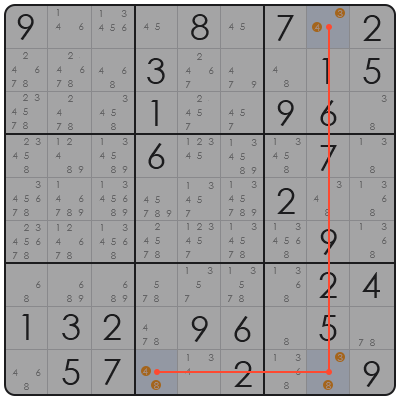
How to win hard sudoku is a sophisticated application of logical deduction and pattern recognition, essential for solving intricate number placement puzzles. This process goes beyond basic techniques, demanding a deep understanding of cell interdependencies and advanced strategic thinking. From a framework perspective, mastering hard Sudoku serves as an excellent model for enhancing analytical capabilities, critical in various professional domains where complex problem-solving is paramount. The significance of developing robust strategies for hard Sudoku lies in its capacity to cultivate patience, meticulous attention to detail, and systematic reasoning. It forces practitioners to move beyond simple trial and error, instead embracing a structured approach to identify hidden patterns and eliminate possibilities. This intellectual discipline is invaluable, particularly in scenarios requiring precise data interpretation and strategic foresight. The primary problem that a structured approach to winning hard Sudoku solves is the frustration and inefficiency associated with haphazard guessing. Without a methodological framework, hard puzzles can seem insurmountable, leading to stalled progress and eventual abandonment. By applying advanced techniques, solvers can navigate complexity with confidence, transforming seemingly intractable problems into solvable challenges through logical progression.
Deconstructing Hard Sudoku: The Underlying Logical Mechanics
Understanding how to win hard sudoku fundamentally involves deconstructing the puzzle’s complex network of constraints. Based on structural analysis, hard Sudoku puzzles are not merely about filling empty cells; they are about identifying logical implications across rows, columns, and 3×3 blocks. This requires a systematic approach to identify ‘hidden’ or ‘naked’ subsets, where specific candidates are restricted to a limited number of cells, revealing crucial deductions.
The core mechanics revolve around the unique placement of numbers 1-9 in each row, column, and 3×3 block. What differentiates a ‘hard’ Sudoku is the sparse initial grid, which necessitates advanced techniques beyond simple singles. These techniques include concepts like ‘X-Wing’ and ‘Swordfish’, which exploit patterns of candidates across multiple rows or columns to eliminate possibilities in other areas. These patterns represent chains of inference, where a decision in one cell has ripple effects across the entire grid.
Furthermore, advanced techniques often involve ‘forcing chains’ or ‘XY-Wings’, which explore hypothetical scenarios to reveal contradictions or necessary truths. This level of logical inference mimics decision-making processes in complex systems, where evaluating cascading consequences of choices is vital. The structural integrity of the Sudoku grid demands that every number placement adheres to strict rules, reinforcing the importance of rigorous validation at each step.
Applying Advanced Strategies: A Step-by-Step Guide to Solving Hard Sudoku
Effectively implementing how to win hard sudoku requires a systematic, multi-layered approach. In practical application, begin by performing all basic candidate elimination (singles, hidden singles, naked pairs/triples) to simplify the grid as much as possible. This foundational step ensures that more complex patterns are not obscured by readily available deductions and sets the stage for advanced tactics.
Next, systematically scan for ‘locked candidates’ and ‘pointing pairs/triples’. These techniques identify when a candidate number is restricted to a specific row, column, or block within a larger 3×3 box, allowing for eliminations outside that specific 3×3. This is a crucial transitional step from basic to intermediate strategies, often unlocking further singles or smaller candidate sets that were previously hidden.
Progress to ‘fish’ patterns like X-Wing, Swordfish, and Jellyfish. An X-Wing, for instance, occurs when a candidate number appears in exactly two cells in two different rows, and these cells also align in the same two columns. This allows for the elimination of that candidate from all other cells in those two columns. Identifying these complex patterns requires careful visual scanning and a deep understanding of how candidates interact across the entire grid. Finally, for the most stubborn puzzles, explore ‘forcing chains’ or ‘Nishio’ techniques, which involve making a hypothetical placement and following its logical consequences to find a contradiction, thereby proving the original hypothesis false.
Comparing Hard Sudoku Strategies with Related Problem-Solving Paradigms
Understanding how to win hard sudoku can be illuminated by comparing its strategic demands with other logical puzzle types and problem-solving approaches. Hard Sudoku, with its reliance on advanced pattern recognition and inferential chains, stands apart from simpler logical challenges. While a basic Sudoku primarily involves direct elimination and single-candidate identification, hard Sudoku demands multi-cell, multi-line candidate interactions.
Consider ‘Naked Singles’ in basic Sudoku versus ‘X-Wings’ in hard Sudoku. Naked Singles are straightforward: if a cell has only one possible candidate, that’s its number. This is high frequency, low complexity, and efficient. X-Wings, however, are lower frequency, high complexity, and require more mental effort to identify, but offer high efficiency once found, eliminating numerous candidates simultaneously. Comparing to ‘Kakuro’, which involves arithmetic sums, Sudoku focuses purely on placement logic, making its ‘cost’ in terms of required mathematical operations lower, but its ‘complexity’ in terms of abstract pattern identification higher.
Furthermore, juxtaposing hard Sudoku with real-world strategic planning, such as project management or resource allocation, reveals parallels. Both demand an iterative process of assessing constraints, identifying dependencies, and making informed decisions that ripple through a system. The ‘efficiency’ of a Sudoku strategy, like that of a project plan, is measured by its ability to yield significant progress with minimal wasted effort, ultimately reducing ‘cost’ in terms of time and cognitive load.
Common Pitfalls in Solving Hard Sudoku and Their Professional Solutions
When approaching how to win hard sudoku, several common pitfalls can impede progress. One frequent mistake is relying too heavily on trial and error, particularly when faced with a seemingly intractable section. This unprofessional approach not only wastes time but often leads to errors that can corrupt the entire puzzle. The professional solution involves meticulously tracking all candidate numbers in each cell, often using pencil marks, and systematically exhausting all direct logical deductions before considering advanced patterns.
Another pitfall is overlooking subtle patterns or breaking chains of inference prematurely. Solvers might correctly identify an X-Wing but fail to execute all possible eliminations derived from it, or miss a ‘hidden pair’ within a block. Professional advice dictates a disciplined approach: after applying any advanced technique, always re-scan the entire grid for new singles or simpler deductions that might have emerged. This iterative process ensures no opportunities are missed and that the grid is truly exhausted of obvious moves.
Finally, many falter by giving up too soon or becoming overwhelmed by the sheer number of candidates in a complex grid. The solution lies in strategic patience and breaking down the problem into smaller, manageable parts. Focus on one region (a row, column, or block) at a time, looking for specific patterns, and then move systematically to the next. Maintaining a positive, analytical mindset, even when stuck, is crucial. Regularly reviewing the rules and established eliminations can often reveal a forgotten possibility or a misidentified candidate, leading to a breakthrough.
FAQs: Essential Insights for Winning Hard Sudoku
What is the most crucial skill for hard Sudoku? The most crucial skill for how to win hard sudoku is logical deduction combined with meticulous pattern recognition. It’s about seeing connections across the entire grid, not just individual cells.
When should I use advanced techniques like X-Wing? Advanced techniques should be employed when basic singles and hidden pairs/triples have been exhausted and no more direct eliminations are apparent. They are for breaking impasses.
How can I improve my speed in solving hard Sudoku? To improve speed, practice regularly, focus on systematic scanning for patterns, and avoid guessing. Develop a consistent workflow for applying techniques efficiently.
Is there a universal strategy for all hard Sudokus? No single universal strategy guarantees a win. Each hard Sudoku presents unique challenges requiring a flexible application of a repertoire of advanced techniques. It’s about adaptability.
What is ‘Nishio forcing’ in Sudoku? Nishio forcing is an advanced technique where you hypothesize a number in a cell and follow its consequences. If it leads to a contradiction, the hypothesis is false, and the number cannot be there.
Mastering how to win hard sudoku offers profound long-term strategic value, extending far beyond the puzzle itself. It hones critical thinking, enhances problem-solving methodologies, and reinforces the importance of structured analysis in complex environments. From a forward-looking industry insight perspective, individuals adept at this level of logical deduction are better equipped to tackle intricate data challenges, optimize processes, and make informed decisions in fast-evolving fields. The discipline cultivated through hard Sudoku serves as a powerful testament to one’s capacity for analytical rigor and persistent problem resolution, skills that remain indispensable in any professional landscape.