

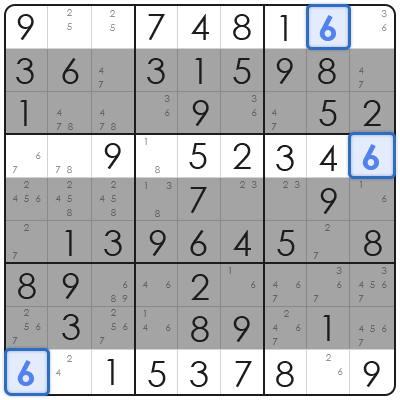
Pencil marks in Sudoku, from a Sudoku Strategy perspective, represent the systematic notation of all possible candidate numbers for each empty cell within a puzzle grid. This fundamental technique serves as the bedrock for approaching and solving more complex Sudoku puzzles, transforming what might appear to be an insurmountable challenge into a manageable, logical progression. The significance of employing pencil marks extends beyond mere organization; it acts as an externalized memory and a visual aid for advanced deductive reasoning. By diligently recording every potential value for every cell, solvers create a comprehensive data layer that reveals hidden patterns and allows for the application of sophisticated strategies that would be exceptionally difficult, if not impossible, to execute purely in one’s head. The primary problem that pencil marking solves in the current landscape of Sudoku solving is the mental overload associated with tracking numerous possibilities across a 9×9 grid. Without this systematic approach, solvers are prone to errors, overlook critical deductions, and often hit an impasse, making highly challenging puzzles seem arbitrary or unsolvable. Pencil marks provide the structural integrity required to navigate these intricate logical pathways, guiding the solver towards a definitive solution with clarity and precision.
Technical and Structural Breakdown: The Core Mechanics of Pencil Marking
Pencil marking, from a framework perspective, involves systematically noting all possible candidate numbers for each empty cell within a Sudoku grid based on the rules of the game: each row, column, and 3×3 block must contain the digits 1-9 exactly once. This process generates a visual database of possibilities, which is then iteratively refined through elimination.
The underlying logic of pencil marks is rooted in constraint satisfaction. By listing every candidate, we externalize the absence of information. As concrete numbers are placed, whether through direct deductions or advanced techniques, those numbers are immediately removed as candidates from all other cells in the same row, column, and 3×3 block. This cascading elimination progressively reduces the number of possibilities for remaining cells, leading to new certainties.
Based on structural analysis, the components of pencil marking are the cells themselves, their associated candidate lists, and the interconnectedness of rows, columns, and blocks. Every notation is a hypothesis; every elimination is a verification. This methodical reduction of the search space is what enables the identification of ‘naked’ or ‘hidden’ singles, pairs, triples, and more intricate patterns, which are the building blocks of advanced Sudoku strategies.
Step-by-Step Implementation: Applying Pencil Marks for Strategic Advantage
In practical application, effectively using pencil marks in Sudoku begins with initial grid scanning and progresses through systematic candidate identification and reduction. The first step involves a thorough initial pass of the puzzle to fill in any ‘easy’ numbers—those that can be placed immediately by observing existing numbers in their respective rows, columns, and blocks. This provides a clearer canvas for the more detailed marking.
Following the initial pass, the solver proceeds to the systematic notation of candidates. For every empty cell, carefully consider its row, column, and 3×3 block. Write down every digit from 1 to 9 that is not already present in those three intersecting units. This should be done meticulously, cell by cell, ensuring no candidate is missed or incorrectly noted. Accuracy at this stage is paramount for future deductions.
Once all initial candidates are marked, the strategic advantage emerges. The grid is now primed for advanced analysis. Look for ‘naked singles’ (a cell with only one candidate), ‘hidden singles’ (a digit that is a candidate in only one cell within a row, column, or block), and then progress to ‘naked pairs/triples’ (two/three cells in a unit sharing the exact same two/three candidates) and ‘hidden pairs/triples’. Each successful deduction leads to the removal of candidates, restarting the cycle of identification and elimination until the puzzle is solved.
Comparative Analysis: Pencil Marks vs. Alternative Sudoku Aids
Based on structural analysis, pencil marks offer a distinct balance of systematic rigor and flexibility compared to other Sudoku solving methods, such as purely mental enumeration or the use of digital solvers. While each approach has its merits, understanding their comparative dimensions highlights the unique value proposition of manual candidate notation.
Mental enumeration, while impressive, suffers from high complexity and low efficiency for puzzles beyond an easy difficulty. It relies heavily on short-term memory and is prone to errors, making it unsuitable for sustained, deep analysis required by hard puzzles. Digital solvers, conversely, offer maximum efficiency and minimal complexity for the user, instantly providing solutions. However, they bypass the cognitive process, negating the learning and satisfaction inherent in solving the puzzle oneself.
Pencil marks strike a critical balance. They introduce a moderate level of complexity in their application but significantly enhance efficiency in solving difficult puzzles by externalizing the problem space. Their frequency of use among expert human solvers is near universal, indicating their indispensable role in Sudoku Strategy. Below is a comparative overview:
| Feature | Pencil Marks | Mental Enumeration | Digital Solver |
|:————|:————-|:——————-|:—————|
| Complexity | Moderate | High | Low (user-side)|
| Efficiency | High | Low | Very High |
| Learning Curve| Moderate | High (for hard puzzles)| Very Low |
| Frequency (Expert Human Play)| Universal | Low | N/A (Automated)|
| Cognitive Engagement| High | Very High | Low |
Common Pitfalls and Solutions in Pencil Marking Adoption
Frequent mistakes in utilizing pencil marks in Sudoku typically involve incomplete candidate notation, failure to update candidates after a number placement, and developing an over-reliance on simple techniques without broader grid analysis. These pitfalls can hinder progress and lead to frustration, underscoring the need for disciplined application.
A common pitfall is ‘incomplete candidate notation,’ where not all possible numbers are correctly marked for a cell, or some cells are skipped entirely. The solution is a methodical, cell-by-cell approach during the initial marking phase, coupled with a double-check across all rows, columns, and blocks to ensure every empty cell has an accurate and exhaustive list of candidates. Professional advice suggests using a consistent pattern (e.g., left-to-right, top-to-bottom) for marking.
Another significant error is ‘failure to update’ candidates. Once a number is definitively placed in a cell, that number *must* be immediately removed from the candidate lists of all other cells in its row, column, and 3×3 block. Neglecting this step leaves incorrect information on the grid, leading to false deductions. The solution is to integrate immediate candidate removal into every placement action, treating it as an inseparable part of placing a number. Furthermore, avoiding ‘over-marking’ or clutter by using small, clear notations or digital tools for complex puzzles can enhance readability and reduce errors stemming from a visually overwhelming grid.
Essential FAQs on Pencil Marking in Sudoku
This section addresses common inquiries regarding the effective application and strategic benefits of pencil marks in Sudoku, providing quick, precise answers for optimal understanding and position zero eligibility.
Q: Why are pencil marks necessary for harder Sudoku puzzles? A: Pencil marks are crucial because they externalize all possible numbers for each cell, allowing solvers to track complex interdependencies and apply advanced logical strategies that are too intricate for mental enumeration alone.
Q: When should I start using pencil marks in a puzzle? A: It is best to start using pencil marks after you have exhausted all obvious placements (single numbers that can be immediately determined) during the initial grid scan. This clears the grid for more detailed candidate notation.
Q: What’s the best way to write pencil marks neatly? A: Write small and consistently. Many solvers use a 3×3 mental grid within each cell for candidates 1-9, placing 1 in the top-left, 2 in the top-middle, etc., or simply writing them in numerical order horizontally.
Q: Can pencil marks help with advanced strategies? A: Absolutely. Pencil marks are the foundation for identifying patterns like X-Wings, Swordfish, XY-Wings, and various chain strategies, as these techniques rely on seeing the distribution of candidates across multiple cells.
Q: Are there any downsides to using pencil marks? A: The main downsides are the time investment for initial marking and the potential for visual clutter if not done neatly. However, these are minor compared to the strategic advantages they provide for solving difficult puzzles.
From a framework perspective, mastering how to use pencil marks in Sudoku is not merely a technique; it is a foundational skill that transforms problem-solving capability. It instills a methodical, analytical approach, externalizing cognitive load and enabling the successful navigation of highly complex logical structures. This systematic notation underpins all advanced Sudoku strategies, making it an indispensable tool for anyone aiming to conquer the most challenging puzzles. The long-term strategic value extends beyond the puzzle grid, fostering disciplined thinking and meticulous attention to detail—qualities highly valued in any field requiring logical deduction and structured analysis.